Iran heads home after World Cup knockout, but fans say players should be proud
The Iranian national team has left North America, departing from its World Cup home in Mexico following a tournament marked by repeated disagreements with U.S. officials, flashes of athletic brilliance and, ultimately, disappointment over barely missin...
TIJUANA, Mexico -- The Iranian national team left North America on Tuesday, departing from its World Cup home in Mexico following a tournament marked by repeated disagreements with U.S. officials, flashes of athletic brilliance and, ultimately, disappointment over barely missing out on advancing beyond the group stage.
The players return to a homeland still in the grips of an unresolved conflict with Israel and the United States. But their fans say they should be proud.
“I think even though they lost, it gave people a sense of hope,” said Mohammad Modarres, 38, who traveled from San Diego to bid the team farewell.
After its three group stage matches ended in draws, Iran's World Cup future depended on either Algeria or Austria winning their match on Saturday.
Watching from the lobby of their Tijuana hotel, the team erupted in celebration when Algeria took the lead in stoppage time.
“I've never seen a room explode like that,” said Kimia Ranjbar, 25, a lifelong fan of Team Melli who had driven down from the Los Angeles area. But minutes later, Austria tied the game again, leaving the lobby in dismayed silence.
It was the last of many disappointments throughout the tournament, including when a late goal by Shoja Khalilzadeh gave Iran the lead in its last match, against Egypt, before being ruled offside.
Distractions abounded off the pitch before and during the tournament, beginning with questions over whether Team Melli would even be allowed to play in light of Iran's war with the U.S. and Israel. What followed was Iran's denied request to move its matches to Mexico, a relocation of its base camp from Arizona, and the U.S.'s refusal to grant visas to key members of the Iranian team's staff. The U.S. also rejected Iran's request to travel to the U.S. two days before its Los Angeles matches, though it relaxed some restrictions for Iran's last match.
During a World Cup security briefing Monday, Homeland Security Secretary Markwayne Mullin told reporters that the U.S. had made several accommodations for Iran's travel and repeated assertions that many of the people Iran originally requested to travel with the team to the U.S. were associated with Iran's Revolutionary Guard.
“I'm just glad they're done and they're not coming back," Mullin said, adding that he “might have sung a song or two or maybe even danced a happy dance.”
FIFA did not respond to request for comment.
In a statement to The Associated Press on Monday, the Iranian team said Mullin's remarks showed a lack of commitment to international law and the basic standards expected to host a global tournament.
“The fact that he openly celebrates Iran’s elimination says far more about him than it does about our team. It reflects a level of pettiness that cannot even tolerate the presence of a football team competing on the world’s biggest stage,” said the team, which declined requests to interview players and staff.
Before decamping Tuesday, the team thanked Mexico and Tijuana for their “kindness” but questioned its treatment at the tournament by the U.S.
“What we experienced was a series of decisions, logistical arrangements, and circumstances that undermined the sense of fairness — an impression only reinforced by the events of the final matchday of our group,” the team said in a statement.
Members of the Iranian diaspora were also divided about whether supporting the team showed tacit backing for Iran's theocratic government, which many of them oppose. Some wanted to keep politics and sports separate.
“You don't see someone screaming at (U.S. soccer star) Christian Pulisic for something Trump does,” Modarres said.
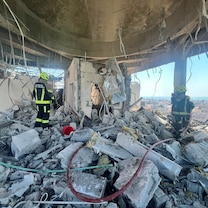


Though the team spoke out against its travel restrictions, it avoided commenting directly on the war. But it didn't shy away from spotlighting the victims of a deadly missile strike on an elementary school at the start of the conflict.
Players wore pins with the number “168” when they first landed in Mexico, referencing the number of people, mostly children, killed in the attack, which was likely launched by the U.S. They left a note in the locker room at Los Angeles Stadium, calling for peace “among all nations” and with the hashtags #168 and #minab, the school’s name.
Sherry Ghaemi, an Iranian living in Los Angeles, called their stand for the young victims “honorable.”
Amid the strife, players tried to focus on the sport. There were high notes, like when goalkeeper Alireza Beiranvand made seven saves to hold Belgium to a scoreless draw, and when Ramin Rezaeian scored off the outside of his boot to equalize against New Zealand.
“They’re going home not as losers, they’re going home as winners," said Ghaemi. “We’re proud of them.”
Meeting some of the players was a thrill for Siavash Khosrowshahi, a 32-year-old Iranian American who drove from Los Angeles to Tijuana on Sunday, the day after the team was eliminated.
“It’s been really tough and stressful,” Khosrowshahi said of the months since the U.S. and Israel started the war. There were times during the conflict when he couldn't reach his parents in Tehran — but not Sunday, when he called his mother from the hotel and surprised her by putting Beiranvand on the phone.
“It’s a source of happiness for her,” he said.
Iranians and Mexicans also deepened a bond, as Tijuana embraced the team throughout its visit.
“Irán, hermano, ya eres Mexicano!" fans chanted in Spanish whenever they saw Team Melli: “Iran, brother, now you are Mexican!”
“Iran is taking home the best of our country, and this city, which is the way in which outsiders are received,” said Arely Ramírez, a Tijuana resident who turned up at the team's hotel Sunday hoping to meet some of the players.
The feeling was mutual.
“We’re leaving Tijuana today, but but our heart stays here,” head coach Amir Ghalenoei said Tuesday before the Iranian team left for the airport.
On Monday, many players still looked solemn as they passed their last hours in Mexico. A few signed final autographs and stood for photos with fans, their smiles more muted than the week before.
Despite the disappointment, some supporters were already looking ahead. “This whole year has been bad events, bad luck after bad luck” for Iranians, said Ranjbar. But the AFC Asian Cup is six months away, a new chance for Team Melli, she said. “I'll be watching them play for that.”
___
Associated Press reporter Graham Dunbar in Geneva contributed.
Related Topics

Popular Reads
ABC News Live