Iran attacks Bahrain and Kuwait following US strikes and threatens to halt talks
Iran has again launched drone and missile attacks on Bahrain and Kuwait in response to new U.S. airstrikes
DUBAI, United Arab Emirates -- Iran again launched drone and missile attacks targeting Bahrain and Kuwait on Sunday following new U.S. airstrikes against the Islamic Republic, and threatened a “complete halt” in negotiations to end the war if Washington continues its attacks.
Efforts to reopen the Strait of Hormuz without Iran's oversight has sparked days of crossfire. A multinational maritime body overseen by the U.S. Navy said Saturday it would expand a route near Oman for inbound and outbound traffic.
Iranian Foreign Minister Abbas Araghchi on Sunday reiterated the claim that Tehran must govern the strait to the Persian Gulf that once carried a fifth of the world’s oil and natural gas.
“Any attempt to establish new or separate arrangements from those currently being carried out by the Islamic Republic of Iran will only lead to further complications, delay the reopening of the Strait of Hormuz and increase the level of tension,” Araghchi said.
The strait has long been considered an international waterway despite its location in Iran and Oman's territorial waters. In recent days, Iran has twice attacked vessels going through a route near the Omani side.
Pakistan, a key mediator, has said talks would resume Tuesday between the U.S. and Iran on the terms of their interim deal. The Trump administration on Sunday said nothing has been canceled and technical talks are on track for the coming days.
Talks include arrangements around the strait, the removal of a U.S. blockade on Iranian ports and sanctions on Iran, and the future of Iran’s stockpile of highly enriched uranium. The two sides have 60 days from their signing of the memorandum of understanding earlier this month to work out details.
Continued conflict in Lebanon threatens the agreement, which says fighting must end on all fronts before certain issues can be discussed.
Iran’s paramilitary Revolutionary Guard claimed responsibility for the attacks in Bahrain and Kuwait.
Kuwait, which hosts a major U.S. military base, said air defenses intercepted Iranian drones and two missiles just after the U.S. strikes in Iran. There were no reports of injuries or damage.
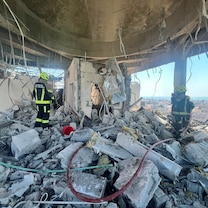
Bahrain said the Iranian strikes damaged a residential building near the international airport and no one was killed. Bahrain is home to the U.S. Navy’s 5th Fleet. The damaged building was not near its headquarters.
Bahrain’s Foreign Ministry denounced what it called “a dangerous escalation that reveals that what Tehran is doing is not a passing act, nor an isolated incident, but rather a deliberate approach and a systematic pattern of repeated aggression."
Later on Sunday, Qatar said a civilian had been killed, and another person was hurt, by shrapnel related to “military operations in the area" after a vessel didn't return at its scheduled time on Saturday. It did not give details.
The U.S. military said it struck Iranian military “surveillance infrastructure, communication systems, air defense sites, drone storage facilities and minelayer capabilities” following an attack on a ship on Saturday. The Panamanian-flagged tanker Kiku carried crude oil for the state-run energy company of Qatar, another key mediator.
U.S. President Donald Trump on social media accused Iran of violating the deal and warned of a point where the U.S. may "be forced to militarily complete the job.”
“If that happens, the Islamic Republic of Iran will no longer exist!” Trump wrote.

The exchanges of fire began when an Iranian drone struck a merchant vessel off Oman on Thursday and the U.S. military retaliated.
Ship traffic on the strait had increased over the past 72 hours, “despite the elevated threat environment,” the multinational maritime body overseen by the U.S. Navy said Sunday, adding that “U.S.-assisted commercial transits continued uninterrupted."
It said 89 such transits had been made, below the historical average of 138 vessels a day.
Last week, Israel and Lebanon signed a framework agreement to end the latest fighting between Israel and the Iranian-backed Hezbollah militant group, which began two days after the Iran war started when Hezbollah fired at Israel. Israel has responded with an invasion of southern Lebanon and it has said it will not withdraw until Hezbollah is disarmed.
The agreement did not include Iran or Hezbollah, which has criticized it and rejected calls to disarm.
On Sunday, Iran's foreign minister again said the U.S. must force Israel to halt attacks and withdraw. Israel occupies around 600 square kilometers (231 square miles) in southern Lebanon, which it says it needs as a security buffer.
Sporadic clashes have continued, and Hezbollah's leader said Saturday that the group would continue fighting until Israel withdraws from Lebanon.
Key Iranian negotiator and parliament Speaker Mohammad Bagher Qalibaf said Sunday that a meeting of a new “conflict control unit” formed among Iran, the United States and Lebanon should meet as soon as possible, Iran's state broadcaster reported.
Two strikes hit southern Lebanon on Sunday morning — one in Taybeh town and the other in the Nabatiyeh area, according to Lebanon’s National News Agency. There was no immediate word on casualties.
Overnight, Hezbollah militants killed an Israeli soldier in Deir Siryan village in southern Lebanon, according to Israel's military. Hezbollah did not comment.
Israel's military targeted Abdin village in southern Syria’s Daraa province with artillery shelling Sunday evening, Syrian state media reported. There was no immediate report of casualties.
The provincial government of Daraa said in a statement that residents of the village had thrown rocks at an Israeli convoy when it advanced on the village, and that the troops withdrew after U.N. peacekeepers intervened. It said the Israeli artillery shelling drove Abdin's residents to flee the village.
Earlier on Sunday, Israel's military said it had killed several armed men in southern Syria but gave no details. There was no statement from Syrian officials.
Israel seized control of a U.N.-patrolled buffer zone in southern Syria in December 2024 following the ouster of former Syrian President Bashar Assad in an insurgent offensive. Israeli officials initially called the move temporary, but more recently they have said they plan to occupy the zone indefinitely.
___
Lidman reported from Tel Aviv, Israel. Associated Press writers Sally Abou AlJoud and Abby Sewell in Beirut and Josh Boak in Washington contributed to this report.

Popular Reads

ABC News Live