What pregnant women should know about measles as cases grow in the US
More than 100 pregnant women in the U.S. have had measles this year.
More than 100 pregnant women have been diagnosed with measles and about a dozen infants have had congenital measles across the United States in the last two years, according to a preliminary analysis published on Monday.
The U.S. also lost its measles elimination status, an important public health achievement previously held since the year 2000, the Pan American Health Organization announced.
Doctors tell ABC News that growing measles cases among pregnant women are concerning because the virus can lead to negative health outcomes for both mom and baby. They fear more cases among pregnant women will arise as measles continues to circulate across the U.S.
Measles cases this year have already more than doubled since 2025, now reaching 5,412 as of Nov. 12. State health departments have reported 10 measles-related deaths across three states: New York, Pennsylvania and Wisconsin.
"The ongoing outbreak is causing an increase in measles cases among pregnant patients," Dr. Camille A. Claire, president of the American College of Obstetricians & Gynecologists (ACOG), said in a statement Monday. "It is also linked to some of the first cases of congenital measles, or an infant born with measles, in decades. We cannot overstate the preventable nature of these infections and deaths."

Health officials in Pennsylvania have been tracking cases among pregnant women as the state deals with its largest measles outbreak in 35 years.
As of Nov. 13, the state has recorded 101 measles cases among pregnant women so far this year, Stephanie Nojiri, the deputy press secretary for the state's department of health, told ABC News.
Risk of measles to mom and baby
From Jan. 1, 2025 to Sept. 28, 2026, researchers at the Centers for Disease Control and Prevention (CDC) identified 112 measles infections among pregnant women, according to the public health alert published in the New England Journal of Medicine Evidence. Almost all cases identified were among women who had never received a measles, mumps and rubella (MMR) vaccine.
About one in five pregnant women was admitted to the hospital for non-labor related reasons, and 11 women were diagnosed with pneumonia. Other complications included dehydration and respiratory failure. At least one woman required intensive care.
Only 37 women had known pregnancy outcomes in the study.
Among 21 women who had pregnancy outcomes within 14 days of developing a measles rash, one experienced pregnancy loss and one baby was stillborn. Of the remaining 19 live births, eight babies were born premature and eight required intensive care.
Thirteen babies were diagnosed with congenital measles, defined as testing positive for measles within 10 days of birth or developing a fever and rash within 10 days of birth if born to a mother with a confirmed measles infection.
The CDC warns that measles infection during pregnancy can lead to complications including pneumonia and death, as well as pregnancy loss, premature delivery and low birth weight for their babies.
Dr. Sharee Livingston, an OBGYN at University of Pittsburgh Medical Center Magee-Womens in central Pennsylvania, has been taking care of pregnant women with measles in the current outbreak.
"You have to watch the mother-fetus dyad so closely because of the risk of fetal death," Livingston previously told ABC News. "You're paying attention to things like growth restriction and ensuring that there's fetal well-being, so that you can intervene with delivery if the fetus is viable."
Livingston added, "That's a scary place to be for the patient, for the supporter, for the healthcare provider to know that you have a person with a communicable disease that is preventable, and that could put both her and her fetus at risk."
If transmitted in utero, a baby can be born with congenital measles. These babies are at risk of many health complications including pneumonia, encephalitis and death.
If the baby survives in the short term, a congenital measles infection places them at higher risk of later developing a progressive and fatal neurological condition called subacute sclerosing panencephalitis (SSPE), the CDC says.


SSPE is characterized by "a deterioration in social skills, deterioration in personality, deterioration in handwriting. You descend into a vegetative state and die," Dr. Paul Offit, director of the Vaccine Education Center at the Children's Hospital of Philadelphia, previously told ABC News. "The difference for congenital measles is you don't have to wait five or seven years. It can happen in a few months. It can happen within two years."
Offit explained that congenital measles has historically been rare because most adults were immune to the virus from infection in childhood before widespread immunization.
"We're learning about congenital measles. We really are," Offit said. "In the measles era, meaning before the [1963] vaccine ... children would get infected, so they wouldn't get infected as adults."
Now, Offit said we are seeing the impacts of a growing adult population who are not immune to the virus.
"You have people in their 20s, 30s and 40s now who really didn't grow up in the age of measles," Offit said. "They are extremely unlikely they would have been naturally infected, and they've chosen not to vaccinate. So now, what you have that I didn't have when I was a child was a fairly large population of vulnerable adults."
Dr. Kevin Ault, an OBGYN at Penn State Health in Hersey and member of the ACOG expert work group on immunization, infectious disease and public health preparedness, told ABC News that in addition to the health risks, he worries that growing measles cases among pregnant women could quickly overwhelm a health system. Cases may also be difficult to initially diagnose, he said.
Symptoms may be similar to other upper respiratory illnesses like the flu or COVID, or mistaken for specific obstetrical health problems such as uterine infections that present with fever, Ault said.
"There's also some very pragmatic things ... as far as isolating those patients," Ault added. "In a negative pressure room, there's a limited number of those on labor and delivery, there's a limited number of those in the NICU and on the pediatric floor, so it's going to overwhelm a lot of hospitals as far as just physical requirements, isolation, and airflow."
Treatment and prevention
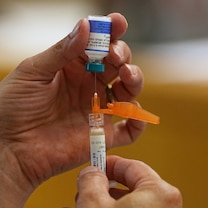
The CDC says pregnant women should not receive the MMR vaccine because it contains some live virus, but they can receive immunoglobulin antibodies. This can reduce the risk of infection if they are non-immune and exposed to measles in pregnancy or to help lessen the severity of illness if infected.
There is no specific treatment for congenital measles, but newborns can also receive immunoglobulin if they are born to a mother with measles which may help lessen the severity or risk of death from congenital measles, the CDC says.
While the CDC says vitamin A can be used as supportive care for infants and children with measles as directed by a healthcare provider, these higher doses cannot be used in pregnancy because it can lead to severe birth defects.

Dr. Holly W. Cummings, an OBGYN and chair of the Pennsylvania section of the American College of Obstetricians and Gynecologists, told ABC News that preconception counseling about vaccines is very important to help prevent more pregnant women from getting measles.
"Optimum pregnancy care for everybody, even outside of the context of a measles outbreak, is to have preconception care," Cummings said. "See your healthcare provider before you get pregnant, so that you can talk about any health planning that needs to be taken into account before pregnancy. One of those things we routinely think about before pregnancy is vaccination status."
It is also recommended that family members be up to date on vaccines, adding an extra layer of protection for infants and mothers.
"If you're a family member with a pregnant woman in your family, she would no longer be able to be vaccinated, but other people in the family could be," Cummings said. "So that's the next best thing for creating a safe environment for the pregnant woman and the unborn fetus and the eventual baby that's going to join the family."
Jade A. Cobern, MD, MPH, is a practicing physician, board-certified in pediatrics and general preventive medicine, and is a fellow of the ABC News Medical Unit. Dr. Elizabeth Herrin also contributed to this story.

Popular Reads
ABC News Live