Iran set to execute 2 men, 18 and 20, over protest role
Amirhossein Maleki and Abolfazl Ebrahimi's families were called for final visit.
Two young men are scheduled to be executed in Isfahan, Iran for their alleged roles in the January protests in the country, according to sources familiar with the case.
Human rights groups and the Iranian judiciary say their charges relate to anti-regime activity during those protests.
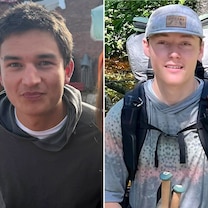
The Center for Human Rights in Iran reports that the families of Amirhossein Maleki, 20, and Abolfazl Ebrahimi, 18, were summoned to prison on Nov. 2 for final visits ahead of their scheduled execution on Nov. 3.
The two are part of the “Alikhani Square case,” in which 12 young men were initially sentenced to death. Maleki and Ebrahimi are among five defendants who remain in the joint case, in which seven people have already been executed. The Supreme Court has rejected the appeals of the three other defendants, who also face imminent execution.
“Their arrests and mass trial were marked by egregious due process violations, including denial of access to independent legal counsel and use of physical, sexual, and psychological torture to extract forced ‘confessions,’ which were then used as evidence against them,” the Center for Human Rights in Iran -- a nonprofit that monitors, documents, and exposes human rights abuses in the country -- wrote on Instagram on Monday.

The earlier executions in the Alikhani Square case were carried out publicly. On July 28, cranes were set up in Isfahan’s Alikhani Square, where Amirhossein Safari and Abolfazl Sepahi were hanged.
The Iranian government accused the two of involvement in the killing of four security personnel, weapons offenses, destruction of property and arson during the unrest of Jan. 8.
Shahrzad Shahbazi, a lawyer representing defendants in the case, has disputed the official account, saying none had formally been charged with murder and there was no fair trial.
“The Iranian authorities are unleashing a horrifying wave of executions and death sentences to punish and suppress dissent and project an image of strength and absolute control in the wake of the January popular uprising and amid ongoing attacks by US and Israeli forces,” said Heba Morayef, Amnesty International’s Regional Director for the Middle East and North Africa. “The muted response from the international community emboldens the Iranian authorities to continue their deadly rampage.”
Executions in Iran have spiked recently, according to Roya Boroumand, executive director of the Abdorrahman Boroumand Center for Human Rights in Iran. As of last week, she said, there had been at least 37 protest-related executions in the country this year.
Of those, 34 were related to January protests and three were related to the "Woman Life Freedom" protest. The organization, which tracks and documents executions in Iran, reports at least 1,145 executions since the start of 2026.
“The increase in the number of politically motivated executions is the Islamic Republic’s response to the significant opposition it faces inside Iran," said Boroumand to ABC News. "In great numbers, citizens have openly rejected a theocracy that has terrorized and impoverished them for decades. Unwilling to change, Iran’s leaders are doing what they have done in the past when their legitimacy was challenged.
"They arbitrarily and summarily execute some of those who stand-up to them, such as the young people prosecuted behind closed doors in blatant violation of due process in the Alikhani case, creating an environment of fear that silences and demobilizes other opponents," Boroumand added.

Popular Reads
ABC News Live