Live

Iran live updates: Peace deal a 'work in progress,' Rubio says

Trump on Saturday said an agreement had been "largely negotiated."

Last Updated: May 25, 2026, 5:09 AM EDT

President Donald Trump announced "major combat operations" against Iran on Feb. 28, with massive joint U.S.-Israeli strikes targeting military, government and infrastructure sites.

Following the announcement of a two-week ceasefire, initial U.S.-Iran talks in Pakistan in April failed to reach a peace deal.

Trump later announced the open-ended extension of the ceasefire and the continuation of a U.S. blockade until negotiations are concluded "one way or the other."

1 hour and 18 minutes ago

'No one' can say deal is imminent despite progress, Baghaei says

Iranian Foreign Ministry spokesperson Esmail Baghaei told a Monday press conference that the U.S. and Iran have "reached a conclusion on a large part of the issues under discussion," though stressed that "no one" can say that the finalization of a deal is "imminent."

Tehran is "witnessing frequent changes in positions" from the U.S. side, Baghaei said, as quoted by the state-run Islamic Republic News Agency.

"Within a few hours you will encounter different and in many cases contradictory views," Baghaei told reporters of the talks.

Baghaei also addressed different facets of a possible deal, saying a ceasefire of the war on all fronts -- including Lebanon -- was part of the draft agreement. He also said details about the management of the Strait of Hormuz are still undecided.

"We have not entered into the details of this agreement. How the Strait of Hormuz will be managed is a matter that concerns the coastal states of the strait," Baghaei said.

He added that no Iranian delegation visit to Pakistan, the mediating country, is planned at the moment.

"We are now focused on the negotiation process. How the understanding will be announced or signed later is an issue that there is time to decide on in the future," Baghaei said.

-ABC News' Victoria Beaule

1:25 AM EDT

Iran deal a 'work in progress,' Rubio says

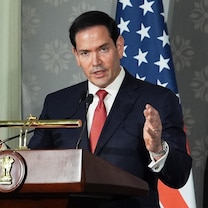
Secretary of State Marco Rubio tempered expectations for a possible deal to end the U.S.-Israeli war with Iran while gaggling with the press before departing for Agra, India, overnight amid his ongoing visit to the country.

Rubio said an Iran deal is still a "work in progress" but signaled confidence that the disruption to shipping in the Strait of Hormuz can be addressed.

"We have what I think is a pretty solid thing on the table in terms of their ability to open up the straits, get the straits open, enter into a very real, significant, time-limited negotiation on the nuclear matters, and hopefully we can pull it off," Rubio said.

Secretary of State Marco Rubio speaks to journalists before boarding his plane at Indira Gandhi International Airport in New Delhi on May 25, 2026.
Julia Demaree Nikhinson/POOL/AFP via Getty Images

Rubio attributed the delay in negotiations to the "Iranian system."

Regarding Lebanon -- where Israeli strikes and Hezbollah attacks continue despite a ceasefire agreed by Israeli and Lebanese leaders -- Rubio said the U.S. delegation is working on that deal separately from any agreement that is made with Iran.

"Lebanon, we're working on separately. With Lebanon, we are engaged now. We have a 45-day ceasefire. We've had weekly meetings now, and ongoing daily engagements between the government of Lebanon and Israel," Rubio said. "The problem is not Lebanon and Israel; the problem is Hezbollah."

"As long as an armed Hezbollah exists, it's going to be hard to achieve peace in Lebanon," Rubio said.

Asked if a ceasefire would include Israel stopping strikes within Lebanon, Rubio said Israel has the right to defend itself and to prevent strikes against Israel from within Lebanon. The issue is "being understood during the ceasefire, and now in Lebanon, and it'll be understood beyond that," Rubio said.

-ABC News' Alex Ederson

May 24, 2026, 12:42 PM EDT

US and Iran making progress on interim agreement, official says

The U.S. and Iran are making progress ironing out a two-step interim agreement in which the U.S. would get a broad "commitment" from Iran to negotiate a removal of their stockpile of enriched uranium, a senior administration official said on a call with reporters on Sunday morning.

This limited agreement includes an immediate opening of the Strait of Hormuz and end to the U.S. naval blockade there, the official said, as questions of how to dispose of the stockpiled radioactive material remain.

Vessels in the Strait of Hormuz, Iran, May 22, 2026.
Majid Asgaripour/West Asia News Agency via Reuters

“We're going to do a deal where ... they will open up the Strait in exchange for us lifting the blockade, and they will agree in principle to dispose of the highly enriched uranium,” the official said. “That is currently where the substantive conversation’s focused.”

“Even if we get this language in a good place, it is going to take days for it to filter through their system and get an approval,” the official added.

The official offered no specific details on timing, both regarding how long this peace negotiation process could last and how long the nuclear material removal process could take.

Trump posted on his social media platform Saturday that “an Agreement has been largely negotiated” between the U.S. and Iran, “subject to finalization” between the parties involved. Secretary of State Marco Rubio said Sunday that the deal’s "ultimate goal is that Iran can never have a nuclear weapon."

Iran has not yet signed on to or publicly commented on the proposal.

-ABC News' Isabella Murray

May 24, 2026, 11:38 AM EDT

Trump says his proposal Iran deal 'the exact opposite' of former President Obama's

As some Republican senators and former GOP officials warn that President Donald Trump's proposed deal with Iran would just be a repeat of the nuclear deal put in place during former President Barack Obama's administration, Trump is pushing back on that notion, saying his deal is the "exact opposite" of Obama's.

Obama's deal "was a direct path to Iran developing a Nuclear Weapon," Trump posted on his social media platform on Sunday. "Not so with the transaction currently being negotiated with Iran by the Trump Administration -- THE EXACT OPPOSITE, in fact!"

President Donald Trump speaks during an announcement with Environmental Protection Agency (EPA) Administrator Lee Zeldin in the Oval Office of the White House in Washington, May 21, 2026.
Kent Nishimura/AFP via Getty Images

Trump went on to say that relationship between U.S. and Iran is becoming a "much more professional and productive one" and that there is 'no rush' to make a peace deal with the regime.

"The negotiations are proceeding in an orderly and constructive manner, and I have informed my representatives not to rush into a deal in that time is on our side. The Blockade will remain in full force and effect until an agreement is reached, certified, and signed. Both sides must take their time and get it right. There can be no mistakes!" Trump wrote.

Trump posted on his social media platform Saturday that "an Agreement has been largely negotiated" between the U.S. and Iran, "subject to finalization" between the parties involved. Secretary of State Marco Rubio said Sunday that the deal's "ultimate goal is that Iran can never have a nuclear weapon."

Iran has not yet signed on to or publicly commented on the proposal.

The Joint Comprehensive Plan of Action (JCPOA), which imposed restrictions on Iran's civilian nuclear enrichment program in exchange for sanctions relief, was signed on July 14, 2015, during the Obama administration. It was agreed to by Iran and the five permanent members of the United Nations Security Council -- China, France, Russia, the United Kingdom and the United States -- as well as Germany and the European Union.

The JCPOA was designed to ensure that Iran's nuclear program would be exclusively peaceful and provided for the lifting of nuclear-related sanctions in order to prevent Iran from developing nuclear weapons.

Two years after the deal went into effect, President Donald Trump withdrew the U.S. from the nuclear accord during his first term in office, saying at the time "it is clear to me that we cannot prevent an Iranian nuclear bomb under the decaying and rotten structure of the current agreement."

-ABC News' Isabella Murray

Related Topics

Sponsored Content by Taboola