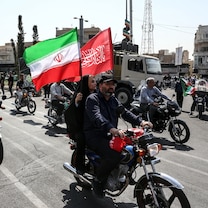
President Donald Trump announced "major combat operations" against Iran on Feb. 28, with massive joint U.S.-Israeli strikes attack targeting military and government sites, officials said.
Ayatollah Ali Khamenei was among those killed in Tehran on the first day of strikes, with his son Mojtaba Khamenei later chosen to succeed him. Iran has responded with missile and drone attacks targeting Israel, regional U.S. bases and multiple Gulf nations. Iran is also attempting to block some shipping traffic through the Strait of Hormuz.
Israel is also intensifying its long-running strike campaign against the Iran-backed Hezbollah militia in Lebanon and expanding its ground operations in the south of the country.
Watch special coverage on Nightline, "War with Iran," each night on ABC and streaming on Disney+ and Hulu.
Most Americans oppose military action in Iran: Polls
Four new polls, one consistent finding: Most Americans oppose the United States' strikes in Iran.
A Reuters/Ipsos poll conducted March 20-23 found 61% of Americans disapproving of U.S. military strikes in Iran, while 35% approved.
A Pew Research Center poll, conducted March 16-22, found 59% of Americans saying the U.S. made the wrong decision in using military force in Iran, while 38% said it was the right decision.
A Quinnipiac poll conducted March 19-23 found 54% of registered voters opposed to the U.S. military action in Iran while 39% supported it.
An AP-NORC poll conducted March 19-23 found 59% of Americans saying U.S. military action in Iran has gone too far, while just 26% say it has been about right and 13% say it has not gone far enough.
Top Armed Services Republican after Iran briefing: 'Not getting enough answers'
The House and Senate Armed Services committees received a classified briefing on Iran on Wednesday -- with lawmakers on both sides of the aisle expressing their frustrations over the quality of information they're receiving from senior Pentagon officials.
"We want to know more about what's going on, what the options are and why they're being considered. And we're just not getting enough answers on those questions," Alabama Republican Rep. Mike Rogers, the chairman of the House Armed Services Committee, told reporters after the briefing.
Rogers has indicated that while he is supportive of the operations in Iran, he believes the Trump administration must "be more forthcoming about what's going on, because we're an essential partner in this process."
Rep. Mike Rogers outside the Capitol, June 27, 2025.
Graeme Sloan/Bloomberg via Getty Images
"This is not just about Epic Fury," Rogers said. "This is a consistent pattern of tagging the base and saying, 'We came over and briefed you,' but they're not telling us things, substantive things."
South Carolina Republican Rep. Nancy Mace told reporters that her concerns about ground troops potentially being deployed in Iran were only emboldened by what she learned in the briefing.
"The justifications presented to the American public for the war in Iran were not the same military objectives we were briefed on today in the House Armed Services Committee. This gap is deeply troubling," Mace wrote in a post on X. "The longer this war continues, the faster it will lose the support of Congress and the American people."
Rep. Nancy Mace departs following a series of House votes at the Capitol Building, March 5, 2026.
Andrew Harnik/Getty Images
Washington Rep. Adam Smith, the ranking Democrat on the House Armed Services Committee, acknowledged that while there were some "new details" provided in the briefing regarding munition stockpiles, he questioned the administration's objectives in the operation.
"The objective seems to be basically to fundamentally break Iran so that they no longer have a nuclear program, they no longer have a ballistic missile program, and they no longer support terrorist proxies in the region," Smith said after the briefing. "But we don't have a way from here to there. What is the military plan for getting Iran to the point where they acquiesce on all three of those? We still have not seen the details of what we think we're going to be able to achieve to force them to make those decisions."
Smith said there was discussion about troops on the ground but added that "there were no specific answers" provided by the administration.
-ABC News' John Parkinson and Lauren Peller
Mar 25, 2026, 5:37 PM EDT
US on track to 'completely eliminate' Iran's military manufacturing capacity: CENTCOM
The U.S. is on pace to "completely eliminate" Iran's military manufacturing capacity, the head of U.S. Central Command, Adm. Brad Cooper, said in a video released Wednesday.
"Today, we have damaged or destroyed over two-thirds of Iran's missile, drone, and naval production facilities and shipyards, and we're not done yet," Cooper said in the video posted on social media. "We are on a path to completely eliminate Iran's wider military manufacturing apparatus, which is why my operational assessment continues to be Iran's combat capability is declining as U.S. combat capability continues to increase."
Cooper said that just hours ago, the U.S. hit its 10,000th Iranian target in the campaign.
"We're in the fourth week of the campaign and remain on plan or ahead of plan in achieving very clear military objectives for eliminating Iran's ability to project power in meaningful ways outside its borders," Cooper said.
The U.S. has destroyed 92% of the Iranian Navy's largest vessels in Operation Epic Fury, according to Cooper.
"My operational assessment is that they have now lost the ability to meaningfully project naval power and influence around the region and around the world," he said.
-ABC News' Chris Boccia
Mar 25, 2026, 3:56 PM EDT
Gulf countries tell Iran, proxies to immediately 'cease' attacks
Gulf countries issued another condemnation of Iran for its strikes across the region, demanding that "Iran immediately and without condition cease any aggression or threat against neighboring states, including the use of proxies," in a joint statement Wednesday.
The signatories -- Qatar, Kuwait, the United Arab Emirates, Bahrain, Saudi Arabia and Jordan -- also warned that they maintain their right to self defense.
Cargo ships in the Gulf, near the Strait of Hormuz, as seen from northern Ras al-Khaimah, near the border with Oman's Musandam governance in United Arab Emirates, March 11, 2026.
Reuters
The states "also condemn the acts and activities that undermine the security and stability of regional states, planned by sleeper cells loyal to Iran and related terrorist organizations affiliated with Hezbollah," the countries wrote in the statement.