President Donald Trump announced "major combat operations" against Iran on Feb. 28, with massive joint U.S.-Israeli strikes targeting military, government and infrastructure sites.
Following the announcement of a two-week ceasefire, initial U.S.-Iran talks in Pakistan in April failed to reach a peace deal.
Trump later announced the open-ended extension of the ceasefire and the continuation of a U.S. blockade until negotiations are concluded "one way or the other."
Status quo 'intolerable' for the US, Ghalibaf claims
Mohammad Bagher Ghalibaf, the speaker of the Iranian parliament who led Tehran's negotiating delegation to Islamabad in April, said in a post to X on Tuesday that Iran knows "full well that the continuation of the status quo is intolerable for America; while we have not even begun yet."
"The new equation of the Strait of Hormuz is in the process of being solidified," Ghalibaf wrote on X, in a reference to Tehran's claimed control of the strait. "The security of shipping and energy transit has been jeopardized by the United States and its allies through the violation of the ceasefire and the imposition of a blockade; of course, their evil will diminish."
U.S. Central Command began its "Project Freedom" mission on Monday to guide commercial shipping through the Strait of Hormuz despite continued Iranian threats against and attacks on cargo vessels in the strategic waterway.
Top Iranian officials have warned that the operation could prompt a new round of fighting, and on Monday the United Arab Emirates accused Iran of launching new missile and drone attacks against it.
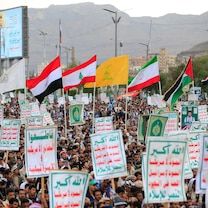
An Iranian demonstrator waves a flag of Lebanon's militant Hezbollah group under an anti-U.S. billboard in Tehran, Iran, on May 4, 2026.
Vahid Salemi/AP
May 05, 2026, 3:34 AM EDT
Trump says war could stretch 3 more weeks, claims US 'already won'
During a phone interview with Hugh Hewitt on Monday afternoon, President Donald Trump refused to say whether the ceasefire with Iran was over after Iran fired at the United Arab Emirates and projected that the war could continue for another two or three weeks.
"Well, I can't tell you that," Trump said when pressed on whether the ceasefire is over. When asked if Monday's hostilities meant the beginning of a renewed conflict with Iran, Trump said that "one way or the other, we win."
"We either make the right deal or we win very easily. From the military standpoint, we've already won that. You know, you've heard me say it a million times, and other people say it. They had 159 ships. Hugh, now they have none. They're all at the bottom of the sea," Trump said.
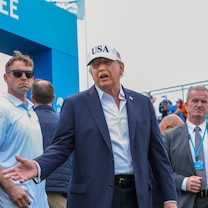
President Donald Trump speaks during an event with small businesses, May 4, 2026, in the East Room at the White House in Washington.
Jacquelyn Martin/AP
The president stopped short of confirming whether Iran violated the ceasefire, saying "we'll see what happens" and instead touting the U.S. military capabilities.
Trump said the conflict could continue for "probably another two weeks" or "maybe three weeks," and emphasized that he is not operating under any time constraints. "Time is not of the essence for us," Trump said, while claiming significant public support for the war.
The president said the U.S. has "control" over the Strait of Hormuz amid the launch of the "Project Freedom" operation. "They said they were going to take over the Homruz Strait, and then we thought they might have. We took it over from them," Trump said of Iran.
On concerns over spiking oil prices, Trump said he thought prices might rise higher than they have -- perhaps as high as $250 -- claiming that the "genius" thing happening was ships were now heading to the U.S. for oil.
Asked about the future of Iran's enriched uranium stockpile -- Tehran's surrendering of which has been a key sticking point for the U.S. -- Trump downplayed its importance.
"From a standpoint of value, it's not very valuable. Probably can't be used. They may not be able to get it," Trump said, before touting the June military operation -- Operation Midnight Hammer -- to destroy Iran's nuclear capabilities. "I'd like to get it back so that they can't be tempted," Trump said of the enriched uranium.
Trump also said he is "convinced" that if the Iranian people had sufficient weapons, they would "fight back" against the regime.
-ABC News' Nicholas Kerr, Emily Chang and Michelle Stoddart
May 05, 2026, 3:04 AM EDT
US, UAE should be wary of 'quagmire,' Araghchi says
Iranian Foreign Minister Abbas Araghchi said in a post to X on Monday that there can be "no military solution to a political crisis" in the Strait of Hormuz.
"As talks are making progress with Pakistan's gracious effort, the U.S. should be wary of being dragged back into quagmire by ill-wishers. So should the UAE," Araghchi wrote.
"Project Freedom is Project Deadlock," the foreign minister said, referring to the U.S. military mission to escort stranded shipping out of the strategic waterway that began on Monday.
Iranian Foreign Minister Abbas Araghchi appears on ABC News' "This Week" on March 1, 2026
ABC News
-ABC News' Will Gretsky
May 05, 2026, 2:53 AM EDT
MBS condemns Iranian attacks on UAE
Saudi Crown Prince Mohammed bin Salman -- colloquially known as MBS -- spoke with United Arab Emirates counterpart Mohamed bin Zayed Al Nahyan on Monday after the UAE reported fresh Iranian drone and missile attacks, according to a readout from the Saudi Foreign Ministry.
MBS "expressed the Kingdom of Saudi Arabia's strong condemnation and denunciation of the unjustified Iranian attacks targeting the United Arab Emirates," the readout said. "He reaffirmed the Kingdom's support for the UAE in its defense of its security and stability."