President Donald Trump announced "major combat operations" against Iran on Feb. 28, with massive joint U.S.-Israeli strikes targeting military, government and infrastructure sites.
Following the announcement of a two-week ceasefire, initial U.S.-Iran talks in Pakistan in April failed to reach a peace deal.
Trump later announced the open-ended extension of the ceasefire and the continuation of a U.S. blockade until negotiations are concluded "one way or the other."
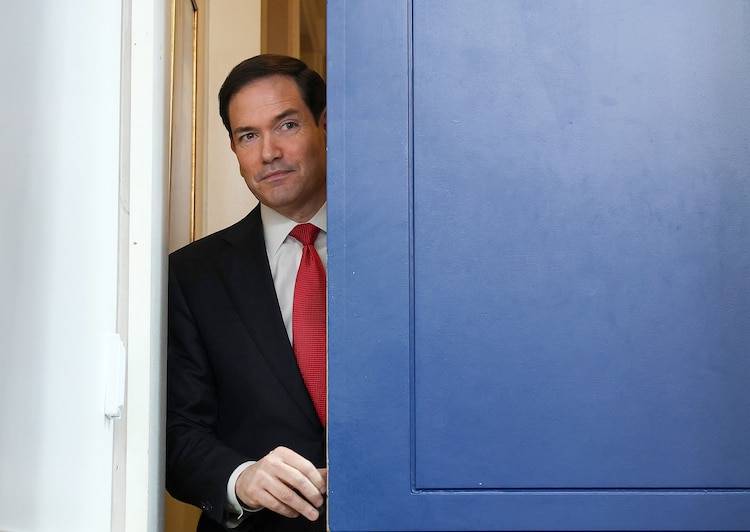
Secretary of State Marco Rubio told reporters at the White House that Operation Epic Fury is now over, saying the U.S. is now involved in a "defensive" operation as it seeks to reopen the Strait of Hormuz.
"If they pose a threat to our forces, we'll shoot down drones, we'll shoot down missiles. But it's defensive in nature," Rubio said.
Secretary of State Marco Rubio arrives to speak during a press conference in the Brady Press Briefing Room at the White House, May 5, 2026 in Washington.
Anna Moneymaker/Getty Images
"There's no shooting unless we're shot at first. We're not attacking them. We're not. But if they are attacking us ... you need to respond to that," Rubio said.
May 05, 2026, 3:18 PM EDT
Rubio announces new UNSC draft resolution to 'defend freedom of navigation' in Strait of Hormuz
As the administration continues its efforts to ramp up international support for opening the Strait of Hormuz, Secretary of State Marco Rubio announced that the U.S. would put a new draft resolution before the United Nations Security Council to “defend freedom of navigation” in the waterway.
"The draft resolution requires Iran to cease attacks, mining, and tolling,” Rubio said in a statement. "It demands that Iran disclose the number and location of the sea mines it has laid and cooperate with efforts to remove them, while also supporting the establishment of a humanitarian corridor.”
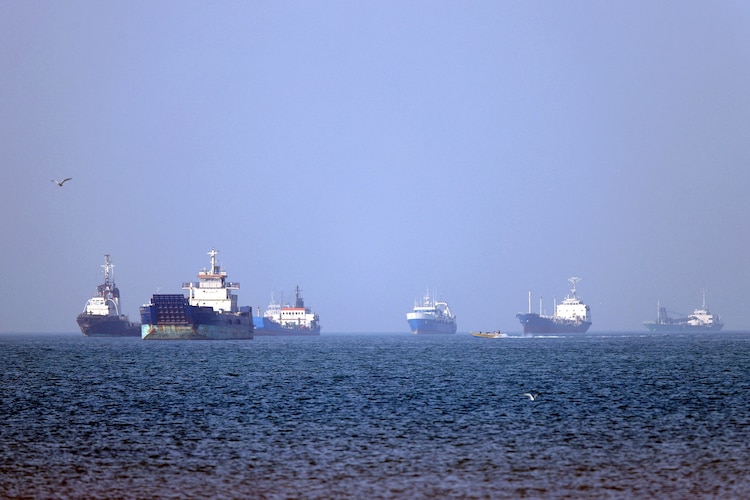
Vessels are pictured anchored in the Strait of Hormuz off Bandar Abbas in southern Iran, May 4, 2026.
Amirhossein Khorgooei/ISNA/AFP via Getty Images
Bahrain, Saudi Arabia, the UAE, Kuwait and Qatar co-authored the draft resolution, which is expected to be put to a vote “in the coming days," according to the announcement.
Last month, the U.S. put forward a similar resolution at the UNSC—but it was vetoed by China and Russia.
It’s unclear whether this resolution can gain the necessary support, but earlier this week U.S. Ambassador to the U.N. Mike Waltz described it as a “narrower effort” designed to win support from Asian countries and expressed hope that, if adopted, the resolution would embolden countries to step up efforts to protect the waterway.
-ABC News' Shannon K. Kingston
May 05, 2026, 2:06 PM EDT
Iran announces system to 'formalize' strait traffic mechanisms
Iran announced a new system in its effort to "formalize" the mechanisms to allow traffic to go through the Strait of Hormuz, calling it the "Persian Gulf Strait Authority."
-ABC News' Desiree Adib
May 05, 2026, 2:05 PM EDT
3 US Navy Destroyers are in Persian Gulf, west of the Strait of Hormuz, officials say
There are three U.S. Navy destroyers inside the Persian Gulf, west of the Strait of Hormuz, as part of the “Project Freedom” defensive shield, according to two U.S. officials.
This includes a multiple layered system of ships, aircraft, and air defense systems to protect any commercial ships seeking to transit the Strait, according to officials.
The three destroyers are the USS Truxtun, USS Mason, and the USS Rafael Peralta, according to the officials.