Live

Iran live updates: Tehran reviewing new US proposals as it reasserts control over Strait of Hormuz

The White House said on Friday that the Strait of Hormuz was "completely open."

Last Updated: April 18, 2026, 12:48 PM EDT

President Donald Trump announced "major combat operations" against Iran on Feb. 28, with massive joint U.S.-Israeli strikes targeting military and government sites.

After negotiations, U.S.-Iran talks in Pakistan failed to reach a peace deal. Trump said that Iran's nuclear program was the key sticking point, and said the U.S. would respond with a blockade of the Strait of Hormuz starting at 10 a.m. ET on Monday.

Iran announced it would fully reopen the Strait of Hormuz on Friday, but Trump said the blockade will remain in place until the U.S.'s "transaction" with Iran is complete.

Israel, meanwhile, has reached a ceasefire agreement with Lebanon, ending its ground operations and intense strikes, where it was engaged with the Iran-backed Hezbollah militia. Israeli Prime Minister Benjamin Netanyahu said he supported the ceasefire with Iran.

Apr 13, 2026, 7:31 PM EDT

Vance lays out US red lines for Iran talks

Vice President JD Vance talked about the weekend negotiations with Iran and what the U.S. red lines are in an interview with Fox News on Monday.

When asked about what went wrong that led to the talks falling apart, Vance noted that there were things that "went right" during the talks.

"We made a lot of progress, but we also made very clear, and I think this is part of the progress we made, what the terms where the United States could make some accommodation, what terms we were flexible on, and what things we absolutely needed to see in order for the president of the United States to feel like he was getting a good deal," Vance said.

U.S. Vice President JD Vance and Pakistan's Prime Minister Shehbaz Sharif pose on the day of a meeting for talks about Iran, in Islamabad, Pakistan, April 11, 2026.
Jacquelyn Martin, Pool via Reuters

Vance said that all of the United States' red lines in the negotiations stemmed from the Iranians never having a nuclear weapon. The two crucial pieces that the U.S. side is not flexible on are, according to Vance, the U.S. getting possession of the "nuclear dust" -- the enriched uranium that Iran currently possesses -- and a "mechanism to ensure" that Iran won't have the ability to enrich uranium.

Vance said the opening of the Strait of Hormuz did come up, and that the "Iranians tried to move the goal post during the negotiation."

"Our expectation is that the Iranians are going to continue to make progress to opening the Straits of Hormuz, and if they don't, it's going to fundamentally change the negotiation that we have with them," Vance said.

-ABC News' Hannah Demissie, Meghan Mistry and Michelle Stoddart

Apr 13, 2026, 3:23 PM EDT

Hezbollah leader says they 'reject' Israel-Lebanon talks in US

The leader of Hezbollah said in an address Monday that they "reject" the negotiations set to take place between Lebanese and Israeli ambassadors in Washington, D.C., on Tuesday.

"We reject negotiations with the usurping entity," Naim Qassem said. "These negotiations are futile and require Lebanese consensus to change the direction from non-negotiation to direct negotiation."

Rockets are launched towards Israel from southern Lebanon, April 11, 2026.
Stringer via Reuters

Qassem also vowed that the militant group won't surrender.

"We will not surrender and will remain in the field until our last breath," he said. "We will confront and demand justice, and we want to set an example for the entire world that Lebanon, with its army, people, and resistance, is unyielding against the enemy."

Apr 13, 2026, 1:50 PM EDT

Mediators push for another round of US-Iran talks before ceasefire expires

Mediators have launched into a flurry of activity aimed at getting negotiations between the U.S. and Iran back on track as they hope to arrange another round of talks between the parties before the two-week ceasefire expires, according to two U.S. officials and another source with knowledge of the situation.

Even though the U.S. and Iran have been accusing each other of violating the truce since its implementation, mediators see its looming end as a potentially useful tool for ramping up pressure on both sides to come to the table, according to the officials and source.

The officials and other source say mediators are trying to stave off a resumption of attacks on Iran from the U.S. and push Tehran to reconsider a proposal put forward by the Trump administration during the Islamabad talks.

When asked at the White House Monday about the negotiations with Iran, President Donald Trump said "we've been called by the other side," and that "they'd like to make a deal very badly, very badly.”

Both the U.S. and Iran have expressed interest in continuing to work toward a diplomatic settlement, the officials and source said.

-ABC News' Shannon K. Kingston

Apr 13, 2026, 11:00 AM EDT

Trump says Iran's Navy is 'completely obliterated'

President Donald Trump touted U.S. military action against Iran’s Navy on Monday, moments after the 10 a.m. ET deadline he set for when he said American troops would start enforcing a blockade of all maritime traffic entering and exiting Iranian ports in the Strait of Hormuz.

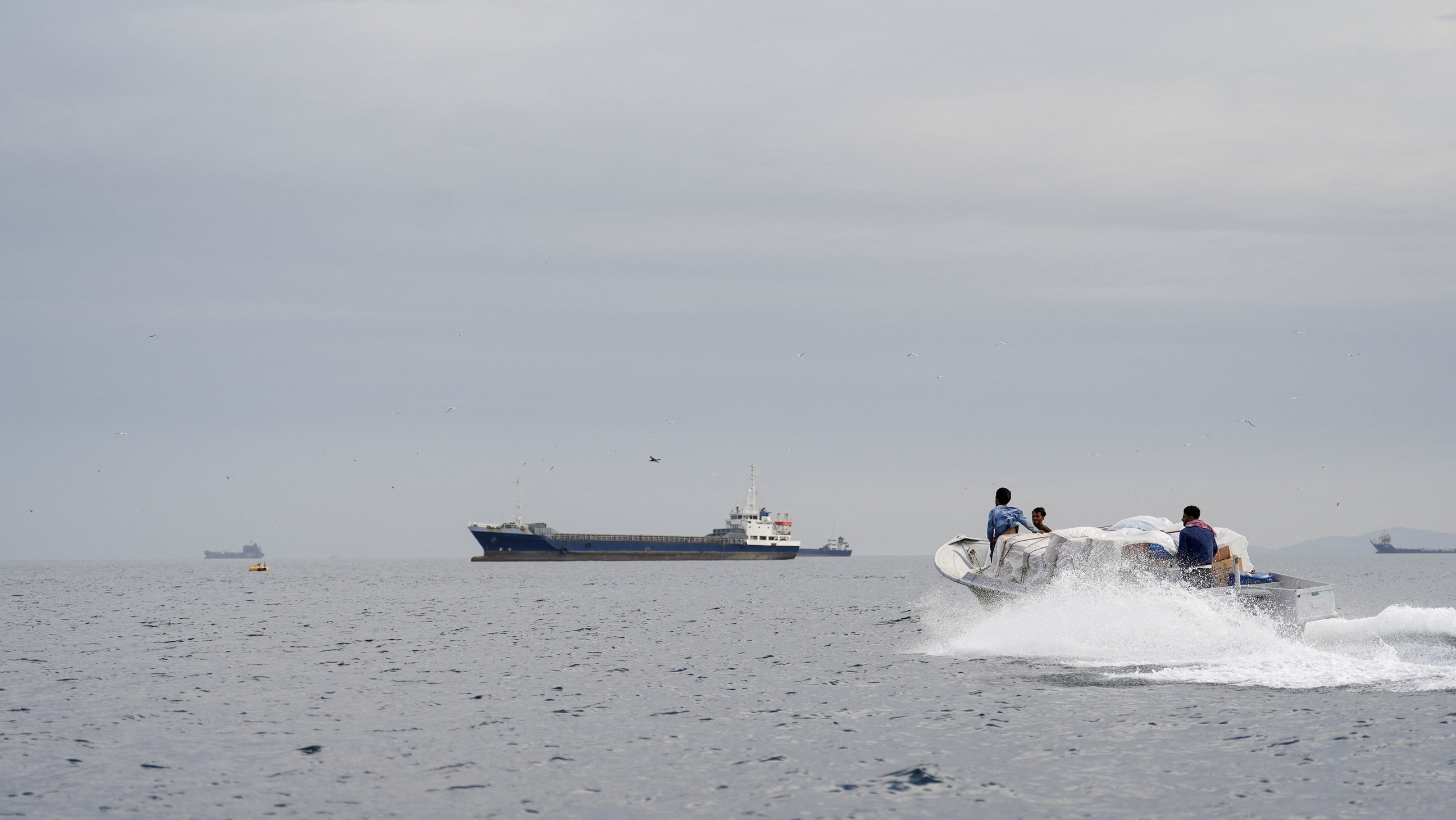
Vessels and a boat at the Strait of Hormuz, off the coast of Oman's Musandam province, April 12, 2026.
Reuters

“Iran’s Navy is laying at the bottom of the sea, completely obliterated - 158 ships,” Trump wrote on social media, claiming that he hadn’t ordered strikes on “fast attack ships” because they aren’t a threat.

On Saturday, CENTCOM confirmed Trump's announcement that the U.S. military had begun mine-clearing operations to ensure safe passage through the Strait.

Trump threatened in his post on Monday, “If any of these ships come anywhere close to our BLOCKADE, they will be immediately ELIMINATED, using the same system of kill that we use against the drug dealers on boats at Sea. It is quick and brutal.”

-ABC News’ Isabella Murray

Sponsored Content by Taboola