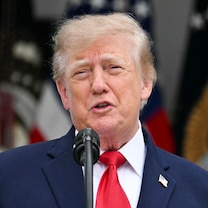
President Donald Trump told ABC News on Tuesday morning he is "not happy" with either Israel or Iran after the opening hours of a nascent ceasefire between the two combatants were marred by reported exchanges. Trump said Iran and Israel both "violated" the ceasefire that he announced late on Monday.
Through last week, the president and his administration continued to push back on an early intelligence report suggesting that the U.S. strikes on Iranian nuclear facilities may have only set Tehran's nuclear program back by months.
Israel says it did not destroy all enriched uranium in Iran, tried to assassinate Khamenei
Israel did not destroy all of Iran's highly enriched uranium and tried to kill Supreme Leader Ayatollah Ali Khamenei during its operation, Israeli Defense Minister Israel Katz said in an interview to Channel 13 on Thursday evening.
When asked about the 408 kilograms of highly enriched uranium the Iranians had before the war and if it was moved inside Iran or taken out of the country, Katz said, "It was clear from the outset of our attack that we would not eliminate all of the material. The shared U.S.-Israeli position is that the Iranians will be asked to hand over that material."
Iran's Supreme Leader Ayatollah Ali Khamenei speaks in a televised message, after the ceasefire between Iran and Israel, in Tehran, Iran, June 26, 2025.
Office Of The Iranian Supreme Leader/AFP via Getty Images
Israel tried during the war with Iran to assassinate Khamanei, but there was "no operational opportunity to do so," Katz said.
He laughed off the suggestion Israel would need "permission" from the U.S. He denied it was "forbidden" by the U.S.
Jun 26, 2025, 4:17 PM EDT
Iran still evaluating if and how they will continue work with IAEA, remain in NPT, Iranian FM says
Iran is still evaluating if and how they will work with the International Atomic Energy Agency in light of a new bill passed in Iran’s Parliament Thursday, Iranian Foreign Minister Abbas Araghchi said on Iranian state TV Thursday.
Whether or not Iran will stay in the Non-Proliferation of Nuclear Weapons Treaty, also known as the NPT, needs to be investigated, Araghchi said. Iran will "act accordingly with the interest of the country," he added.
One of the reasons Iran cannot maintain the same relationship with the IAEA as it had before the 12-day war is because the IAEA did not condemn Israel and the US’s attacks on Iran’s nuclear facilities, he said.
"The IAEA Director-General should have done this," referring to condemning Israel and the U.S.'s attacks on Iran’s’ nuclear facilities, Araghchi said. “Attacking nuclear facilities is an unforgivable crime from international law."
Araghchi said the law passed by Iran’s Parliament will be further investigated by the Iranian government and said the new law hasn’t completely blocked a path for cooperation with the IAEA.
"We need to perform more legal work on this law and decide how we can set our relations with the IAEA," Araghchi said.
The IAEA inspections have stopped inside Iran, Araghchi said.
Jun 26, 2025, 3:42 PM EDT
Iran has not reached an agreement to resume negotiations with the US, Iranian FM says
Iran has not reached an agreement to return to negotiations with the U.S. on its nuclear program and no date for a potential meeting to re-start the negotiations has been set, the Iranian Foreign Minister Abbas Araghchi said on Iranian state TV Thursday.
Araghchi said speculation about negotiations resuming should not be taken seriously.
"I would like to state clearly that no agreement, appointment or conversation has been made to start new negotiations," Araghchi said.
Iran's Foreign Minister Abbas Araghchi speaks to the media after his meeting with the E3 group of European ministers, June 20, 2025 in Geneva, Switzerland.
Sedat Suna/Getty Images
Araghchi also said the negotiations between the U.S. and Iran will only be more difficult after the U.S. and Israel’s military actions.
"The next negotiations won’t be any easier for the Americans compared to the previous ones," Araghchi said. "Human beings have been killed for it. It’s not possible to make an agreement on it as easy as before."
Jun 26, 2025, 2:45 PM EDT
Iran will not change its position on nuclear program, foreign ministry says
Iran will not change its position regarding its nuclear program despite the military action taken by the U.S. and Israel, Esmaeil Baghaei, a foreign ministry spokesperson, told Iranian state media on Thursday.
"We have shown that pressure, intimidation, threats, and even the use of naked force against a sovereign state, in violation of all international standards and norms, cannot undermine our rights. Our rights remain intact," Baghaei told IRNA in a lengthy interview published Thursday.
Baghaei also addressed accusations that Iran was looking to prolong the negotiations with the U.S. that had been scheduled to take place in Oman before Israel attacked.
"All of these cases show that the American side was not serious about the negotiations from the beginning. But this does not diminish the value of the actions of the Islamic Republic of Iran. In my opinion, Iran's entry into these negotiations truly exposed the hypocrisy and lies of the other side," Baghaei said.
This satellite image provided by Maxar Technologies shows extensive new building damage across the Isfahan facility in Iran after U.S. strikes, June 22, 2025.
Satellite Image 2025 Maxar Technologies
"History will record that in the midst of a diplomatic process between Iran and a party that considers itself a global power, Iran's logic prevailed, and they failed to meet this logic. For this reason, they encouraged and supported their proxy in the region to attack Iran," Baghaei added.
On the calls to resume negotiations with the U.S. over Iran’s nuclear program, Baghaei said, "First, we never trusted the other side. Because sometimes some words are used, such as 'the recent incident caused trust between Iran and America to decrease' or 'to disappear,' while we basically never trusted [them]. One of the reasons for this is the events that we are witnessing now. We were talking to the other side in an atmosphere of absolute distrust. The reason for this distrust is their history of breaking promises."