Russian President Vladimir Putin's "special military operation" into neighboring Ukraine began on Feb. 24, with Russian forces invading from Belarus, to the north, and Russia, to the east. Ukrainian troops have offered "stiff resistance," according to U.S. officials.
The Russian military has since launched a full-scale ground offensive in eastern Ukraine's disputed Donbas region, capturing the strategic port city of Mariupol and securing a coastal corridor to the Moscow-annexed Crimean Peninsula.
A look at the two leaders at the center of the war in Ukraine and how they both rose to power, the difference in their leadership and what led to this moment in history.
Here's how the news is developing. All times Eastern.
Apr 12, 2022, 8:59 AM EDT
Putin calls Russia's objectives in Ukraine 'noble'
Russian President Vladimir Putin said Tuesday that his country's "special military operation" in Ukraine would undoubtedly achieve its "noble" objectives."
"On the one hand, we are helping and saving people, and on the other, we are simply taking measures to ensure the security of Russia itself," Putin said, according to Russian news agencies. "It's clear that we didn't have a choice. It was the right decision."
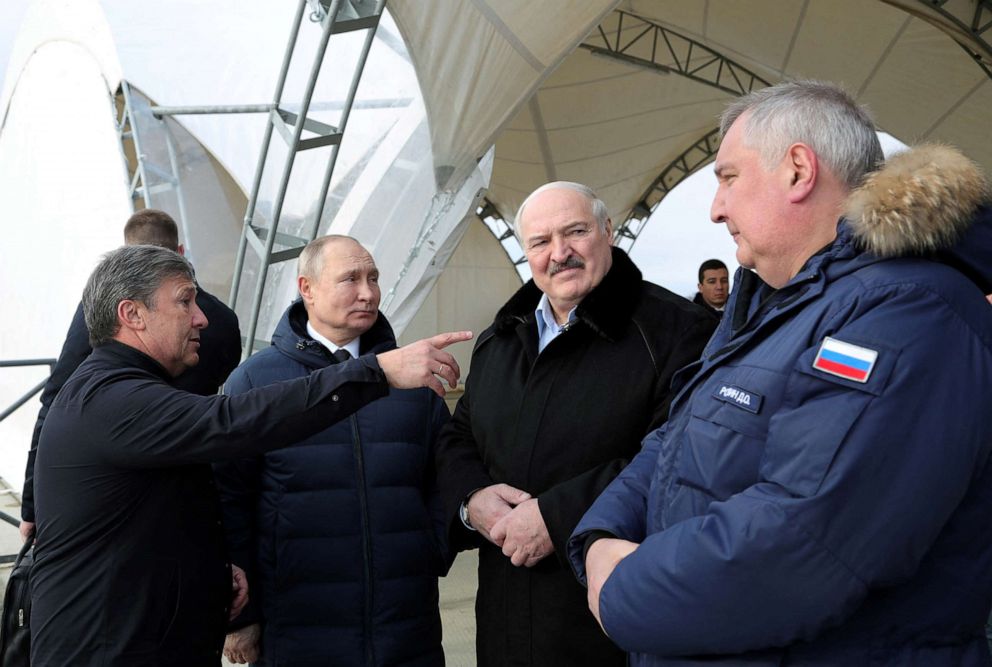
Russian President Vladimir Putin, Belarusian President Alexander Lukashenko and Director General of Roscosmos Dmitry Rogozin visit the construction site of the Amur launch complex for Angara rockets at the Vostochny Cosmodrome in Amur Region, Russia April 12, 2022.
Kremlin via Reuters
Putin made the comments while visiting the Vostochny Cosmodrome, a Russian spaceport in the Amur Oblast in the Russian Far East, to mark Russia's annual Cosmonautics Day.
He was joined by Belarusian President Alexander Lukashenko. The two leaders held talks on bilateral relations and the situation in Ukraine, without the participation of Russian or Ukrainian delegations.
Apr 12, 2022, 8:07 AM EDT
9 humanitarian corridors to open in eastern Ukraine on Tuesday
Nine humanitarian corridors are expected to open in eastern Ukraine again on Tuesday to allow civilians escape heavy fighting, according to Ukrainian Deputy Prime Minister Iryna Vereshchuk.
She said in a statement via social media Tuesday that evacuation routes were agreed upon for those traveling by private cars from besieged Mariupol in the Donetsk Oblast, as well as from Berdyansk, Tokmak and Enerhodar in the Zaporizhzhia Oblast -- all of which lead to the southeastern city of Zaporizhzhia.
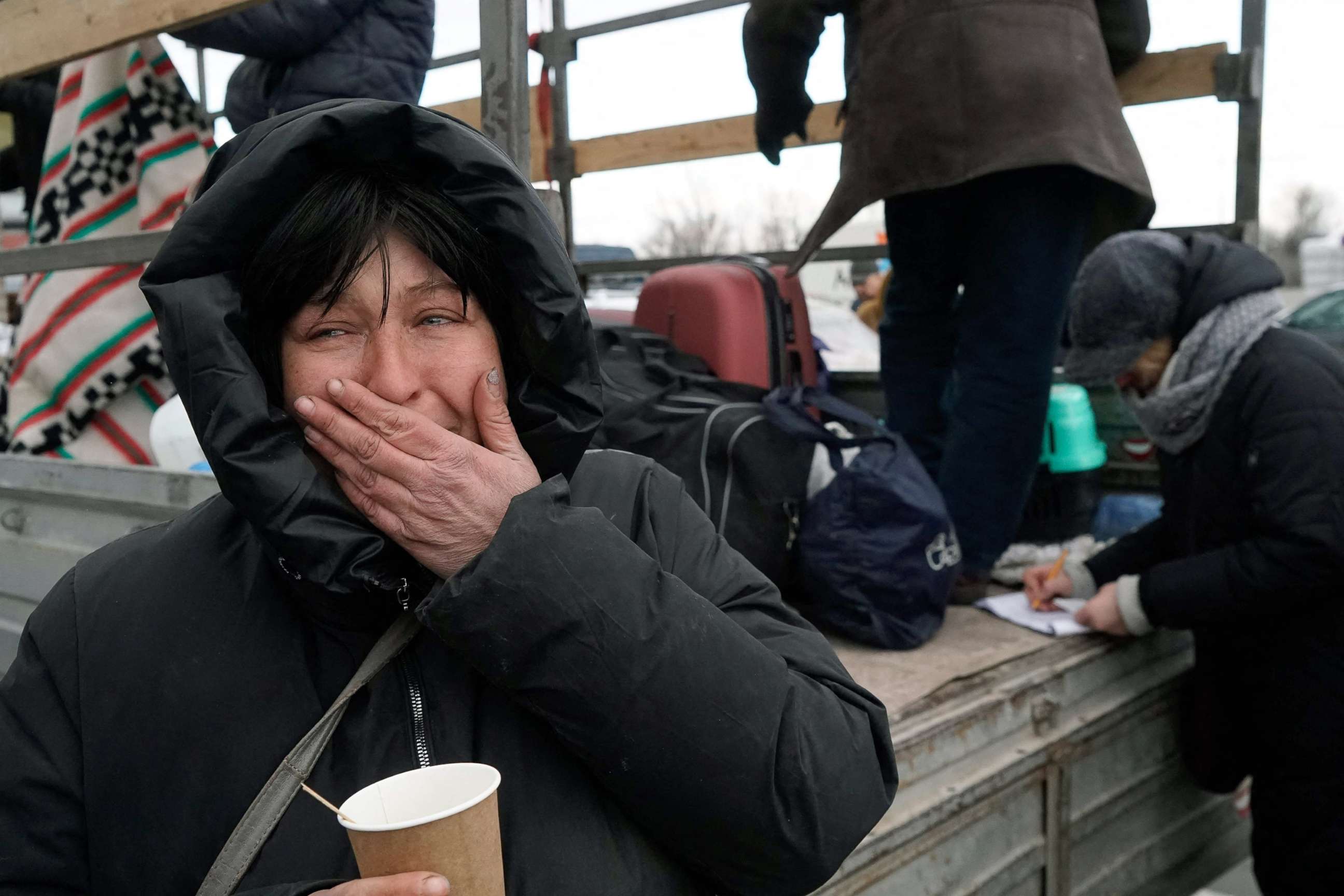
Evacuees from Mariupol arrive at the car park of a shopping center on the outskirts of the city of Zaporizhzhia, which is now a registration center for displaced people, March 16, 2022. Some 20,000 residents were been allowed to leave Mariupol through a humanitarian corridor agreed with Russian forces.
Emre Caylak/AFP via Getty Images
In the Luhansk Oblast, Vereshchuk said routes were established from the cities of Severodonetsk, Lysychansk, Popasna, Hirske and Rubizhne, leading to the city of Bakhmut in the Donetsk Oblast.
The same routes were opened Monday, allowing a total of 4,354 people to evacuate via buses and private cars, according to Vereshchuk. However, Vereshchuk said buses carrying people from Berdyansk, Tokmak and Enerhodar to Zaporizhzhia city were being held up by Russian forces at a checkpoint in Vasylivka for a third day in a row.
Apr 12, 2022, 7:26 AM EDT
Ukraine, West probe alleged chemical attack in Mariupol
Ukraine announced Tuesday it is investigating claims that chemical weapons were used in an attack against Ukrainian soldiers in besieged Mariupol.
The Azov Regiment, a far-right group now part of the Ukrainian National Guard, alleged in a statement via Telegram on Monday that a Russian drone had dropped "a poisonous substance of unknown origin" on its fighters defending a giant metals plant in Mariupol, a southeastern port city in Ukraine's Donetsk Oblast that has been subjected to heavy bombardment since the Russian invasion began on Feb. 24. The Azov, which did not provide evidence of the alleged attack, said its fighters had suffered minor injuries.
The claims could not be independently verified by ABC News.
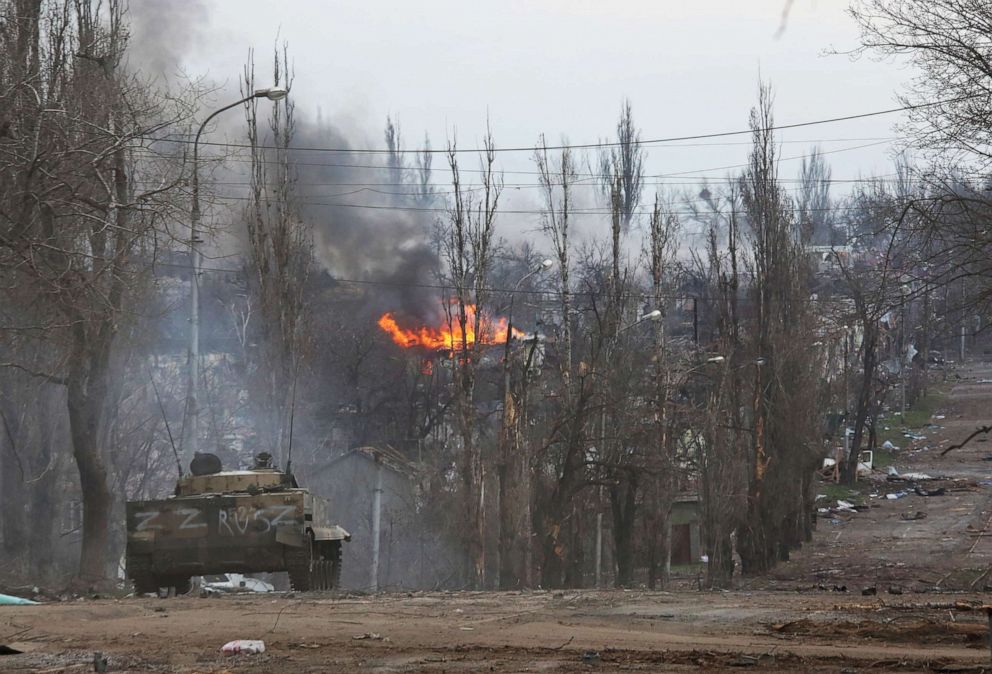
An armored vehicle of pro-Russia troops is seen in the street of the southeastern port city of Mariupol, Ukraine, on April 11, 2022, amid Russia's invasion of Ukraine.
Chingis Kondarov/Reuters
Eduard Basurin, a spokesperson for Russia-backed separatist forces in Donetsk Oblast, denied the allegations, telling Russian news agency Interfax that separatist forces "haven't used any chemical weapons in Mariupol." However, on the eve of the alleged attack, Basurin appeared to urge their use, telling Russian state media that Russia-backed forces should seize the Mariupol plant from Ukrainian soldiers by blocking the exits and using "chemical troops to smoke them out."
Ukrainian Deputy Defense Minister Hanna Maliar said Tuesday the government is investigating the claims, adding that preliminary information suggested phosphorous munition had been used.
When deployed as a weapon, phosphorus can inflict excruciating burns and lead to infection, shock and organ failure. Although phosphorus is not classified as a chemical weapon under the Chemical Weapons Convention, its use as an incendiary weapon in civilian areas is forbidden under the Geneva Conventions.
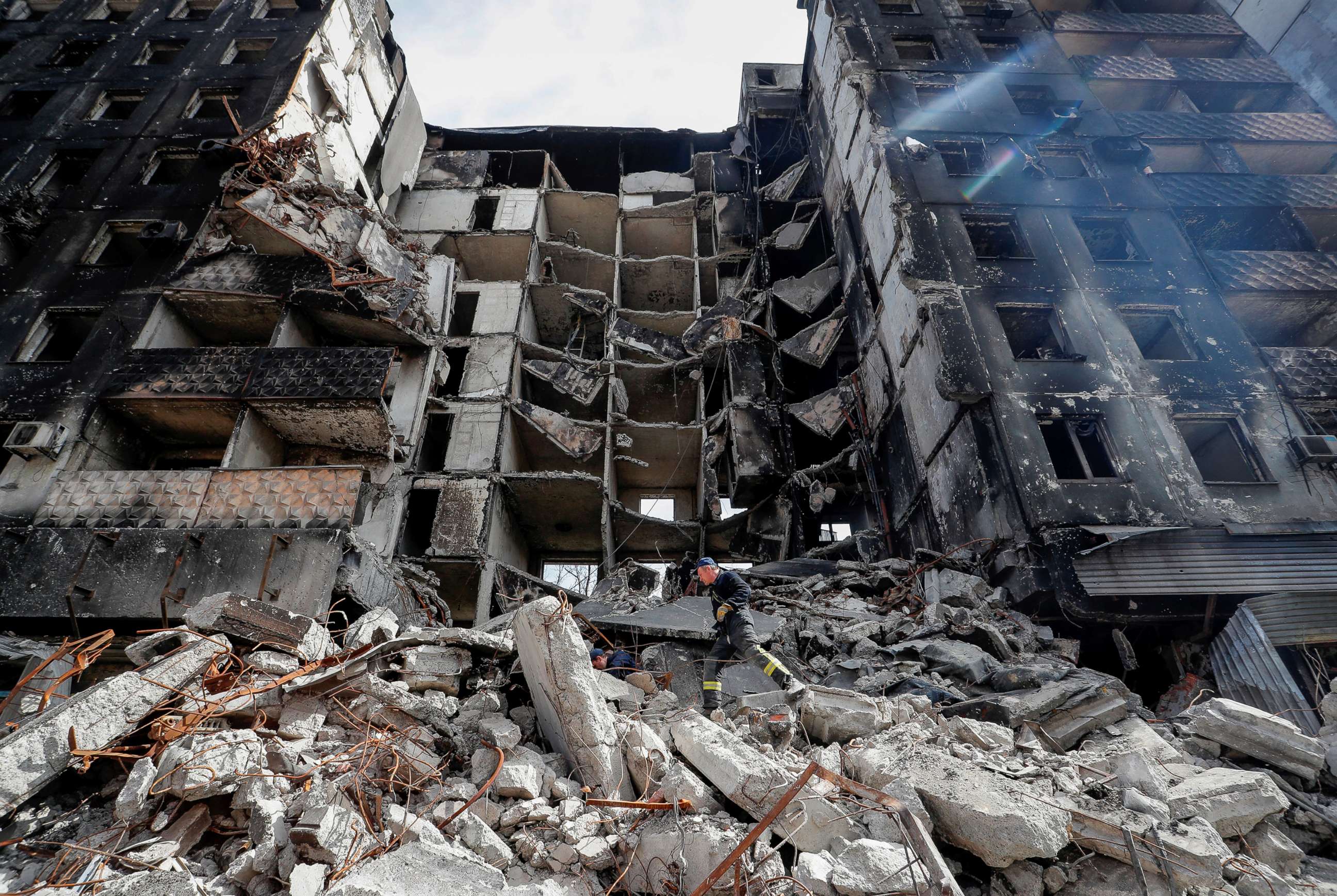
Emergency workers remove debris of a building destroyed in the southern port city of Mariupol, Ukraine, April 10, 2022.
Alexander Ermochenko/Reuters
The United Kingdom is "working urgently" to investigate the reports, according to U.K. Foreign Secretary Liz Truss, who noted that any confirmed use of chemical weapons in Mariupol would be a "callous escalation" of the war.
U.K. Armed Forces Minister James Heappey told Sky News on Tuesday that "all options are on the table in terms of how the West might respond."
Meanwhile, the United States said it was "aware" of the reports.
"We cannot confirm at this time and will continue to monitor the situation closely," Pentagon press secretary John Kirby said in a statement Monday. "These reports, if true, are deeply concerning and reflective of concerns that we have had about Russia's potential to use a variety of riot control agents, including tear gas mixed with chemical agents, in Ukraine."
-ABC News' Guy Davies and Luis Martinez
Apr 11, 2022, 6:45 PM EDT
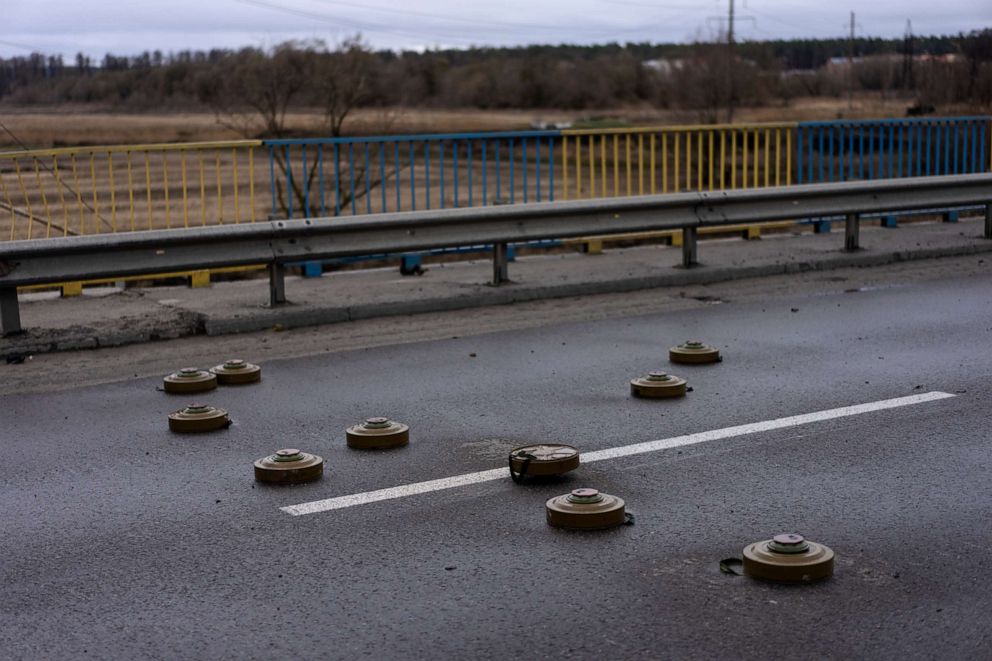
Russian troops left mines 'everywhere,' Zelenskyy says
Ukrainian officials are focusing on clearing the mines left behind by Russian forces before they retreated the region surrounding Kyiv, Ukrainian President Volodymyr Zelenskyy announced in his address Monday.
The Russian troops deliberately left mines "everywhere," Zelenskyy said, adding that they did so "to kill or maim as many of our people as possible, even when they were forced to withdraw from our land."
"Russian troops left behind tens, if not hundreds of thousands, of dangerous objects," Zelenskyy said.
Anti-tank mines are spread out on a bridge in Bucha, Ukraine, April 2, 2022.
Rodrigo Abd/AP
Zelenskyy said Ukrainian officials are also focusing on procuring more arms. The country is not getting the lethal aid it needs to end the war sooner, he said.
The president also called on the European Union to include an oil embargo in its sixth round of sanctions toward Russia, saying that unless they do, another round of sanctions will be received by Moscow "with a smile."