Almost a year after Russian President Vladimir Putin launched a full-scale invasion of neighboring Ukraine, the two countries are engaged in a struggle for control of areas throughout the east and south.
Putin's forces pulled out of key positions in November, retreating from Kherson as Ukrainian troops led a counteroffensive targeting the southern port city. Russian drones have continued bombarding civilian targets throughout Ukraine, knocking out critical power infrastructure as wintersets in.
Here's how the news is developing. All times Eastern.
Sep 21, 2022, 6:27 PM EDT
Zelenskyy demands punishment for Russia in UN remarks
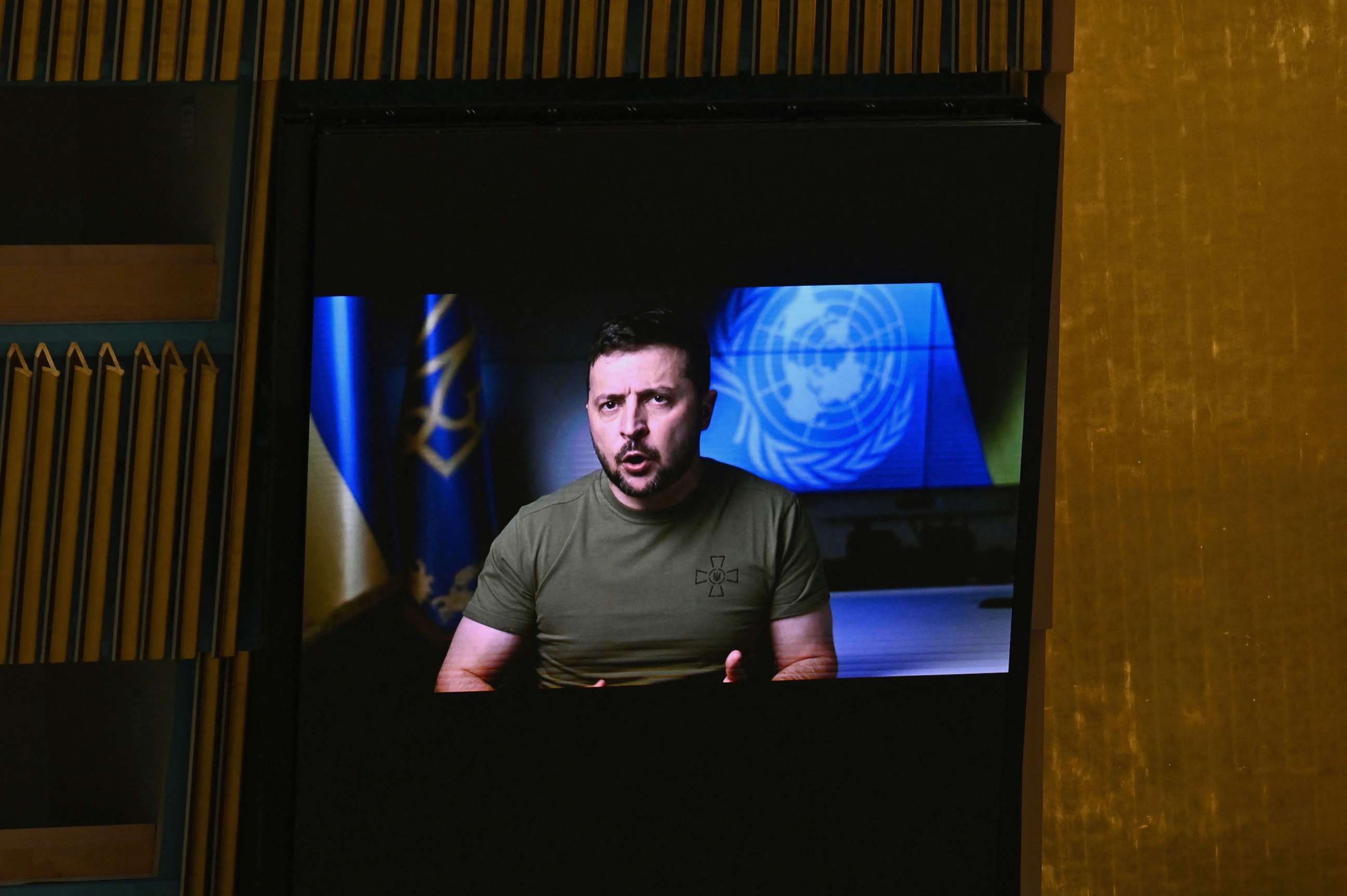
Ukrainian President Volodymyr Zelenskyy demanded punishment for Russia in his remarks to the United Nations General Assembly on Wednesday.
"A crime has been committed against Ukraine, and we demand just punishment," he said in video remarks, the only state leader allowed to appear virtually this year.
Ukrainian President Volodymyr Zelenskyy remotely addresses the 77th session of the United Nations General Assembly at the UN headquarters in New York City, Sept. 21, 2022.
Angela Weiss/AFP via Getty Images
Zelenskyy spelled out the alleged atrocities discovered in Izyum after Russian forces retreated. "The bodies of women and men, children and adults, civilians and soldiers were found there -- 445 graves," he said.
Zelenskyy vowed to other world leaders that Ukraine's forces would ultimately emerge successful -- and claimed any rhetoric from Russia about negotiating peace was a façade.
"We can return the Ukrainian flag to our entire territory. We can do it with the force of arms, but we need time," he said. "Russia wants to spend the winter on the occupied territory of Ukraine and prepare forces to attempt a new offensive -- new Buchas, new Izyums."
He warned that Russia's warfare near nuclear plants meant no one was safe and again made an appeal for Russia to be branded as a state sponsor of terrorism by all nations -- something the Biden administration has so far said it is against.
"We must finally recognize Russia as a state sponsor of terrorists, at all levels, in all countries," Zelenskyy urged. "This is the foundation for restoring global security."
-ABC News' Shannon Crawford
Sep 21, 2022, 6:15 PM EDT
More than 1,400 people detained at antiwar protests in Russia
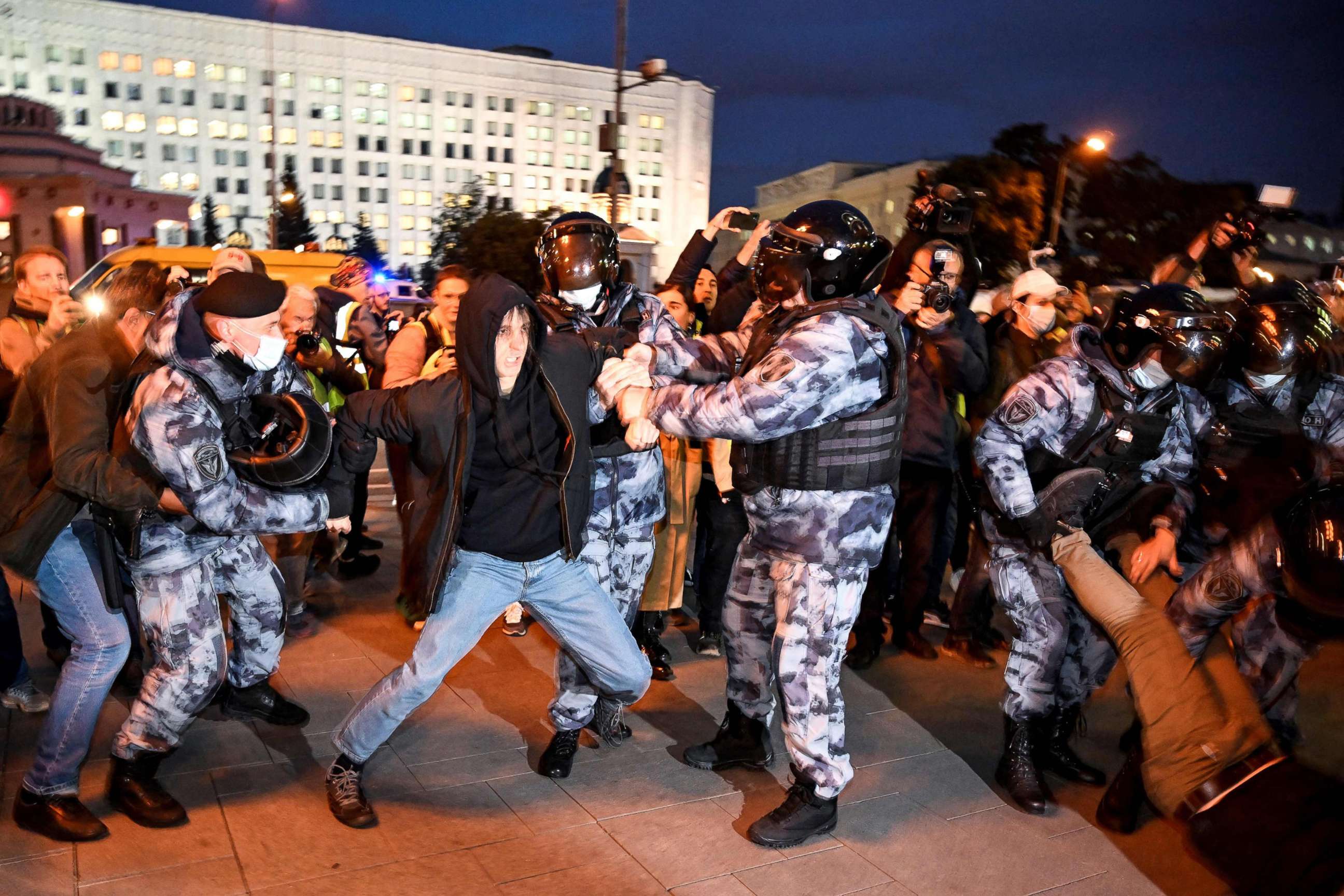
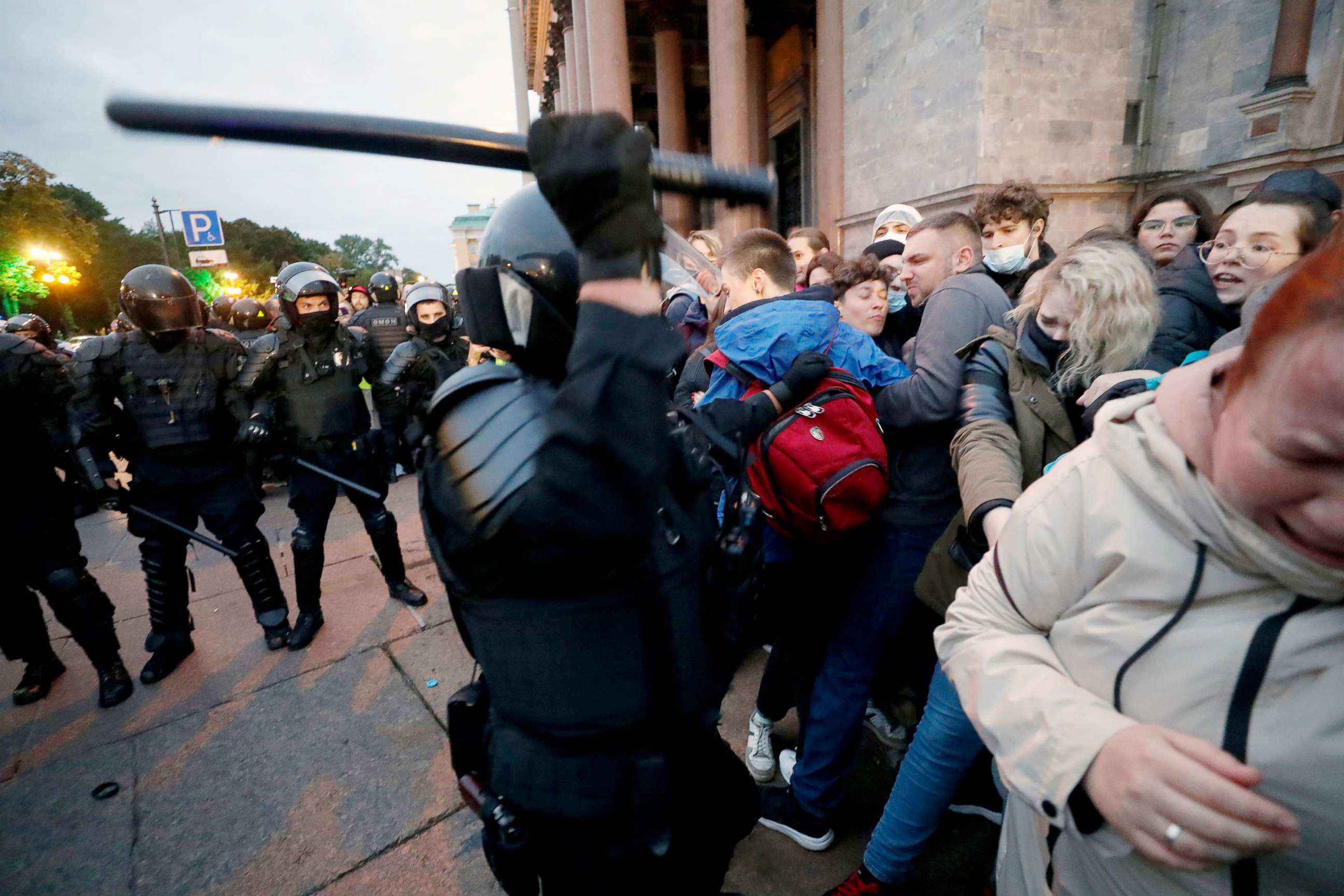
More than 1,400 people were detained at antiwar protests that have erupted across Russia after President Vladimir Putin ordered a partial mobilization of reservists to fight in Ukraine, according to the independent Russian human rights monitoring group OVD-Info.
A demonstrator jumps on a police officer to prevent his friend from being detained during a protest against mobilization in Moscow, Sept. 21, 2022.
Alexander Zemlianichenko/AP
Police officers detain a protester in Moscow, Sept. 21, 2022.
Alexander Nemenov/AFP via Getty Images
At least 1,408 people have been detained at mobilization protests in nearly 40 cities on Wednesday, OVD-Info said in its latest update. Most were reported at protests in St. Petersburg and Moscow.
The protests followed a televised address Wednesday morning during which Putin announced the start of the first mobilization in Russia since World War II. The measure is expected to draft more than 300,000 Russian citizens with military experience, according to Russian Defense Minister Sergei Shoigu.
Police officers detain a man during a protest against partial mobilization announced by President Vladimir Putin in Moscow, Sept. 21, 2022. President Vladimir Putin called up Russian military reservists on September 21, saying his promise to use all military means in Ukraine was "no bluff," and hinting that Moscow was prepared to use nuclear weapons. His mobilization call comes as Moscow-held regions of Ukraine prepare to hold annexation referendums this week, dramatically upping the stakes in the seven-month conflict by allowing Moscow to accuse Ukraine of attacking Russian territory.
Alexander Nemenov/AFP via Getty Images
Russian policemen move in to detain participants of an unauthorised protest against the partial mobilization due to the conflict in Ukraine, in central St. Petersburg, Russia, Sept. 21, 2022.
Anatoly Maltsev/EPA-EFE/Shutterstock
Protesters could be seen holding "stop war" signs. One man shown being taken into custody in Novosibirsk had shouted, “I don’t want to die for Putin or for you,” according to Russian independent media outlet Mediazona.
Russia has criminalized protests against the war, and demonstrations held following its invasion have been met with a heavy police response.
Sep 21, 2022, 9:32 AM EDT
White House reacts to Putin's partial military mobilization
Russian President Vladimir Putin's partial military mobilization for his ongoing war in neighboring Ukraine is "definitely a sign that he's struggling," according to the White House's National Security Council spokesman John Kirby.
"And we know that," Kirby told ABC News' George Stephanopoulos during an interview Wednesday on "Good Morning America."
"[Putin] has suffered tens of thousands of casualties. He has terrible morale, unit cohesion on the battlefield, command and control has still not been solved. He's got desertion problems and he's forcing the wounded back into the fight," Kirby added. "So clearly manpower's a problem for him, he feels like he's on his back foot, particularly in that northeast area of the Donbas."
Some 300,000 Russian reservists are expected to be conscripted, which Kirby noted is "a lot."
"That's almost twice as much as [Putin] committed to the war back in February," he said.
Kirby said Putin's latest nuclear threats are "typical" but something the United States and its allies still take "seriously."
"We always have to take this kind of rhetoric seriously," he added. "It's irresponsible rhetoric for a nuclear power to talk that way, but it's not atypical for how he's been talking the last seven months and we take it seriously. We are monitoring as best we can their strategic posture so that if we have to, we can alter ours. We've seen no indication that that's required right now."
And if Russia does use nuclear weapons, "there will be severe consequences," according to Kirby.
While Moscow appears poised to annex Russian-held regions in Ukraine and attempt to politically legitimize it with sham referendums in the coming days and weeks, Kirby said the United States will still consider those areas Ukrainian territory.
"We're going to continue to support Ukraine with security systems and other financial aid, as the president said, for as long as it takes," he added. "That is Ukrainian territory. It doesn't matter what sham referendum they put in place or what vote they hold, it is still Ukrainian territory."
3:18
John Kirby talks Putin's move to call up more troopsThe national security council coordinator for strategic communications at the White House discusses Russia's latest war strategy in Ukraine.
ABCNews.com
Sep 21, 2022, 7:47 AM EDT
Putin orders partial military mobilization, issues nuclear threat
Russian President Vladimir Putin has ordered a partial mobilization of reservists in Russia, in an apparent admission that his war in neighboring Ukraine isn't going according to plan.
In a seven-minute televised address to the nation that aired on Wednesday morning, Putin announced the start of the mobilization -- the first in Russia since World War II. The measure is expected to draft more than 300,000 Russian citizens with military experience, according to Russian Defense Minister Sergei Shoigu.
The move comes as Moscow is poised to annex all the regions it occupies in Ukraine in the coming weeks, with plans to hold sham referendums this weekend in an effort to politically legitimize its actions. By declaring those areas officially Russian territory, Putin is also threatening that any continued efforts by Ukraine to retake them will be seen as a direct attack on Russia. In his speech Wednesday, the Russian leader raised the specter of using nuclear weapons if Ukraine continues to try to liberate the occupied regions.
"In the event of a threat to the territorial integrity to our country, for the protection of Russia and our people, we of course will use all means in our possession," Putin said. "This is not a bluff."
"Those who are trying to blackmail us with nuclear weapons should know that the wind can turn in their direction," he added.
Russian President Vladimir Putin makes an address on the conflict with Ukraine, in Moscow in this still image taken from video released Sept. 21, 2022.
Sputnik via Reuters
It's an attempt to regain the initiative after disastrous setbacks in Russia's war against Ukraine.
Russia has been suffering severe manpower shortages in Ukraine after months of heavy losses, mainly because the Kremlin has pretended it is fighting not a war but a "special military operation." That, in part, allowed Ukraine's spectacular counteroffensive in the country's northeast two weeks ago, which led to the collapse of Russia's frontline there.
Military experts and Russian commentators themselves had acknowledged that without a mobilization, Moscow is not capable of anymore offensive operations in Ukraine and in the longterm might well be unable to even hold the territory it has already taken.
Putin has balked at ordering a mobilization, until now, because of the huge political risks it carries for him at home. Russians have proved relatively supportive of the war while they have not been ordered to fight it, but this carries much bigger risks now of domestic unrest. It will bring up dangerous memories of the Soviet disaster in Afghanistan and Chechnya.
Yet Putin has clearly decided he must take the risk, with losing the war in Ukraine seen as an existential danger to his regime.
The mobilization order has profound implications for not just Russia and Ukraine, but also for Europe and the United States. It means Putin is expanding the war in Ukraine even further, ready to throw hundreds of thousands more people into it -- making the fight harder again for Ukraine, while also raising the threat of nuclear strikes on it. And at home, Putin is going to enter uncharted waters.
-ABC News' Patrick Reevell and Tom Soufi Burridge
2:41
Putin declares partial mobilization as war in Ukraine escalatesLegislation being pushed through Russia's parliament lays the groundwork for a general mobilization, forcing men over the age of 18 to fight in Ukraine.