Gabbard avoids answering whether Iran posed an 'imminent threat'
Gabbard testified the Iranian regime appears "intact" but "largely degraded."
For the first time since the start of the war, Director of National Intelligence Tulsi Gabbard faced pointed questions Wednesday on whether Iran posed an "imminent threat" to the U.S. as President Donald Trump has maintained.
Lawmakers pressed Gabbard, CIA Director John Ratcliffe, FBI Director Kash Patel and other national security officials on the conflict, and other global matters, on the intelligence community's annual assessment of such worldwide threats on Capitol Hill.
Gabbard was also questioned on her presence at an FBI raid of an election center in Georgia in January.
The hearing came one day after the resignation of Joe Kent, the Trump administration's top counterterrorism official, who stepped down over his objections to the war, arguing there was no "imminent threat" from Iran.
Gabbard says only Trump can determine an 'imminent threat' in contentious exchange
Democratic Sen. Jon Ossoff pointedly questioned Gabbard about the intelligence community's assessment on Iran's nuclear capabilities.
President Trump previously said Iran's nuclear program was "obliterated" by U.S. strikes last summer. Among its several justifications for the current war, however, the White House said Tehran posed an imminent nuclear threat.
"Was it the assessment of the intelligence community that there was an imminent nuclear threat posed by the Iranian regime? Yes or no?" Ossoff asked Gabbard.
"Senator, the only person who can determine what is and is not an imminent threat is the president," Gabbard said.

Ossoff pushed back, accusing Gabbard of not answering directly because her response would contradict a statement from the White House.
"It is precisely your responsibility to determine what constitutes a threat to the United States. This is the worldwide threats hearing, where, as you noted in your opening testimony, you represent the [intelligence community's] assessment of threats. You are here to represent the IC's assessment of threats," Ossoff said.
Gabbard's counterpart at the CIA, Ratcliffe, did say Iran posed an "immediate threat" when the U.S. attacked Iran, outlining a series of provocative actions he assessed Iran to be taking, including a missile buildup during ongoing negotiations with the U.S.
Gabbard: Iran made 'no efforts' to rebuild nuclear enrichment program
Gabbard also contradicted the president's claim that Iran was restarting its nuclear weapons program.
"They were warned to make no future attempts to rebuild their weapons program and in particular nuclear weapons," Trump said during his State of the Union speech days before launching the war. "Yet they continue, they’re starting it all over."
But Gabbard told Congress on Wednesday in her written testimony that Iran has actually made "no efforts" to rebuild its nuclear enrichment program.
"That's the assessment of the intelligence community?" Sen. Ossoff asked.
"Yes," Gabbard replied.
Ratcliffe said the regime halted enrichment of its nuclear material. Tehran has "been unwilling and incapable of enriching uranium to 60% as a result of" last summer's strikes, he told senators.
Lt. General James Adams, the director of the Defense Intelligence Agency, would not discuss the nuclear material still in Iran -- likely buried under sites the U.S. struck -- in a public hearing. Asked whether the U.S. would deploy boots on the ground to secure the material, he promised to discuss the issue in "great [detail]" with senators in a classified hearing.
Gabbard says Iranian regime appears 'intact' but 'largely degraded'
In her opening statement, Gabbard provided the latest intelligence community assessment on Iran.
Gabbard had repeated a longstanding Defense Intelligence Agency assessment that Iran could build a missile that could reach the United States before 2035. That finding was cited by the administration as a justification for its military action in Iran.
On the country's current leadership, Gabbard said the regime "appears to be intact, but largely degraded due to attacks."

"Its conventional military power projection capabilities have largely been destroyed, leaving limited options. Iran's strategic position has been significantly degraded," she said.

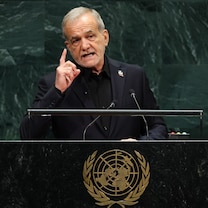
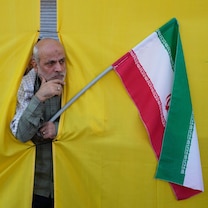
She also warned that while "internal tensions are likely to increase" inside Iran as its "economy worsens."
"If a hostile regime survives, it will likely seek to begin a yearslong effort to rebuild its military, missiles and UAV [Unmanned Aerial Vehicle] force," Gabbard said.
Officials pressed on planning for Strait of Hormuz, Gabbard sidesteps
Gabbard sidestepped questions on whether she briefed the president on a probable response from Iran -- which has now been borne out with Iranian strikes against U.S. partners in the region and a closure of the critical Strait of Hormuz.
Asked by Sen. Angus King, an independent from Maine, whether that contingency was "communicated to the president," Gabbard would only say that the U.S. military took "preemptive planning" measures ahead of its attack.

She later acknowledged that it’s "long been an assessment of the IC that Iran would likely hold the Strait of Hormuz as leverage."
"Did you brief the president, if he starts a war of choice, that the likely result would be that Iran would strike adjacent Gulf nations and close the Strait of Hormuz?" Sen. Mark Warner, the top Democrat on the Senate Intelligence Committee, asked Gabbard at one point.
"I have not and won't divulge internal conversations," Gabbard replied.
Gabbard faces questions on Fulton County election raid
Gabbard and Sen. Warner sparred over her presence at the FBI raid of an election center in Fulton County, Georgia, earlier this year, where agents seized election materials tied to the 2020 election.
Warner asked Gabbard to explain her "authority" to be involved in the matter.
"I did not participate in a law enforcement activity, nor would I, because that does not exist within my authorities," Gabbard testified.
"I was at Fulton County, sir, at the request of the president and to work with the FBI to observe this action that had long been awaited. I was not aware of what was in the warrant," Gabbard added.
Trump previously said Gabbard was in Georgia at the direction of Attorney General Pam Bondi.
Warner said in his opening statement that Gabbard’s appearance at the raid "suggests something that should alarm every American: an organized effort to misuse her national security powers to interfere in domestic politics … and provide a pretext for the president’s unconstitutional efforts to seize control of the upcoming elections."

Gabbard provided additional details about the day in Fulton County, including the now-viral photo showing her standing on what she described as an empty truck while being questioned by Sen. Ossoff.
Gabbard declined to say how President Trump personally communicated his request that she be there, saying only that “the message was delivered” and that it was "a request from the president’s administration to go and help oversee this warrant being executed."
She later argued that her presence fell within her statutory responsibilities, saying, "It is my role, based on statute that Congress has passed, to have oversight over election security, to include counterintelligence."
Gabbard also addressed the image of her speaking on the phone during the operation, describing it as a photo taken while she was inside what she called "an empty truck."
Related Topics

Popular Reads

ABC News Live