Highlights from Senate vote to confirm Ketanji Brown Jackson

The Senate voted 53-47 in a bipartisan vote on Jackson's nomination.

Last Updated: April 7, 2022, 5:29 PM EDT

Judge Ketanji Brown Jackson, the first Black woman nominated to the U.S. Supreme Court in its 233-year history, was confirmed by the Senate in a 53-47 vote Thursday.

She got three Republican votes, marking a bipartisan victory for President Joe Biden and his high court nominee.

Mar 23, 2022, 11:43 AM EDT

Senators debate whether Jackson called Bush, Rumsfeld 'war criminals'

Beginning the second and final round of questioning, Senate Judiciary Chairman Dick Durbin, D-Ill., did not use all of his allotted 20-minutes as Democrats, pleased with Judge Jackson’s performance this week, appear on track to confirm Biden’s first Supreme Court nominee.

Durbin responded to the accusation -- made by Sen. John Cornyn of Texas -- that Jackson had called former President George W. Bush and former Secretary of State Donald Rumsfeld "war criminals" in a legal filing when, as a federal public defender, she represented Guantanamo Bay detainees. Cornyn complained that Durbin on Tuesday had "editorialized" about the filing in her favor after he left the room following his exchange with Jackson.

"Now I don't understand the difference between calling someone a war criminal and accusing them of war crimes," Cornyn said at the start of Wednesday's session.

Later Wednesday, during his turn, Durbin noted Bush and Rumsfeld were named in the lawsuit for alleged torture crimes in their official capacity, said they were never specifically called "war criminals," and asked Jackson if she'd like to respond.
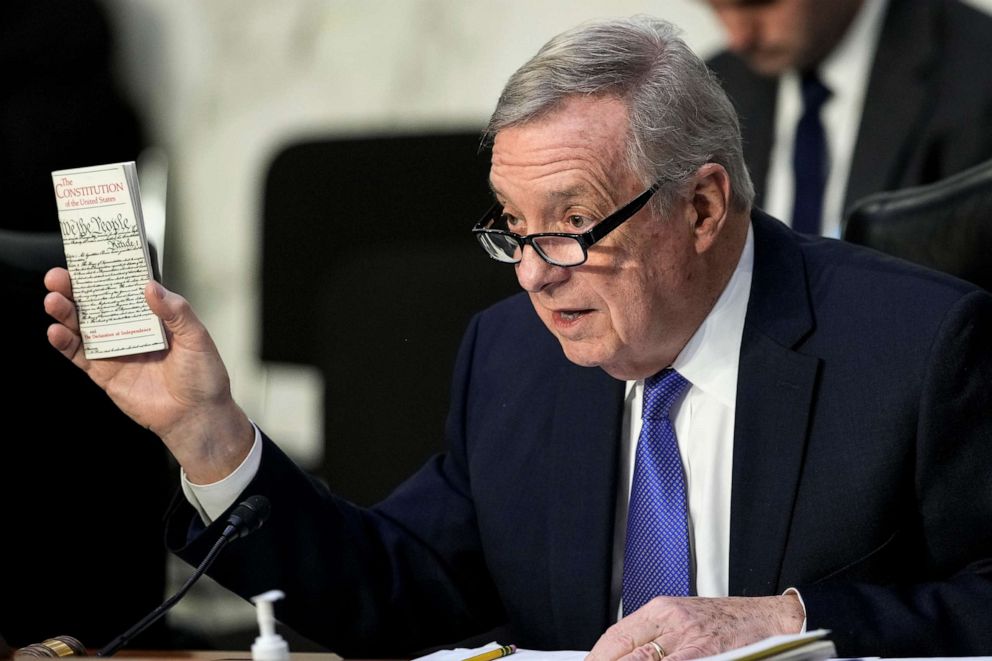
PHOTO: Senate Judiciary Committee Chairman Richard Durbin holds a copy of the U.S. Constitution as he questions Supreme Court nominee Judge Ketanji Brown Jackson during her confirmation hearing, March 23, 2022 in Washington, D.C.
Senate Judiciary Committee Chairman Richard Durbin holds a copy of the U.S. Constitution as he questions Supreme Court nominee Judge Ketanji Brown Jackson during her Senate Judiciary Committee confirmation hearing, March 23, 2022 in Washington, D.C.
Drew Angerer/Getty Images

Without directly addressing the exact language used in the filing and its implications, she reminded the committee that public defenders can't choose their clients, "yet they have to provide vigorous advocacy. That's the duty of a lawyer," she said. "And as a judge now, I see the importance of having lawyers who make arguments, who make allegations."

"In the context of a habeas petition, especially early in the process of the response to the horrible attacks of 9/11, lawyers were helping the courts to assess the permissible extent of executive authority by making arguments, and we were assigned as public defenders," she added. "We had very little information because of the confidentiality, or the classified nature of a lot of the record, and as an appellate lawyer, it was my obligation to file habeas petitions on behalf of my clients."
Mar 23, 2022, 10:45 AM EDT

Republican presses Jackson on prison release recommendations

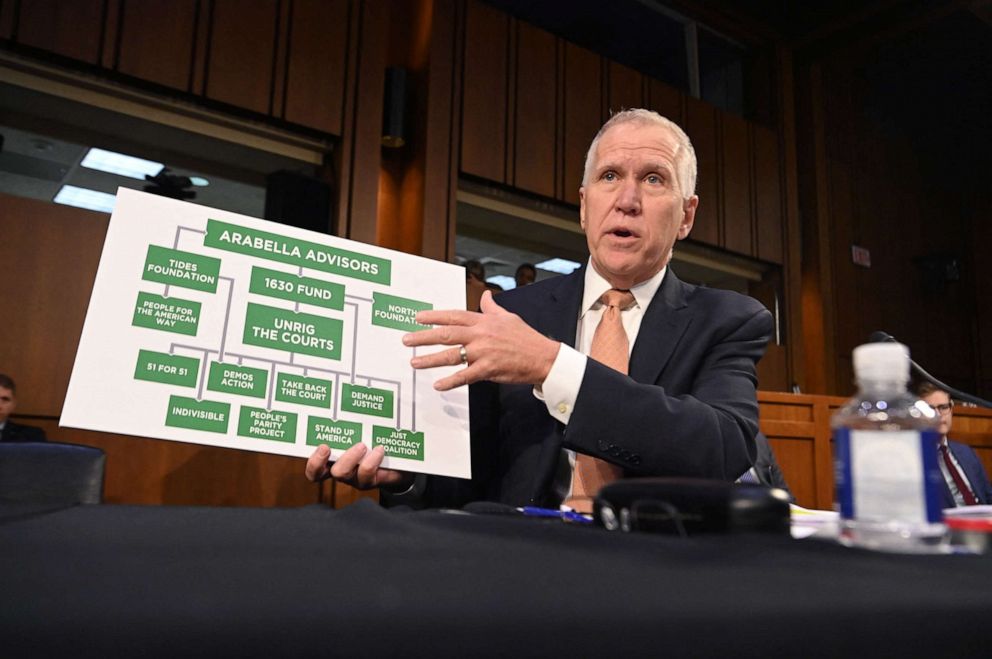
Sen. Thom Tillis, R-N.C., questioned Judge Jackson about a case when she was considering a prisoner's release due to the outbreak of the COVID-19 pandemic.

After reading a line taken out of context from an opinion where she declined the blanket release of inmates, Tillis asked Jackson if her "empathy" and "compassion" could lead her to release criminals.

PHOTO: Republican Senator Thom Tillis shows a chart during the confirmation hearing of Judge Ketanji Brown Jackson on Capitol Hill in Washington, D.C., March 23, 2022.
Republican Senator Thom Tillis shows a chart as Judge Ketanji Brown Jackson testifies on her nomination to become an Associate Justice of the Supreme Court, during the third day of a Senate Judiciary Committee confirmation hearing on Capitol Hill in Washington, D.C., March 23, 2022.
Saul Loeb/AFP via Getty Images

Jackson noted Tillis was not reading her whole statement and that she decided not to release the defendant in that case. She added that she speaks directly to defendants for public safety and accountability.

"Congress also tells us that one of the purposes of punishment is rehabilitation. My attempts to communicate directly with defendants is about public safety," she said. "It is to our entire benefit to ensure people who come out stop committing crimes."

Judge Ketanji Brown Jackson testifies on her nomination to become an Associate Justice of the U.S. Supreme Court, during the third day of a Senate Judiciary Committee confirmation hearing on Capitol Hill, in Washington, D.C., March 23, 2022.
Saul Loeb/AFP via Getty Images

"You have to go away understanding that I am imposing consequences for your decision to engage in criminal behavior," she added. "I was the one in my sentencing practices who explained those things in an interest of furthering Congress's direction that we’re supposed to be sentencing people so that they can ultimately be rehabilitated to the benefit of society as a whole."

Tillis replied that more than half of the people she sentenced have, "statistically speaking," re-offended and "were back in prison."

-ABC News' Trish Turner

Mar 23, 2022, 10:09 AM EDT

Jackson addresses ruling that 'presidents are not kings'

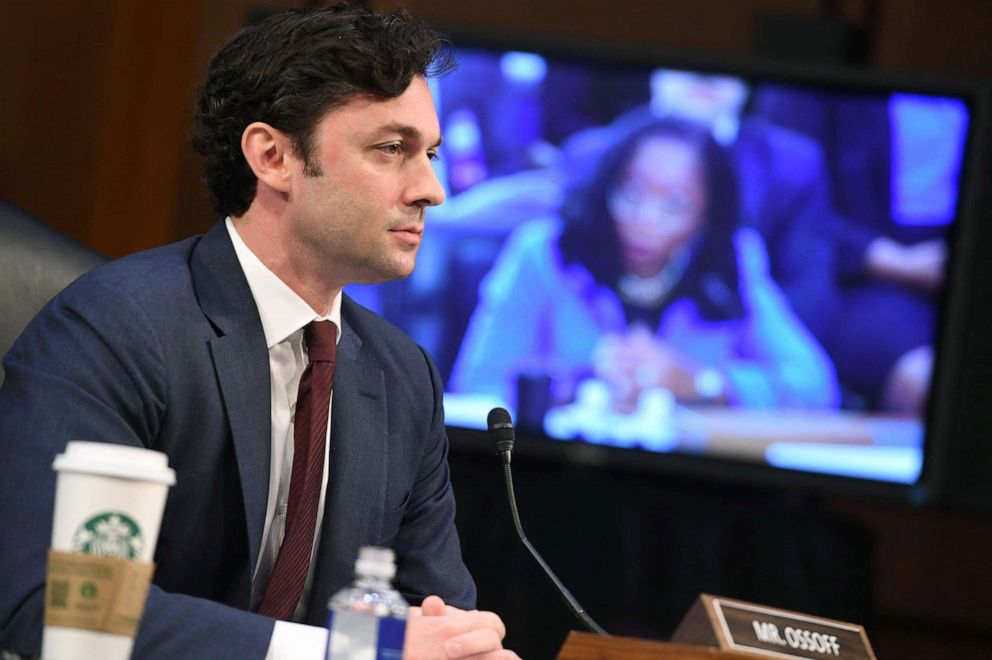
Addressing limitations on power, Sen. Jon Ossoff, D-Ga., raised a ruling by Judge Jackson for the D.C. Circuit Court in 2019, in which she determined that former Trump White House counsel Don McGahn had to comply with a congressional subpoena and wrote, "Presidents are not kings."

He asked Jackson to explain that observation and what bulwarks in the Constitution protect against abuse of executive power.

PHOTO: Senator Jon Ossoff listens to Judge Ketanji Brown Jackson during the third day of a Senate Judiciary Committee confirmation hearing on Capitol Hill in Washington, D.C., March 23, 2022.
Senator Jon Ossoff listens to Judge Ketanji Brown Jackson testify on her nomination to become an Associate Justice of the US Supreme Court, during the third day of a Senate Judiciary Committee confirmation hearing on Capitol Hill in Washington, D.C., March 23, 2022.
Saul Loeb/AFP via Getty Images

"Our constitutional scheme, the design of our government, is erected to prevent tyranny," Jackson said. "The framers decided after experiencing monarchy, tyranny, and the like, that they were going to create a government that would split the powers of a monarch in several different ways."

She walked through the separation of powers and called them both "crucial to liberty" and "consistent" with her judicial methodology.

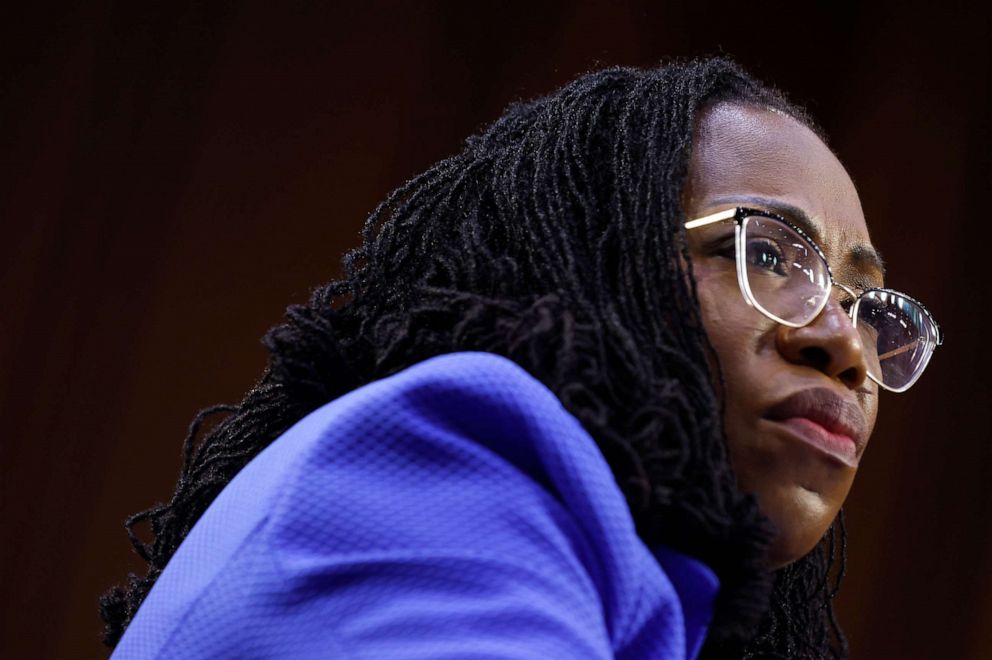
Supreme Court nominee Judge Ketanji Brown Jackson listens during her confirmation hearing before the Senate Judiciary Committee on Capitol Hill, March 23, 2022, in Washington, D.C.
Chip Somodevilla/Getty Images

"It is what our country is founded on. And it's important, as consistent with my judicial methodology, for each branch to operate within their own sphere. That means, for me, that judges can't make law. Judges shouldn't be policymakers. That's a part of our constitutional design, and it prevents our government from being too powerful and encroaching on individual liberty," she said.

Mar 23, 2022, 10:03 AM EDT

Jackson talks about family ties to public service

Sen. Jon Ossoff, D-Ga., allowed Judge Jackson the opportunity to speak again to her family’s ties to law enforcement and public service as some Republicans have attempted to paint her as "soft on crime" and taken issue with her record defending Guantanamo Bay detainees.

Jackson recalled how after her younger brother graduated from Howard University, he followed in the footsteps of her uncles and became a police officer in Baltimore. In the wake of the Sept. 11 attacks, he joined the Army and deployed twice, not as an officer, though he could have with his college degree, but on the frontlines.

"That's the kind of person my brother is. That's the kind of service that our family provides, and for me, what that meant was an understanding that to defend our country and its values, we also needed to make sure that when we responded as a country to the terrible attacks on 9/11, we were upholding our constitutional values -- that we weren't allowing the terrorists to win by changing who we are," she said.

"And so I joined with many lawyers during that time who were helping the courts figure out the limits of executive authority consistent with what the framers have told us is important, the limitations on government," Jackson continued. "I worked to protect our country. My brother worked on the front lines, and it was all because public service is important to us."

Related Topics

Sponsored Content by Taboola