Russian forces are continuing their attempted push through Ukraine from multiple directions, while Ukrainians, led by President Volodymr Zelenskyy, are putting up "stiff resistance," according to U.S. officials.
The attack began Feb. 24 as Russian President Vladimir Putin announced a "special military operation."
Russians moving from Belarus towards Ukraine's capital, Kyiv, don't appear to have advanced closer towards the city since coming within about 20 miles, although smaller advanced groups have been fighting gun battles with Ukrainian forces inside the capital since at least Friday.
Russia has been met by sanctions from the U.S., Canada and countries throughout Europe, targeting Russia's economy and Putin himself.
Here's how the news is developing. All times Eastern.
Feb 16, 2022, 9:52 PM EST
UN Security Council to discuss Minsk agreements Thursday
The United Nations Security Council will meet Thursday to discuss the Minsk agreements -- the series of agreements between Ukraine and Russia that were meant to end the Russian-led separatist conflict in eastern Ukraine.
Vassily Nebenzia, Russia's envoy to the U.N., announced the session earlier this month when Moscow took control of the rotating Security Council presidency for the month of February.
The meeting takes on greater urgency this week, especially after the lower house of Russia’s parliament, known as the Duma, voted to ask Russian President Vladimir Putin to recognize those separatists as independent republics.
Ukraine has urged the Security Council to consider the Duma motion during the meeting, Ukrainian Foreign Minister Dmytro Kuleba said on Twitter Wednesday.
-ABC News' Conor Finnegan
Feb 16, 2022, 9:04 PM EST
Harris to meet with Ukrainian president in Munich this week
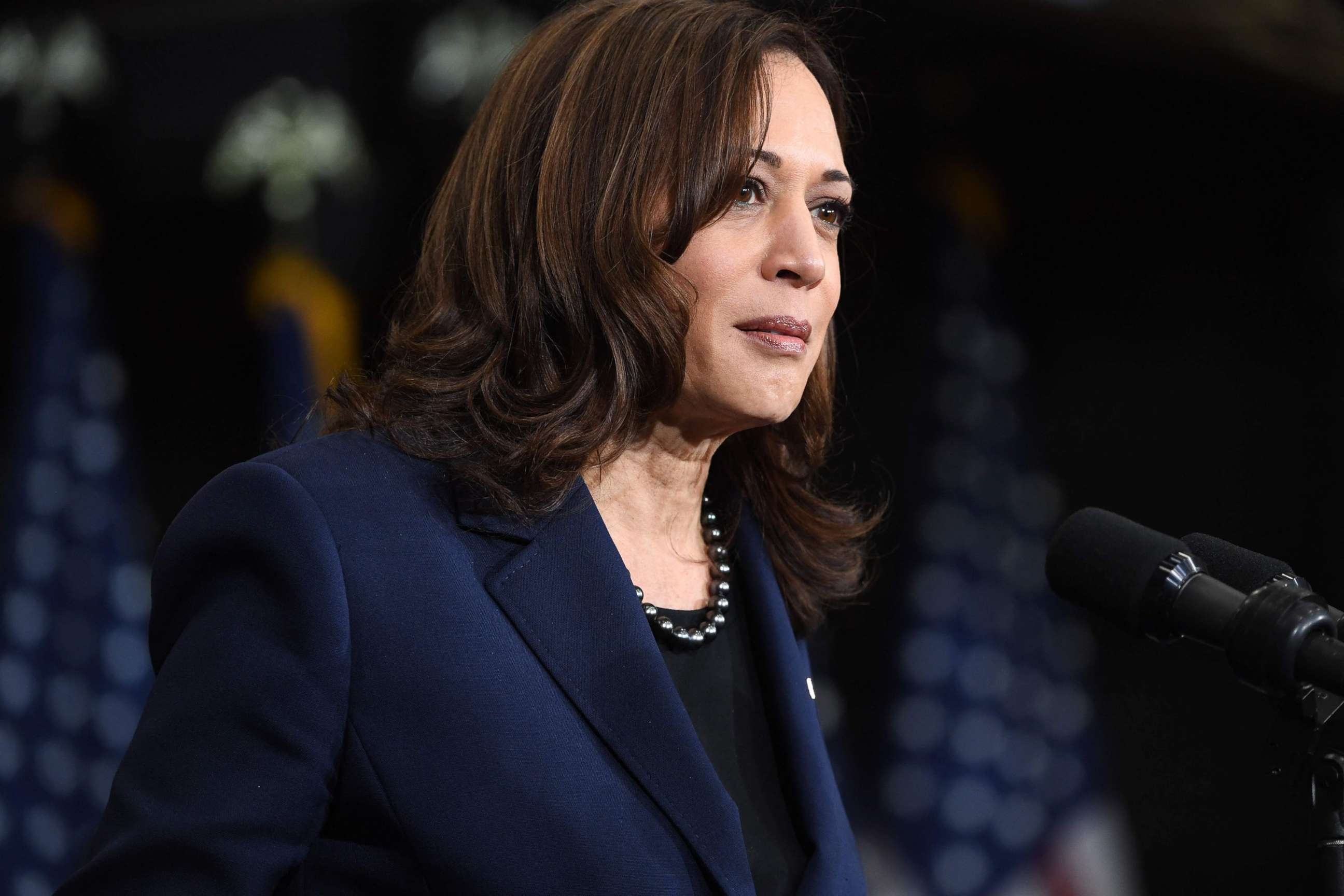
Vice President Kamala Harris this week will make one of her most significant foreign policy trips since taking office, heading to Germany to lead the U.S. delegation at the Munich Security Conference -- where she will meet with Ukrainian President Volodymyr Zelenskyy.
"We are in a very decisive moment," a senior administration official told reporters as Harris prepared to lead the U.S. delegation, calling it a "resounding signal that engagement with our allies and partners is an absolutely critical part of our overall diplomacy in our approach to this situation."
Vice President Kamala Harris speaks in Upper Marlboro, Md., Feb. 4, 2022. Harris will meet with Ukrainian President Volodymyr Zelenskyy on the sidelines of the annual Munich Security Conference this week, a senior White House official said Feb. 16, 2022.
Saul Loeb/AFP via Getty Images, FILE
During the Wednesday night call, senior administration officials said the tensions with Russia will be a major focus of the vice president's time abroad, with her schedule featuring a "series of high-stakes, high-level diplomatic talks."
Harris' most notable meeting will be with the Ukrainian president on Saturday.
"That'll be a real opportunity to underscore our commitment to Ukraine sovereignty and territorial integrity and to further coordinate the diplomatic efforts that have been underway to provide economic, and defensive security in Ukraine," an official said.
Harris is also expected to meet with NATO Secretary General Jens Stoltenberg, German Chancellor Olaf Scholz, and the leaders of Latvia, Lithuania and Estonia.
She will deliver keynote remarks at the conference, where she is expected to address the situation on Ukraine's borders -- touching on diplomatic, military and economic coordination of allies.
"The vice president will underscore how that unity is a source of strength that will allow us to respond quickly and severely to any further Russian aggression," an official said.
-ABC News' Molly Nagle
Feb 16, 2022, 7:24 PM EST
Russia has added as many as 7,000 troops in last few days, White House official says
Russia has increased its presence along the Ukrainian border by as many as 7,000 troops in the last few days, with some arriving Wednesday, a senior White House official told ABC News.
The assessment comes a day after the Russian government said it has started to withdraw some troops from near Ukraine's borders.
The official didn't comment on the total number of Russian forces currently along the border.
President Joe Biden said Tuesday that Russia has "more than 150,000 troops encircling Ukraine and Belarus and along Ukraine's border." It's unclear if that number includes any of the new troops cited by the official.
Private satellite imaging company Maxar on Wednesday released over two dozen new images from the last 48 hours that continue to show Russia's heightened military activity in Belarus, Crimea and western Russia.
They include images that show a new 20-strong attack helicopter unit deployed in Belarus, a field hospital in Belarus and a pontoon bridge that has appeared across a river in Belarus, four miles from Ukraine’s border.
At least three of the images indicate some troops have departed or are preparing to depart, according to Maxar, though it's unclear where the troops are going.
-ABC News' Mary Bruce and Patrick Reevell
Feb 16, 2022, 6:11 PM EST
Biden holds call with German Chancellor Scholz
President Joe Biden had a secure call Wednesday afternoon with German Chancellor Scholz, according to the White House, ahead of Secretary of State Antony Blinken traveling to Germany on Thursday for the Munich Security Conference.
The two leaders "reaffirmed their commitment to Ukraine’s sovereignty and territorial integrity" and "underscored the importance of continued transatlantic coordination on diplomacy and deterrence measures," the White House said.
Scholz visited the Kremlin and met with Russian President Vladimir Putin on Wednesday, after meeting with Ukrainian President Volodymyr Zelenskyy in Kyiv on Monday. The German chancellor has said that war is "unimaginable" and shouldn't be an option since Ukraine has not formally requested to join NATO, as Russia demands it be barred from doing so.
"That is why it is somewhat peculiar to observe that the Russian government is making something that is practically not on the agenda the subject of major political problems," Scholz said earlier this week.
"That is, after all, the challenge we are actually facing. That something that is not at all an issue now is being made an issue," he said.