Feb 10, 2021, 2:15 PM EST
Senate trial resumes
The Senate has returned from a roughly 15-minute break to resume opening arguments from the House impeachment managers.
Biden remembered those who were killed and called for unity going forward.
Former President Donald Trump's historic second impeachment trial ended with a 57-43 vote to acquit in the Senate. He faced a single charge of incitement of insurrection over his actions leading up to the Jan. 6 riot at the U.S. Capitol.
The Senate has returned from a roughly 15-minute break to resume opening arguments from the House impeachment managers.
As Trump faces an unprecedented second impeachment trial, here's how the impeachment process works.

Rep. Eric Swalwell, D-Calif., in helping to lay out opening arguments for House impeachment managers, said that Trump's conduct leading up to Jan. 6 was "deliberate, planned and premeditated," matching the criteria for prosecuting a violent crime.
"This was not one speech, not one tweet. It was dozens in rapid succession with the specific details," Swalwell said, displaying tweets and recordings. "In fact, when he had assembled his inflamed mob in D.C., he warned us that he knew what was coming."
"This was one of his dozens of statements on Twitter in the hours leading up to the attack, 'I hope the Democrats and even more importantly the weak and ineffective RINO section of the Republican party are looking at the thousands of people pouring into D.C. They won't stand for a landslide victory to be stolen. @Senatemajorityleader. @Johncornyn. @Senatejohnthune,'" Swawell said, appearing to look at those senators while he said their names. "He tags senators to pressure you to stop this."
"He built this mob over many months with repeated messaging until they believed that they had been robbed of their vote, and they would do anything to stop the certification," Swalwell continued. "He made them believe that their victory was stolen and incited them so he could use them to steal the election for himself."
Swalwell, attempting to appeal to Republican senators, also made a point to say Trump's actions were different than those senators in the room who raised election concerns.
A pool of reporters inside the Senate chamber observed that nearly every seat was filled when the House managers arguments began at noon and that almost every senator wore a mask. One notable absence was Sen. John Hawley, R-Mo.
Some senators, such as Sens. Ben Sasse, R-Neb., Lisa Murkowski, R-Alaska, and and Pat Toomey, R-Pa., intently took notes as the House impeachment managers made this assertions. Though reporters noted that the vast majority of senators appeared to be at least partially engaged with the content arguments from Rep. Raskin, D-Md., and Rep. Joe Neguse, D-Colo.
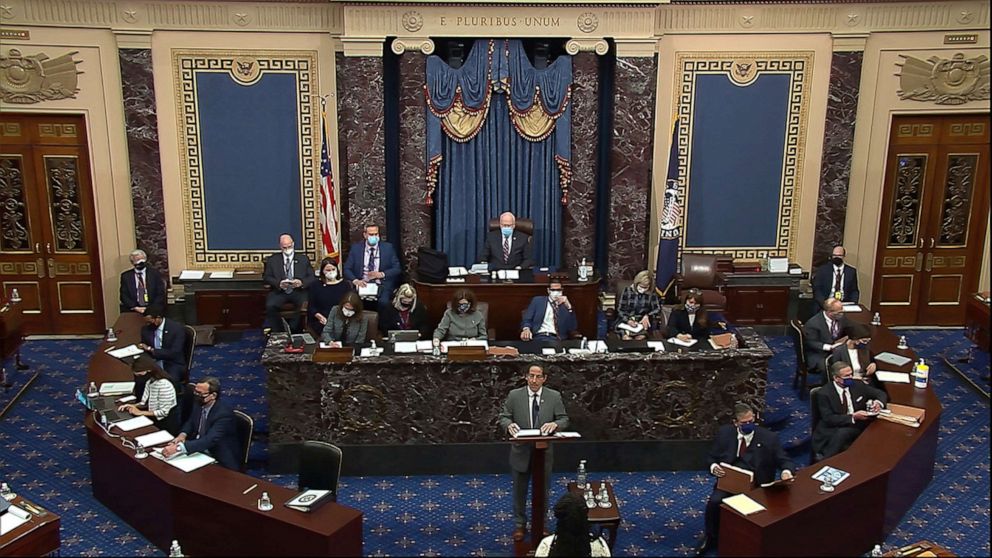
During the prayer and pledge, as Chaplain Barry Black said, “during this impeachment trial, give our lawmakers the gift of discernment so that they will know truth from falsehood,” several seats on both sides of the aisle were empty. Republicans who were there bowed their heads while standing over their desks, and Democrats, like Sens. Cory Booker, D-N.J. and Maize Hirono, D-Hawaii, were gathered in the back of the chamber.
Sen. Tammy Baldwin, D-Wis., sat on the Republican side talking to Sens. Ron Johnson, R-Wis., and Toomey before going to her seat on the other side of the aisle. After the pledge, once Rep. Jamie Raskin, D-Md., stepped up to the microphone, Democrats and Republicans filed in from the cloakrooms -- some of them still chewing underneath their masks.
Some Republicans came in late, like Sens. Ted Cruz, R-Texas, Roy Blunt, R-Mo., Susan Collins, R-Maine, and James Risch, R-Idaho. Hawley, when he came in alone, watched from the gallery above. He was seen flipping through manila folders and -- at one point -- put his feet up on the desk. He rarely looked at the arguments on the Senate floor.
Senate Minority Leader Mitch McConnell sat with his hands folded in front of him.
When House managers used video exhibits, reporters noted that many GOP senators took notice. During some videos, they described every GOP senator turning and watching the exhibit or reading the exhibits for an extended period of time.
-ABC News' Katherine Faulders