Sen. Reed on Trump’s Iran strategy: ‘I don’t believe the president has a plan’
Top Democrat says Trump is "ignoring the law" on War Powers Resolution.
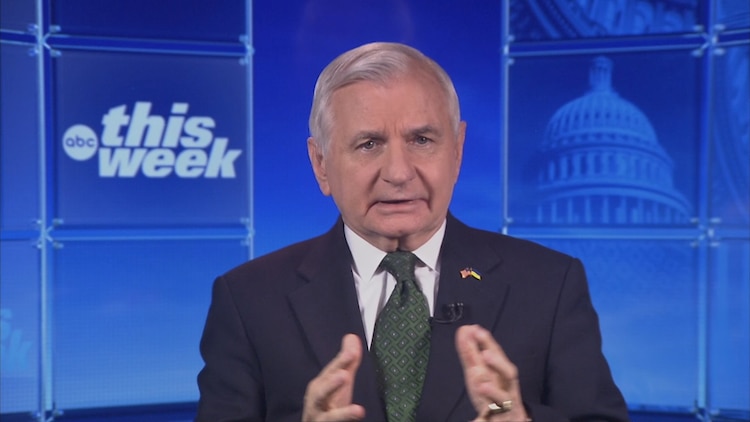
Sen. Jack Reed, the ranking Democrat on the Senate Armed Services Committee, said Sunday he believes the U.S. is in a "much worse position" with Iran since the war started, and that he doesn't believe President Donald Trump has a plan to achieve his stated objectives.
"We're in, in many respects, a much worse position," Reed told ABC News' "This Week" co-anchor Martha Raddatz. "The regime in Tehran is probably more hostile and fanatical than the one that we replaced ... We have not yet resolved the issue of nuclear material in Iran. So this has been a tactical demonstration of prowess, but has not achieved the strategic goal that the president announced, and he seems not to have a plan to achieve those goals."
The U.S. war with Iran has now spanned 10 weeks, and while a ceasefire is ongoing, the two countries have been at a stalemate after peace talks failed April 12. The critical Strait of Hormuz remains closed, sending oil prices skyrocketing globally.
The Trump administration has consistently said that preventing Iran from obtaining a nuclear weapon was a primary objective for going to war. Iran has maintained that they are not seeking nuclear weapons.
Asked by Raddatz about remarks from Reed's colleague Sen. Richard Blumenthal, D-Conn., speculating that there could be additional strikes on Iran, Reed said that it is possible, but that he does not know what the president might do next.
"I do have the impression from some of the briefings that I have received, as well as other sources, that an imminent military strike is very much on the table, which is deeply disturbing because it could well involve American sons and daughters in harm's way and potential massive casualties," Blumenthal said on CNN Thursday.
"Well, they are certainly positioned for strikes. That's what a military force has to be," Reed said. "I don't believe the President has a plan. I think it's impulsive. It's day to day. It's how [Trump] feels, and he's not being given I think the support and the planning that is necessary to make judicious judgments."

Reed sparred with Defense Secretary Pete Hegseth in an Armed Services Committee hearing last week, accusing the secretary of "dangerously" exaggerating the military successes of the war.
"The problem with your statements, Mr. Secretary, is they are dangerously exaggerated," Reed said in his opening statement at the hearing. "Iran's hardline regime remains in place, it still retains stockpiles of enriched uranium, and its nuclear program remains viable."
Hegseth was asked if the president would ask Congress for authorization to continue the war -- under the War Powers Resolution, presidents must ask Congress for authorization to continue a military operation after 60 days.
That 60-day deadline passed on Friday, but Hegseth argued in the hearing that the clock paused once Trump declared a ceasefire. Trump sent a letter to Congress Friday affirming that argument, saying "hostilities that began on February 28th, 2026, have terminated."
Reed disagreed with that assertion Sunday.
"The language of the statutes does not provide for timeouts, like in a football game," Reed said. "There can be a 30-day extension to 90 days, but that has to be requested by the president. We have to be notified. No such notifications have come through. The president's ignoring the law."

Popular Reads

ABC News Live