Transportation Secretary Duffy says ATC router's ability to broadcast data turned off, being investigated
Duffy said the router at issue is being examined at a lab in Florida.
Transportation Secretary Sean Duffy said Sunday that air traffic control router's ability to broadcast data has been turned off as officials continue to investigate the router communication issue that prompted a nationwide ground stop Friday.
"We have that router in the L3 Harris lab down in Florida," Duffy told co-anchor Martha Raddatz on ABC's "This Week" Sunday, referring to the specific router in Arkansas that officials believe caused instability in the air traffic communication system Friday afternoon. L3 Harris is a government contractor that provides technology and IT support for the Federal Aviation Administration (FAA).
"Our FAA team is on site as well. We've been partnering with the FBI and other law enforcement. We're going to take a look at what happened there," he continued. "But what we've now done, we have 69 of these routers in the national airspace. We've stopped their ability to broadcast, and it was this router was broadcasting data from this this radio facility into the whole network. Once we shut the shut the ability to broadcast down on the routers, the issue is resolved. So we're going to take a hard look at it."
Duffy explained that work was being done to replace outdated copper wire with fiber cables in El Dorado, Arkansas. When the router in that area was turned on, "we saw that in Amarillo, Texas, a system we had replaced about three weeks earlier, that started to flood our system as well."
"So we're looking at those two issues and trying to find the root cause of what happened," Duffy said.
In a post on social media, Duffy said that the router from Texas was also being investigated at the Florida lab.
"If we see these inconsistencies in the network, whether it's communication with air traffic controllers and pilots or with data feeds, we're going to keep you safe," Duffy said. "We did the ground stop. We were able to isolate the issue, shut it down. Our network came back online, and from there we opened up the airspace thereafter."
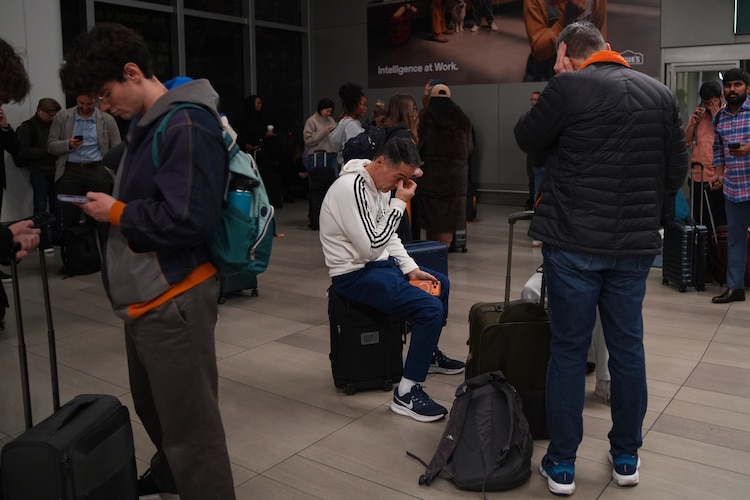
At 3:54 p.m. Friday, the FAA declared a rare, nationwide ground stop, bringing air travel to a halt. While planes already in the air were able to continue flying, for more than four hours, millions of travelers awaited news about when or if their scheduled flight would be able to take off.
Shortly after the ground stop was lifted at 8:15 p.m. Friday, Duffy briefed reporters, along with Department of Homeland Security Secretary Markwayne Mullin. Duffy said then that the nation’s aging air traffic control system routers were “overloaded with data,” causing “inconsistency in the data” that prompted officials to “shut the system down.” He called for Congress to appropriate tens of billions of dollars more to cover the cost to completely overhaul and modernize the ATC system.
Saturday morning, Duffy updated reporters again alongside FAA Administrator Bryan Bedford. The transportation secretary said officials believed that “routine maintenance” being done by government contractor L3 Harris in a “remote” location prompted the communication breakdown.
“What we're working to determine was whether we had incompetence, meaning was it user error or installer error from L3 Harris, or did they install a faulty router? We haven't determined what the fault was,” Duffy said Saturday. “That router that was being replaced as we switched from copper to fiber, it started flooding other routers in our air traffic control system. … What that did was gave us issues with our, our communication with airplanes, and it also caused some disruption with our radar feeds.”
In a statement, L3 Harris said it was “supporting the FAA in its investigation to understand” what happened Friday.

“L3Harris takes the nationwide ground stop and its impact on travelers, airlines and air traffic operations seriously,” the statement read.


Duffy reiterated on Sunday that officials do not see evidence that the router issues were caused by a cyberattack, but added "if the FBI comes in and says, 'No, we found something,' obviously we'll share that with the American people, but we have no indication that this was a hack."
Duffy also said officials "don't think that someone tried to sabotage the network on the install at all. But we don’t actually have the root cause, which is why we do the investigation."
Duffy again made the case for Congress to appropriate more funding to overhaul the nation's aging air traffic control system.
"What I'm doing is saying, hey, Congress, this is old. There's issues with how it operates. Let's build a brand-new system," he told Martha Raddatz, adding that "this will be the one great bipartisan bill that can pass in an era of great partisanship."
He added that telecom companies AT&T, Verizon and Lumens are "ready to start working tomorrow" on new air traffic control architecture.
"All we need is the money to say, go build a new network. That would be done by the end of 2028 or possibly the first quarter of 2029," Duffy said.
The secretary also said that while Congress appropriated $12.5 billion to the FAA in the "One Big Beautiful Bill" signed into law last year, it cannot be used to address telecom architecture.
"They gave me money for tower -- for radios, money for radar, money for systems. But I don't have any money in that $12.5 billion for a new architecture for telecom. I don't have any money given by Congress to build a new software system to manage the airspace. They’re very specific on how we spend the 12.5 and none of the money goes to this telecom that I have to build. So, they need to give me additional money to finish that project," Duffy said.
Democrats, however, are skeptical of the funding request.
"Congress approved $12.5 billion for the Department of Transportation to make necessary safety upgrades to our air traffic control system. Fifteen months later, the administration’s obligated $4.3 billion but only spent $1 billion, leaving $8 billion unobligated and $11 billion unspent. Explain to Congress, again, why they need more money?" Rep. Rick Larsen (D-Wash.), ranking member of the House Committee on Transportation and Infrastructure, and Rep. André Carson, D-Ind., ranking member of the House Subcommittee on Aviation, said in a statement Saturday.
Related Topics

Popular Reads

ABC News Live