'This Week' Transcript 8-16-26: Former Joint Chiefs of Staff Chair Adm. Mike Mullen, Sen. Ruben Gallego, Sen. Bill Cassidy & the Generational Divide in the Democratic Party
This is a rush transcript of "This Week" airing Sunday, August 16.
A rush transcript of "This Week with George Stephanopoulos" airing on Sunday, August 16, 2026 on ABC News is below. This copy may not be in its final form, may be updated and may contain minor transcription errors. For previous show transcripts, visit the "This Week" transcript archive.
(COMMERCIAL BREAK)
MARTHA RADDATZ, ABC “THIS WEEK” CO-ANCHOR: A record-breaking deployment draws concerns about the conditions aboard the USS Lincoln. “THIS WEEK” starts right now.
(BEGIN VIDEO CLIP)
RADDATZ: Lengthy deployment.
REPORTER: Have the deployments gone on too long? Are you worried about the mental health concerns?
DONALD TRUMP, PRESIDENT OF THE UNITED STATES: No. No. Not nearly long enough.
RADDATZ: Military families raise alarms over the well-being of sailors on a Navy ship that has been at sea for nearly nine months. This morning we speak with former Joint Chiefs Chairman Admiral Mike Mullen and Arizona senator and veteran Ruben Gallego.
Surprise upset.
DAVID CROWLEY, (D) WISCONSIN GUBERNATORIAL CANDIDATE: So, today, today begins a new chapter.
RADDATZ: As the moderate and progressive Democrats fight for generational change.
UNIDENTIFIED MALE: You know, I think these are not meant to be lifetime jobs.
RADDATZ: So, you don’t -- you don’t think age is an issue at all?
UNIDENTIFIED MALE: It’s about what you fight for.
RADDATZ: We’re on the ground across New England, with just 79 days until the midterms.
Vaccine controversy. Fierce pushback against President Trump’s changes to the childhood vaccine schedule.
SEN. BILL CASSIDY, (R) LOUISIANA: We should leave vaccination policy to the people who know how a disease spreads.
RADDATZ: Republican Senator Dr. Bill Cassidy joins on the potential impact.
(END VIDEO CLIP)
ANNOUNCER: From ABC NEWS it’s “THIS WEEK”. Here now, Martha Raddatz.
RADDATZ: Good morning and welcome to “THIS WEEK.”
Not long enough. That is what President Trump said about the record-breaking deployment of the USS Lincoln aircraft carrier and the 5,000 sailors and Marines aboard after mounting reports this week of plummeting morale and mental health concerns aboard the ship. That carrier has been among the many Navy assets now in the Mideast fighting the president’s war in Iran and taking part in the blockade of the Strait of Hormuz. The president also told Americans this week that paying a little bit more for gas prices to prevent Iran from getting a nuclear weapon is OK, and he would never apologize.
Those comments have already been seized upon by Democrats as we approach the midterms, just 79 days away. But Democrats are facing their own problems in the midterms. There’s a showdown between the progressives and moderates and renewed calls for generational change. We will get into that later in the broadcast. But we begin with the conditions on that ship and word overnight of a visit from CENTCOM’s commander.
(BEGIN VIDEOTAPE)
RADDATZ (voice over): There have been thousands of combat missions for the 5,000 sailors and Marines aboard the USS Lincoln during its staggering 268 days at sea. Overnight, U.S. Central Command posting this video of CENTCOM commander, Admiral Brad Cooper, visiting sailors aboard the Lincoln after reports of deteriorating conditions, including extreme exhaustion, cratering morale and growing mental health concerns.
The deployment, primarily in the Middle East, includes a record length of consecutive days without a port call. More than 200.
AIRMAN RANDALL STONE, U.S. NAVY: I haven’t stepped off the ship in the year 2026. I haven’t been off the -- I haven’t been off the ship. I haven’t touched land.
RADDATZ (voice over): Sailors aboard the ship detailing the strain of the extensive and uncertain time at sea to CNN.
LT. CMDR. JOE CAPSTAFF, U.S. NAVY: It’s tough. So, I had my first kid born in February. So, very excited to get home and meet her.
RADDATZ (voice over): A U.S. official telling ABC News, one sailor went overboard the ship earlier this month, but was quickly recovered. That incident, now under investigation.
Defense Secretary Hegseth saying the reports of poor conditions have been completely misrepresented. And Admiral Cooper, addressing service members on board, calling them “a strong team of high-achieving Americans standing tall with immense justified pride in everything they accomplished.”
But Democrats, like Senator Richard Blumenthal, writing to Secretary Hegseth and Acting Navy Secretary Hung Cao, demanding answers about the conditions. Cao responding to the week’s report saying that “the Lincoln was extended because the mission demanded it,” saying, “war is hell,” adding, “there is no question our young men and women have been pushed to their limits, but they have never broken.” Cao also said that “a small number of mental health cases were treated with no loss of life>”
And with another carrier on its way now to replace the Lincoln over the next few weeks, President Trump downplaying the concerns.
REPORTER: Family members of U.S. service members are concerned about the conditions onboard the USS Lincoln.
DONALD TRUMP, PRESIDENT OF THE UNITED STATES: Well, no, that ship is moving. No, they’re not. That ship is moving right now, or very shortly, and it’s being replaced with another very similar ship.
REPORTER: Have the deployments gone on too long.
TRUMP: No, no, no.
REPORTER: Reports of mental health --
TRUMP: Not nearly long enough.
(END VIDEOTAPE)
RADDATZ: And I'm joined now by the former chairman of the Joint Chiefs of Staff, Admiral Mike Mullen.
Good to see you, Admiral Mullen.
Just your reaction to what you've seen and the deployment, 200 days without a port call?
ADM. MIKE MULLEN, FORMER JOINT CHIEFS OF STAFF CHAIR & U.S. NAVY (RET.): Well, it's significant, and it's tough. Those deployments are very, very difficult. Historically, we've been able to typically go to a -- go to a port to take a break, do maintenance, and then come back online. Even back in Vietnam, a timeframe we did that.
The problem right now is in the AOR, the places we would do that --
RADDATZ: The theater.
MULLEN: Bahrain, in the theater, Bahrain or in the United Arab Emirates, those are -- those are targeted right now. In fact, we've, because of that, established a base down in Diego Garcia. But even Diego Garcia, you know, the Iranians have taken a shot at. So, the security and that -- the safety and security, obviously, of these assets is hugely concerning. So, there just isn't an easy place to go in terms of a port visit.
RADDATZ: You told me you were a bit appalled by -- by this.
MULLEN: Well, I was certainly -- from what I could see in the -- in the news reports, that the conditions on the ship were certainly of great concern. Now I know the commanding officer, in particular the commanding officer of the Lincoln is working these issues hard. And I also believe the truth probably lies somewhere in the middle.
Some of these problems, I was connected with Admiral Cooper last night, who was -- who was on the ship yesterday, and he told me he had a really good visit. He said many of these problems were early in the deployment and they were solved. But those -- these are morale issues on a ship, which you really have to focus on. And they have been pressed in combat -- the number of missions, the accomplishments. Cooper talked about how significant they have been in the war itself.
And my experiences, these crews will do absolutely everything to make sure the mission goes well. And they clearly have done that on Lincoln.
RADDATZ: And we know that, and we know they're pressed, and Admiral Cooper, we did see fly out there to check on things. He sounds like he has confirmed that there were some problems. If they were problems that were solved, what does that say about the planning to begin with that they happened at any time during that deployment (ph)?
MULLEN: Well, I think we clearly didn't expect the -- our allies’ bases where we have had people before to be wiped out --
RADDATZ: By the Iranians because of the war?
MULLEN: By the Iranians. And that happened in Bahrain and Kuwait and in the UAE.
And so those places where we normally would go for some rest and relaxation, they just -- they weren't usable. So, the planning with respect to that, I think you had to adjust on the fly, and it became very, very difficult to find a place to do that. So, basically, you end up staying at sea.
And Lincoln, while certainly very much in the headlines now, she is not the first carrier in a long deployment. There have been almost no carriers in recent years that have gotten back home on time.
One of the positives of Cooper's visit yesterday is he announced to the crew that they're going home. And I can tell you, the uplift in morale when you have that, even if they don't have an exact date, you know you've got a relief, the George Washington is coming from the Pacific, and so the morale is up significantly from where it was just a few days ago.
And I just can't emphasize enough how well this group has performed. And when you're at war, you -- there's always adjustments. There’s -- you've got to be flexible and adaptable. Things change.
So, could you plan for this? That would have been pretty difficult to predict.
RADDATZ: OK. And I want to say that like Bradley Cooper, I'm sure, Admiral Cooper, raised morale, but let me repeat what President Trump said when asked about the deployment, whether it had gone on too long and about the mental health. He said, “No, no, no,” adding that it has not been nearly enough.
What do you think of that?
MULLEN: Well, we -- I mean, we focused on mental health. I mean, for the last 20, 25 years coming through the wars in Iraq and Afghanistan and all the services have done that. And there are always challenges with that. Even in some of the most benign environments. So, I'm sure that the chain of command has addressed that issue.
RADDATZ: How about the president's statement, however?
MULLEN: The deployments -- we learned in Vietnam, we deployed for a year at a time there. That's just too long. You wear yourself out. You actually start to cash in future readiness significantly.
These ships, these people, these families, you know, need to basically come back, figure out how to get ready for the next post, but it takes time to do that.
And in particular with the carriers, I mean, we've only got 11 of them. I was involved in a debate with Rumsfeld back in the early 2000s who moved us down from 12 to 11. We actually need more, I think, in the current environment if we're going to deploy them like this.
So there's a sacrifice of the future, which we're eating now as well, particularly with the capability that we've got.
RADDATZ: I know one thing, I just want to go back to the extension a little bit. A retired general I spoke to last night was reminding me in Iraq when they extended these time periods. He said it practically broke the force.
MULLEN: Yeah, I -- I mean, I've been around the Navy my whole life and we’ve had -- been on an extended deployment. I don't think that this will do that for the Navy. I get the concern, although I think the word now that they have a relief and that they're going to come home is going to, you know, relieve that.
I think people deploying on aircraft carriers even with a set date when they start, because none of them have come home on time, have an expectation that just may not happen.
And the other thing that's so important here is -- are the families. We work hard to take care of them. Obviously, they're concerned. They, too, obvious -- their morale, I think, will go up significantly now that they know they're coming home.
RADDATZ: I'm sure it will. Thanks for joining us this morning, Admiral.
MULLEN: Okay, Martha.
RADDATZ: And I'm joined now by Arizona Democratic Senator Ruben Gallego, who also served in the Marine Corps in Iraq.
It's good to see you this morning, Senator. You listened there to Admiral Mullen.
SEN. RUBEN GALLEGO, (D) ARIZONA & VETERANS AFFAIRS COMMITTEE: Thank you.
RADDATZ: He was told by Bradley Cooper, Admiral Bradley Cooper, that they have solved or resolved these problems.
Now, what's your reaction?
GALLEGO: Well, I'm glad they're resolving their problems now, but where was the leadership for so long that it got to this point? And I think later on, he says, like, this is a problem of a long ago. I was just speaking to a spouse just about three days ago, and this is the current problems right now.
And then it really goes to the deep, deep, deep problem here is that this administration did not plan for this war. They did not plan how to get out of this war, did not really understand how this war was going to escalate. They were basically trying and hoping that this war would end up just like the war in Venezuela. And our men and women are now suffering the consequences of that.
There's a deep, deep, deep mistrust of this leadership. The secretary of defense is absolutely not qualified to be leading the Department of Defense. And certainly, the president has shown that he just doesn't really care about the troops.
His lack of -- lackadaisical attitude about men and women and their deployments, you know, just kind of reflects what he actually thinks about them. He thinks about them more as toys and as ways to basically show off or show its strength, but not the fact that they truly, at the end of the day, are humans. They're Americans. And they have families, and these things, these deployments, these wars have consequences.
RADDATZ: Are you hearing -- you said you've talked to a spouse, and I know that, and she have told you a lot about what's happening on that ship or what was happening on that ship. You say that was current. It wasn't resolved.
GALLEGO: Correct. And as of three days ago, she was sharing with me text messages that her husband was forwarding to her, as well as pictures. So, whatever the admiral was saying that this is a problem of the past, that's really not the case.
Now, there is a problem also with the future. You know, right now, the aircraft carrier is going to undergo a lot of maintenance. You're going to have problems with retention once people get back and families start meeting again, they're going to say, do I want to stay in the Navy?
You're going to have some of the most experienced men and women. They're going to take a lot of their technical skills and walk away because they don't want to serve in a U.S. Navy that treats them in such manner, that makes fun of them.
You have some of the cabinet members, as well as acting cabinet members in the Navy and things of that nature, they are basically downplaying their sacrifice. So when they get back to home and they start having that conversation with their wife or with their husband, is it worth rejoining? They're going to have to think twice because look at how this leadership is treating them.
And that again is a lack of -- a true lack of leadership from secretary of defense as well as the president, and just an attitude that kind of pervades the whole Department of Defense where they just look at these men and women as being expendable.
RADDATZ: I know you are hearing things from sailors, Marines, Army. Is this something you're actually hearing about, Pete Hegseth, about the president? Because we see him visiting the troops, and he's warmly welcomed.
GALLEGO: Well, because troops will always be professional. That is, you know, one of the best things, whether you're an officer or you're down to a private that just joined. They're absolutely always going to be professional, and they're also going to be quite afraid.
This is an administration that is very vindictive. They've been firing some of the best and brightest generals just because they won't, you know, align with the oath or vision of this -- of this president instead of actually being there to defend the Constitution of the United States, which should be their only goal.
So, it does not surprise me that they’ll have, you know, this show of support. But we have heard this for quite a while of men and women feeling like this Department of Defense has been politicized, that is make -- that the Department of Defense is making decisions about, you know, who’s going to get promoted depending on your loyalty to the president or to the secretary of defense.
We’ve seen -- and just in general, we’ve seen their lack of planning. This Iran war is now going on for almost six months now. We have men and women that have been killed because the Department of Defense did not plan proper defense of bunkers and different installations. You have deployments, such as the aircraft carrier right now that has gone longer than is normal. And again, didn’t have any backup plans when two of our supply depots were hit.
So, there is a lot, a lot of fear that this administration and the secretary of defense are way over their head and they’re just using these men and women for their political aims.
RADDATZ: Senator, in light of your outrage, and other Democrats, “The Wall Street Journal” editorial board wrote this while acknowledging the sacrifice of the sailors, saying, “if Democrats are so concerned, perhaps they could expedite passage of the $17 billion for U.S. military operational costs that the administration requested? Democrats have been refusing to pass a special appropriation for Iran lest anyone think they support the commander in chief.”
Your response?
GALLEGO: Well, we are more focused on making sure that we are supporting the American warfighter and trying to, you know, get us out of this war. The president again planned nothing, did not expand the full extent of the war, how this will go, how will it end. What is our mission? We still don’t quite understand why we went to Iran. We don’t know exactly how we’re going to get out of Iran. So, for us to actually give more money to something like this is extremely dangerous. It’s like giving a drunk more money and hoping that they’ll stop drinking.
And so, I appreciate “The Wall Street Journal’s” opinion, but, you know, the first thing that we have to understand is, what is the president’s goal in how he’s going to get us out of Iran before we start getting more and more money because, at the end of the day, we’re going to end up going down this rabbit hole, which I saw as a, you know, as a Marine from the Iraq War, where we kept on hoping that the next corner we’d turn would actually bring success and end up, you know, winning the war, whether it’s Afghanistan or Iraq. Instead, we just kept on funding every, every year and hoping that something would happen.
I’ve seen that mistake. I don’t want to find ourselves in another 20-year war because we’re afraid to actually put a stop to the money that is essentially funding this illegal war. And so the president needs to actually tell us what is the end goal here? How are we going to get out of this quagmire? What is actually the mission? Because so far the mission has changed and the objective has changed so many times. And then we could potentially talk about the funding.
RADDATZ: OK. Thanks very much for joining us this morning, Senator. We appreciate your time.
Up next, we travel to New England, where a generational divide is playing out in several Democratic primaries. Our report on what it could mean for the midterms, when we come back.
(COMMERCIAL BREAK)
(BEGIN VIDEO CLIP)
DONALD TRUMP, PRESIDENT OF THE UNITED STATES: For you to pay a tiny little bit more for your gasoline. Just remember you're doing it so that a very evil country cannot have a nuclear weapon. So remember that, when you have to pay a little bit more, your $4, it's OK. I mean, it's -- I'm not -- I'm not -- I'll never apologize.
(END VIDEO CLIP)
RADDATZ: President Trump speaking about gas prices with just 79 days until the midterms. Dissatisfaction with the economy is one reason Democrats are bullish on their chances to take back control of Congress. But the party itself is in a fight for its future. The moderate and progressive wings each scoring wins at the ballot box this week. But another divide was on full display as well.
This week we traveled to New England days ahead of a key primary, where a senator who has been in politics since the 1970s is in a tight battle to keep his seat.
(BEGIN VIDEOTAPE)
RADDATZ (voice-over): The fight for the future of the Democratic Party was on overdrive this week, a week that ended with a rather muddled message -- moderates scoring a big win in Wisconsin.
DAVID CROWLEY (D), WISCONSIN GUBERNATORIAL CANDIDATE: Together, we will build the broad coalition that this moment absolutely demands.
RADDATZ (voice-over): David Crowley defeating the fiery frontrunner in the polls, Democratic socialist Francesca Hong in the gubernatorial primary, a major upset in the high stakes battleground test for progressives. But in Minnesota --
LT. GOV. PEGGY FLANAGAN (D), MINNESOTA SENATE CANDIDATE: This campaign was about the many versus the money.
(CHEERS)
RADDATZ (voice-over): It was the progressive Lieutenant Governor Peggy Flanagan who carried the day, beating moderate Congresswoman Angie Craig in the primary battle to replace retiring Senator Tina Smith. And for the Democrats, it isn't just a battle of progressives versus moderates, it is a call for a new generation.
LUKE BRONIN (D), CONNECTICUT CONGRESSIONAL CANDIDATE: I think these are not meant to be lifetime jobs.
RADDATZ (voice-over): Here in New England this week, the 47-year-old former Hartford mayor, Luke Bronin, crushed the 78-year-old, 14-term Congressman John Larson by some 20 points to represent Connecticut's First District.
BRONIN: We would just be a healthier party if we had more leaders that recognize that part of leadership is knowing when it's time to pass the torch, and that you need that renewal.
RADDATZ: When you say people and leaders should know when to pass this torch, when should they know? What is that point?
BRONIN: Look, I think what we showed in this campaign is that if that change doesn't come from the top down, it's going to come from the ground up.
RADDATZ (voice-over): Larson is now the seventh House Democrat to be ousted in a primary this year. Bronin's win in Connecticut and his rallying cry is reverberating in neighboring Massachusetts.
REP. SETH MOULTON (D-MA): We need new leaders.
RADDATZ (voice-over): While many incumbent Democrats have faced younger challenges from the left, this race is different. Congressman Seth Moulton is trying to beat a progressive movement titan in the Senate.
I couldn't help watching you out there and thinking you still have kind of that sparkle in your eye for these things. You love this job.
SEN. ED MARKEY (D-MA): It's an honor. It's a dream come true.
RADDATZ (voice-over): Eighty-year-old Senator Ed Markey has served in public office since 1973 and was first elected to Congress 50 years ago this November.
MARKEY: We're going to win the House. We're going to win the Senate.
RADDATZ (voice-over): We met up with Markey at a campaign stop with local business leaders in Worcester ahead of the September 1st primary, where he would rather talk policy than age.
You came in, hard-charging young guy, they said another. Mr. Smith comes to Washington. Is there any part of you that understands kind of that chorus that some people are singing across the country when they're running for office, that it's time for a generational change?
MARKEY: I don't think people think generational change is giving Donald Trump a $1 trillion budget to fight a war on Iran. I don't think it's generational change to be opposed to Medicare for All. That's not generational change. It's how you are going to fight for ordinary families and what they're going to need in order to get the protections and the opportunities which our country presents for everyone. And there's a big difference between Seth Moulton and me.
RADDATZ (voice-over): Markey successfully fended off a challenge from young Joe Kennedy in 2020, and this time around, a University of New Hampshire poll conducted in June found Markey leading Moulton by six points among likely primary voters, although Moulton has seen momentum in the polls.
And, Senator, your opponent, obviously you've heard this again and again, is making age a real point in this campaign. Why do you think you could serve until you're 86 years old?
MARKEY: Well, this is the most energized that I've ever been. And there's a lot of work to be done. And that is what energizes me every single day. That's what gets me up and fighting.
RADDATZ (voice-over): And Markey says he will know if it is time to stop.
MARKEY: If someone can't do the job, they should step down. And that's regardless of your age.
And that's what I'm going to do. I'm going to continue to fight and fight and fight for the people. If I couldn't do the job, I would step down. But there's no indication that that is the case.
RADDATZ (voice-over): Up here on the North Shore, where Seth Moulton's district is in Salem, Massachusetts, he is absolutely convinced that the generational change will resonate with voters.
(CHEERING)
RADDATZ (voice-over): Just outside his campaign headquarters, the congressman rallying staffers and volunteers in his bid to become a senator.
REP. SETH MOULTON, (D) MASSACHUSETTS SENATE CANDIDATE: There are a lot of eyes on us to make this happen.
RADDATZ (voice-over): The congressman and his team working the phones.
MOULTON: Hi, Bridget. It's Seth Moulton calling. I'm running for Senate.
UNIDENTIFIED FEMALE: And if you have any questions about Seth's positions on the issues, or you want to give him some feedback, please give me a call.
MOULTON: I hope to earn your support on September 1st.
RADDATZ (voice-over): The 47-year-old congressman and combat veteran says his call for new leadership is resonating in this political moment.
MOULTON: The overriding message is that the Democratic Party needs to change, that the establishment in Washington is not getting it done.
RADDATZ: I talked to Senator Markey as well. He said generational change is about getting stuff done for Massachusetts voters. It's not age. It's not generational change.
MOULTON: One out of three residents of Massachusetts thought about leaving the state last year because costs are too high. Housing costs are skyrocketing. Electricity bills are twice the national average. I mean, if you think that's getting things done, then vote for the status quo.

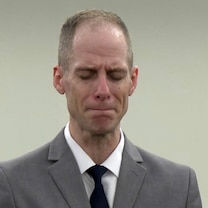

But what I hear from residents across this commonwealth is that we need to do better.
Senator Markey's been elected longer than I've been alive, so he's had a lot of time to shake hands and meet voters. But as they get to know me throughout this campaign, they're ready for change. They're ready for a new generation of leaders. And that's what this election is ultimately all about.
(END VIDEOTAPE)
RADDATZ: So let's talk about that with our roundtable.
Former DNC chair Donna Brazile; our Capitol Hill correspondent, Jay O'Brien; “USA Today” Washington bureau chief Susan Page; and “National Review” editor, Ramesh Ponnuru.
Good to see all of you.
Donna, I want to take it right to you. You heard Seth Moulton say that the country is ready for a new generation of leaders. That is what this election is all about -- is it?
DONNA BRAZILE, FORMER DNC CHAIR & ABC NEWS CONTRIBUTOR: Absolutely. It's about a new generational -- a generational shift within the Democratic Party. I think a generational shift across the country.
But also, I think Democrats want change. They are demanding that we elect people who can fight for them, not fight for themselves.
But there's something about Ed Markey that I would not dismiss. Ed Markey has a brand. He's a populist. He's a progressive.
That's the reason why Bernie Sanders, Elizabeth Warren, Ayanna Pressley, who's a famous member of the squad, that's why they've rallied behind him.
He's someone who has delivered for the people of Massachusetts. And he's someone who's still fighting the cause of justice.
RADDATZ: And, Jay, age is -- is on the front page there. Just in this Congress, you've had five House members and one senator die. Senator Mitch McConnell, you haven't seen him on the Hill since June.
JAY O’BRIEN, ABC NEWS CORRESPONDENT: Uh-huh.
RADDATZ: Correct?
O’BRIEN: That’s right.
RADDATZ: Eighty-four years old.
Clearly, that's on people's minds as well as Joe Biden.
O’BRIEN: It is. And I think one of the things from the members of Congress I've talked to of both parties is that this idea that you can run on your record, this idea that you can run on the 20 years, in the case of John Larson, that you've spent delivering for your constituents, that is starting to erode more and more and more.
And it's not what you did for the last 20 years, some of these members feel, but now what you can deliver for the next two years or four years. And for members who have a long history, who are used to running on that long history, that frightens them.
RADDATZ: It does.
And, Susan, we've talked a lot about age again and again and again. And this isn't a lifetime job. But for many people, it is a lifetime job. You see it.
SUSAN PAGE, USA TODAY WASHINGTON BUREAU CHIEF: Yeah. But we see this broad dissatisfaction in the Democratic Party and age is part of it. The age of the leadership, priorities are part of it.
There's a rising generation that feels that Democrats haven't fought hard enough and haven't fought on the right issues.
And Gaza and support for Israel has become another really divisive issue in this party. You know, a lot of Democrats hope to kind of slide to the midterms and ride on opposition to Donald Trump. That has not proved to be possible in this election.
RADDATZ: Ramesh, what about generational change versus ideology? I mean, listening to Ed Markey talk about that and looking at the poll numbers there, he's 80 years old. And yet those poll numbers were pretty good for him in June.
RAMESH PONNURU, NATIONAL REVIEW EDITOR AND ABC NEWS CONTRIBUTOR: Yeah, I think there are three overlapping divides in the Democratic Party right now. One is age, one is ideology, and another is style. And we've hit on all of them already in this conversation.
In the Markey-Moulton case, the ideology and the style are cutting against Moulton and in favor of Markey. Age is cutting in favor of Moulton and against Markey. These other places where progressive Democrats have succeeded, they've had all three going for them. That was the case in Maine. It was the case to a lesser degree in Michigan, case in Connecticut. Massachusetts is an outlier because it's flipped from the usual script.
RADDATZ: It really is kind of an outlier.
And Donna, on that point, just your overall takeaway this week. I described it as a rather muddled message.
(LAUGH)
BRAZILE: Well, first of all, this has been a very dynamic primary season for the Democratic Party. We are in a period of renewal. We're trying to figure out how to get fresh faces, new voices, a lot of voices in some cases, but at the same time, there's something that keeps Democrats together, a party that believes in opportunity, responsibility, keeping Americans safe.
And now we want to make sure that we can help make America more affordable. I think overall, when this primary season ends a month from now in Delaware, you will see a party that is ready to come back and govern for the American people.
RADDATZ: To that point, Susan, you've seen some rather contentious races, but the loser will quickly get behind the winner to keep that Democratic Party together. But do you see supporters doing the same thing so quickly? I'm thinking of Maine, for instance.
PAGE: Well, Maine, for instance, can he pull together the supporters who are so disappointed that Platner is not the nominee?
RADDATZ: Graham Platner and then (inaudible).
PAGE: Graham Platner.
RADDATZ: The lumberjack.
PAGE: Yes. In Michigan, can El-Sayed build more -- the support he must have among Black voters in Detroit that he did not win in the primary if he's going to prevail. This is, of course, a standard process, right? After a primary, you have to pull the party together.
But when the debate is as bitter as it's been in some of these states, it gets to be tougher.
PONNURU: And these left-wing candidates who've been winning a lot of primaries in the Democratic Party, they've got a weakness among African-American voters. They showed it in the primary. They've also got a weakness with working-class voters of all races, and they got it -- they're not going to win the working-class white vote in the general election, but they've got to keep their numbers competitive.
RADDATZ: Jay, on that point, let's also switch to the Republican primaries and what we saw this week, particularly in South Carolina.
O'BRIEN: Yeah, Darline Graham doesn't get 50 percent of the vote in that primary. She's going to a runoff now. That's despite the endorsement of President Trump. President Trump's endorsement also came up short in Minnesota. Didn't get Mike Lindell over the goal line. He lost.
And so the big takeaway as we prepare for that South Carolina runoff in just about over a week from now is President Trump's endorsement still very powerful in these Republican primaries, but it's not bulletproof.
RADDATZ: Very, very -- a big statement this week for President Trump about gas prices. That could not be very helpful.
O'BRIEN: Absolutely right. And that's the concern of Republicans here, is that the president, every time they want him to talk about the economy, talks about something else or says the opposite of the message that they're trying to put out.
RADDATZ: A lot of eye rolls, I imagine. And Donna, let's turn to 2028.
(LAUGH)
BRAZILE: Wait.
RADDATZ: Not far away. We haven't gotten through the midterms, but we're already talking about 2028, of course. The DNC approved its early primary calendar for 2028 just yesterday. Let's put the states and dates up.
The lineup suggests Democrats are focused on shoring up support among two key constituencies, Black voters and Latino voters. You got South Carolina first, Nevada, New Hampshire after that.
BRAZILE: Look, I think it's a very dynamic slate of states. We're going to start in South Carolina and in Virginia. It will battle test our potential nominee. We'll give them an opportunity to road test their message with Black voters, rural voters, urban voters, working-class voters.
Look, in Louisiana, we call it LAN-yap. We added a little bit of something extra to the calendar. We wanted to make sure we included more battleground states and a couple of swing states.
RADDATZ: Susan, when you look at the calendar, I just want to go around to all of you on that.
PAGE: Well, good luck keeping New Hampshire from going first. I would say that.
(LAUGH)
PAGE: I would also say that we're going to have so many candidates running in the Democratic Party. I've covered 12 campaigns. This is the most open campaign in terms of age and jobs and in every way, opportunity in the post-Trump era for Democrats. And we're going to see a lot of Democrats taking a look at that.
RADDATZ: When you look at that calendar, Iowa isn't on that. What does that mean?
PONNURU: Well, I think the Iowa race has generated so many difficulties and embarrassments, frankly, for both parties over the years that you really have to wonder whether it made sense to continue their outsized role.
But the other thing is, if you look back at the 2020 race, which Biden eventually won, there was a chance, because he got pummeled in those first races in that old schedule, and there was a chance he would have been taken out before a sizable number of African-American Democratic voters, the backbone of the party, had even weighed in on the race.
And this new schedule means that that can't happen.
RADDATZ: Jay?
O'BRIEN: Susan took the words right out of my mouth. New Hampshire Democrats --
RADDATZ: Well, you can say them again.
O’BRIEN: That’s -- they’re going to try something sneaky. They view their state law as giving them a mandate to be first. They’re probably going to try to be first.
RADDATZ: And, Donna, when you look at Iowa, just respond to what he was saying about Iowa. Does it make it more difficult to compete in the future there?
BRAZILE: First of all, I care about Iowa. We got a great gubernatorial candidate. Democrats have a great senatorial candidates, two or three congressional candidates. They matter. But in this climate, in this political environment, we want to test these candidates in a different set of states under different circumstances.
RADDATZ: Jay, I want to come back to you on the carrier, just quickly. You heard Admiral Mullen. You heard Gallego. Is that resonating? Is that a -- is that an issue? How are they responding beyond what you heard?
O’BRIEN: I think it’s interesting. We know that it’s an issue for Democrats up on The Hill. You heard from Gallego. Blumenthal sent that letter. It’s something that they want to do oversight on. I think the interesting dynamic of this carrier is that it comes during a recess. And so, there are members of Congress who, as you know, Republican members of Congress, who are typically pro-military, often they -- we come to them on military issues, that have not been forced to have to discuss this. The chairman of the Armed Services Committees in both the House and the Senate, for example, the chairman of the Intelligence Committees. And so, this issue, I expect, unless the carrier gets swapped out before they return, is still going to be potent. I’m looking to see what they say when the cameras are shoved in their faces.
RADDATZ: And, Ramesh, the Iran war is obviously getting a little tiresome to people, but do you think that is still resonating?
PONNURU: Look, you know, think back to what the president said. We can tolerate higher gas prices because the mission is so righteous. Well, the problem is, the American people have not been asked to buy into the mission and didn’t buy into the mission. The war itself is unpopular. And so, when you have all of these costs in terms of what’s happening to the military, in terms of what’s happening to the economy, it makes it that much harder to bear.
RADDATZ: And -- go ahead, Susan.
PAGE: Yes, Americans don’t believe this war is justified. They don’t believe the United States is winning this war. So, when you hear these terrible stories off the Abraham Lincoln, it just undercuts their feeling about that.
RADDATZ: And I think they will focus on it a little bit more as we get closer and closer to the midterms. Thanks to all of you.
Coming up, the mounting questions about that elaborate ruse that had the president ducking into a catering truck to switch planes.
(COMMERCIAL BREAK)
(BEGIN VIDEO CLIP)
DONALD TRUMP, PRESIDENT OF THE UNITED STATES: Effectively immediately, my administration is recognizing gold standard childhood vaccine recommendations for only 11 core vaccinations. You have the MMR. We want it in three separate vaccinations given at separate times.
(END VIDEO CLIP)
RADDATZ: President Trump’s new executive order recommending major changes to the childhood vaccine schedule faced fierce backlash from our next guest, Republican senator, Dr. Bill Cassidy, joins us when we come back.
(COMMERCIAL BREAK)
RADDATZ: The United States is in the midst of a record-breaking measles resurgence. Since January, more than 2,500 confirmed cases have been reported across the country, the most in a single year since 1991. The U.S. is now poised to lose its measles-free status.
This week, President Donald Trump proposed major changes to the vaccine that safeguards against the virus.
Republican Senator, Dr. Bill Cassidy, joins me now.
Good morning to you, Senator.
You are among the many critics of the president's executive order recommending that the MMR vaccine measles, mumps, rubella be divided into three different shots. You don't think he has the authority or any reason to do that. Is that correct?
SEN. BILL CASSIDY, (R) LOUISIANA: That is absolutely true.
But let's just take it from the perspective of the parent why this is a -- why this is just a stupid thing to do. Now instead of your child getting two shots, she has to get six shots. Instead of the child getting -- you missing work to take your child to the doctor two times, you're doing it six times. And instead of the insurance company paying for two visits, it's now paying for six visits.
Now this is going to drive up the cost of your life, inconvenience you tremendously, and your child is getting six jobs -- six jabs, not two.
As a physician, but as a parent, as a human, I know that all that is wrong for the family. And I'll point out that Dr. Jay Bhattacharya, the NIH head representing the administration, said on TV, “Well, you know, there's no evidence that vaccines causes autism,” which I think is where this is supposed to come from.
So, it's stupid policy.
RADDATZ: Well --
CASSIDY: It’s inconvenient for the parent.
RADDATZ: You've heard President Trump say they -- they inject like a soda bottle size of things into children. It's better to pause them between. Is there any evidence of that?
CASSIDY: No evidence whatsoever. And by the way, the -- right now, you cannot, there is not three different vaccines. There's only these three combined. And why did they combine them? To make it more convenient for the parent, to make fewer jabs for the child.
This is why the president's poll numbers are down, because you've lost sight of affordability for the parent. You've lost sight of the convenience for the American family. You've lost sight of that which is driving higher costs in health care, for example, more doctors' visits, not few.
For something which has no rationale in science, which is somehow breaking it into three is better for the child. That's just wrong. There's no evidence. We should move past that.
RADDATZ: You brought up autism. President Trump brings up autism. RFK brings up autism. They repeatedly said this the other day.
Trump saying he believed that giving these shots over a longer period of time would make a big difference and have a huge impact on autism. You have been adamant and are still right now, along with medical research, that there is no connection to autism and these vaccines.
CASSIDY: Jay Bhattacharya, his NIH Director, said there is no connection. But you know what the -- what the connection is going to be? Instead of focus -- by the way, we've got to have compassion for those families who have a child with autism. Believe me, I'm a doctor. I've treated patients. I understand the kind of trauma that this brings to a family.
So what we have here, though, is a diversion from actually looking at things that could be a cause. Instead of spending resources, effort, and attention trying to truly -- to find what is truly the cause, or how to truly prevent, we're in this little cul-de-sac of something which has been thoroughly disproven.
Now -- now, at some point, you got to move out of that into moving -- into moving and to finding real answers. This is why the president's poll numbers are down. Getting diverted totally into something which is not true, counterproductive for the family. Did I say the child is getting six jabs instead of two? That was not -- MAHA doesn't like that and yet he's even going after MAHA right now.
So, let's move beyond this. Let's actually focus where the need is and let's focus on that family. Let's focus on what makes their life more affordable and more convenient. That's where we should be.
RADDATZ: Why do you think the president is so passionate about this? Why do you think he believes this and is convinced there is some sort of a tie-in?
CASSIDY: You're asking me to get inside the president's brain, I cannot do that. All I can do is speak to the parent.
Listen, if you have a question, speak to your pediatrician. She or he, your doctor, is going to talk to you about these issues from a wealth of medical training and from the experience not just of their own practice, but that of many other doctors and that of the medical literature.
Now we've got to find problems -- we've got to find the cause of autism and there are plausible theories as to what may be going on and we need to thoroughly expose -- explore those. But in the meantime, let's focus as well upon the family's affordability, upon the convenience, upon how they perceive their child to be doing and going from two injections to six is the wrong way to go.
RADDATZ: You ultimately voted for Secretary Kennedy's nomination despite concerns about his views on vaccine, on autism. He convinced you in some ways that nothing would change. Was he lying to you?
CASSIDY: Well, as I've mentioned multiple times in the past, there are guarantees that were given to me and guarantees that were supposedly going to be enforced by the White House. Among those were not to affect the ACIP schedule.
So people can draw their own conclusions, but it's pretty evident that that was the White House and the RFK pledge -- RFK may say, technically, this is the president, not him, and technically, he's right. But the point is, the American people have been poorly served.
RADDATZ: Was he lying to you?
CASSIDY: Again, Martha, people love to go there -- again, it speaks for itself. I don't know if we have to, like --
(LAUGH)
CASSIDY: -- my staff said, you're going to get this question. I'd say, yeah, for the 10,000th time. So it's pretty evident.
RADDATZ: Why did you think he would change? I'm curious about that. You voted for him. You knew what RFK had said for years about autism. What convinced you he would change?
CASSIDY: You know, there's a lot of -- a lot of parents who contacted me. I am a representative of people. So if I got -- if I got a thousand contacts over that period of time, 60 to 70 percent of them were from folks who believed in the need to address ultra-processed food.
Also, some people -- from people within the biotech industry or people who were investors who said we need a shakeup at the FDA and they thought there would be a positive shakeup.
There was a lot of folks who were again either concerned about ultra-processed food and in credit, this administration has brought attention to ultra-processed food as no other administration has, still haven't done anything about it but they've brought attention to it, and as well as people who felt that this could be a very positive development in getting things done.
But the point is that when you're making the decision process, you're taking in everything at once, and you just make the best decision that presents at this -- at the time.
RADDATZ: Okay, thanks, Senator. We appreciate your time this morning. Thanks for joining us.
And coming up, the fallout over President Trump using a catering truck to sneak off of Air Force One to another plane on his recent trip to Turkey. One of "The Washington Post" reporters who broke the story joins me when we come back.
(COMMERCIAL BREAK)
RADDATZ: It was a week of revelations that every day seemed more remarkable. This morning we have more on that straight from a spy novel effort that moved President Trump onto a catering truck to board an alternate plane, and the threat that led to this elaborate ruse.
(BEGIN VIDEOTAPE)
RADDATZ (voice-over): It happened just days after the U.S. restarted strikes against Iran. The president at the time saying this.
TRUMP: They want to take out the U.S. leader, me. I'm on every list.
RADDATZ (voice-over): What Trump didn't say was that just hours later, while he prepared to depart the NATO summit in Turkey, the decision was made to secretly move him off Air Force One onto a separate plane, concealing him in a catering truck.
A senior administration official telling ABC News the decision was based on intelligence that an Iranian terror cell had sneaked into Turkey with a shoulder-fired missile and that they had information about Trump's whereabouts. That secret plan, of which only a few top officials were aware, meant that the president wasn't actually on board Air Force One with the press and senior White House officials.
Instead, those on board were effectively acting as a decoy, unaware of the fact that Trump was now on the smaller plane with Secretary of Defense Pete Hegseth and a handful of aides, including Walt Nauta, Dan Scavino and Natalie Harp. Secretary of State Marco Rubio and Treasury Secretary Scott Bessent, along with communications director Steven Cheung, were aware of the ruse but remained on Air Force One despite the threat.
When Air Force One of the smaller plane with the president on board landed in the U.K., Trump sneaked back onto Air Force One as if nothing had happened. Trump, now shrugging off concerns about the threat posed to those who remained aboard the plane he was supposed to be on.
TRUMP: I think actually, the plane that I flew on was at greater risk. I think it was at greater risk because that would be the plane I think that we -- that they would be more likely to go for it.
RADDATZ (voice-over): A source later telling ABC News that the president's reaction to the ruse was that he loved it.
(END VIDEOTAPE)
RADDATZ (on-camera): I am joined now by the "Washington Post's" Dan Lamothe, who helped break this story to the public with his reporting this week.
And Dan, you just heard us report that the president loved it, but no one would have known about this if it wasn't for your reporting. How did that tip come in?
DAN LAMOTHE, WASHINGTON POST PENTAGON REPORTER: Yeah, I mean, we had an individual who thought this should be in the public square, was surprised that days had past and there had been no public acknowledgement. So this conversation really starts there.
RADDATZ: And the White House is clearly taking this very seriously this week, because it hadn't come out before, because you revealed all these incredible details. And yet, it was based on intelligence that that we now learn wasn't credible or wasn't highly credible to the administration.
LAMOTHE: That's right. I think the Secret Service was really in a tough spot that particular day. They got this tip from Israel, obviously seemed like a grave concern. They didn't have high confidence in that information. Certainly, in the moment and after the fact, and they kind of would have left, you know, I think trying to choose the least bad option there.
RADDATZ: And to keep the president safe, of course. But the threat apparently was from a shoulder-fired missile which could be very dangerous and very difficult to find that someone got into Turkey and was targeting the president of the United States. So they just did what they could.
LAMOTHE: That's right. And I mean, there are people who thought that tip was -- pulling that off would have been very difficult. There were tens of thousands of Turkish forces involved in protecting that summit.
RADDATZ: And just finally, obviously, they left the press on the plane, the press pool, and the White House and senior officials, including Marco Rubio. The press has been criticized in a way like, look, you know, you take a risk, but we do know we take a risk, but we take that risk because we believe you're on the safest plane in the world with the president on board and he wasn't this time.
LAMOTHE: That's all true. And then I think the other piece here is there's an expectation when you're traveling and taking these trips, that you're with the principal, you're with the individual that you're covering. Otherwise, what's the point? Especially if something goes wrong. If either of those planes go down and there's confusion about where the president is, that puts you in a whole another universe.
RADDATZ: But that that Air Force One was really a decoy at that point.
LAMOTHE: Yes.
RADDATZ: OK. Great reporting, Dan. We really appreciate it. Thanks for joining us this morning.
LAMOTHE: Thank you.
RADDATZ: We'll be right back.
(COMMERCIAL BREAK)
RADDATZ: That's all for us today. Thanks for sharing part of your Sunday with us. Check out "World News Tonight" and have a great day.
(COMMERCIAL BREAK)

Popular Reads

ABC News Live