'This Week' Transcript 8-9-26: Rep. Alexandria Ocasio-Cortez & Mark Esper
This is a rush transcript of "This Week" airing Sunday, August 9.
A rush transcript of "This Week with George Stephanopoulos" airing on Sunday, August 9, 2026 on ABC News is below. This copy may not be in its final form, may be updated and may contain minor transcription errors. For previous show transcripts, visit the "This Week" transcript archive.
(COMMERCIAL BREAK)
JONATHAN KARL, ABC “THIS WEEK” CO-ANCHOR: Democratic socialists are on a roll. That has some Democratic leaders nervous, but not the most high-profile Democratic socialist of all, Alexandria Ocasio-Cortez, who joins me live this morning. Another “THIS WEEK” exclusive.
(BEGIN VIDEO CLIP)
ABDUL EL-SAYED, (D) MICHIGAN SENATE CANDIDATE: We are a state in need of a movement to take our politics back.
KARL: Abdul El-Sayed wins in battleground Michigan, as Democrats scramble to unite after a brutal primary.
PETE BUTTIGIEG, FORMER TRANSPORTATION SECRETARY: The stakes are high, and people from around the country, people from around the world are watching the state of Michigan.
MIKE ROGERS, (R) MICHIGAN SENATE CANDIDATE: This guy is dangerous for America.
KARL: Can El-Sayed win in November? And what would it mean for Democrats going into the 2028 presidential election? This morning --
REP. ALEXANDRIA OCASIO-CORTEZ, (D) NEW YORK: If we want a different politics, we have got to elect different politicians.
KARL: A “THIS WEEK” exclusive. The kingmaker of progressive politics, Congresswoman Alexandria Ocasio-Cortez, joins us live, hours after a deeply personal announcement.
Iran, defiant. The president is looking for a way out.
DONALD TRUMP, PRESIDENT OF THE UNITED STATES: I’m involved in the negotiation. I think we’re doing fine.
KARL: But the Iranians say they will never reopen the Strait of Hormuz unless the U.S. corrects its behavior. We’ll speak with Trump’s former defense secretary, Mark Esper.
And --
TRUMP: Because a lot of them are very angry at Republicans, to be honest with you.
UNIDENTIFIED MALE: Why is that?
TRUMP: They’re not angry at me, but they are angry at Republicans.
KARL: The roundtable on what is really driving voters and dividing the parties.
(END VIDEO CLIP)
ANNOUNCER: From ABC News it’s “THIS WEEK. Here now, Jonathan Karl.
KARL: Good morning. Welcome to “THIS WEEK.”
We witnessed a political earthquake in Michigan on Tuesday Abdul El-Sayed defeated an opponent who was supported by the most powerful Democratic leaders in both Michigan and in Washington. And he survived an onslaught of super PAC spending, attempting to portray him as too extreme to win in one of America’s most important battleground states. El-Sayed’s victory was narrower than some had expected. He prevailed with less than 50 percent of the vote. But it was the first major statewide victory for an insurgent, progressive movement that has been toppling Democratic incumbents this primary season.
(BEGIN VIDEO CLIP)
ABDUL EL-SAYED, (D) MICHIGAN SENATE CANDIDATE: Sometimes, you know, intra family squabbles are the biggest ones. But we all know that when we walk out the house, we stand united.
(END VIDEO CLIP)
KARL: If El-Sayed manages to win in November, the progressive movement will be well on its way to taking over the Democratic Party. If he loses, Democratic hopes of winning control of the Senate may well be extinguished.
And in just two days, there’s another primary, this one in battleground Wisconsin, where Francesca Hong, a candidate backed by Democratic Socialists of America, holds a commanding lead in the polls to be the Democratic nominee for governor. She’s been explaining and backing off controversial positions that she has taken in the past, from abolishing prisons and abolishing police, to canceling Thanksgiving.
Republicans see an opportunity here, portraying progressive and socialist Democrats as lunatics and communists.
Those attacks from Republicans aren’t surprising, but some moderate Democrats are raising alarms, too. This week, a group of moderates announced a multimillion dollar ad campaign targeting Democratic Socialists of America, saying the movement poses a, quote, “mortal danger for Democrats.”
Back in 2018, it was a little known 28-year old bartender and Democratic socialist who ran against one of the most powerful Democrats in Congress and actually won, helping to spark the movement that we see today.
Eight years later, Alexandria Ocasio-Cortez is arguably the leading progressive voice in America. And in a recent New Hampshire poll, the top Democratic choice for president.
And Congresswoman Ocasio-Cortez joins me now.
Thank you for being here.
REP. ALEXANDRIA OCASIO-CORTEZ, (D) NEW YORK: Thank you for having me.
KARL: Well, it’s been a huge week. What does Abdul El-Sayed’s victory in Michigan say about the future of the Democratic Party?
REP. ALEXANDRIA OCASIO-CORTEZ, (D) NEW YORK: I think that we are in a time of renewal for the Democratic Party. And it’s tremendously exciting for all of us, for the big tent of the Democratic Party. We have really an ascendance of a young, inspiring, exciting electorate, energizing wave of candidates that I think really inject a new energy to the Democratic Party and add to the toolbox of candidates that we have to win the midterm elections hopefully in November.
KARL: And as you’ve seen progressives winning in a lot of these other primaries, it was often dismissed, people saying, oh, this is in very blue parts of the country, in big cities. But this is -- this is Michigan. I mean this is battleground Michigan. And he won. Now he has the biggest test, can he win in November? What does he have to do to win over those Democrats who opposed him?
OCASIO-CORTEZ: Well, you know, I think that this really is a moment, not just in Michigan, but across the country, where the party is unifying. The party is unifying, and it is focused on the November elections. We understand that our priority is the working class of this country. And we have to make the case that we’re here to make people’s lives better. And the Republican Party, right now, is jacking up prices, making housing impossible to afford. And we are focused on everything from healthcare to your grocery bill and making it more affordable for working people.
KARL: You know, this week there was also a prominent Republican, I mean a very prominent Republican, who said some things about wealthy corporations profiting, effectively of fleecing Americans. It sounded a lot like what I’ve heard you said. I want to play this and see your reaction.
OCASIO-CORTEZ: OK.
(BEGIN VIDEO CLIP)
DONALD TRUMP, PRESIDENT OF THE UNITED STATES: They’re making to much money, OK. Based on a shortage, they’re making too much money. I don’t like it. When you look at one company where they made 12 times what they made the year before, they ought to give some of that back to the public. And they better cut the retail price, the consumer price.
(END VIDEO CLIP)
KARL: Well, that was Donald Trump, obviously, talking about oil and gas companies and high gas prices. What did you make of that?
OCASIO-CORTEZ: I think that every day people, every day Americans, we can see the very large gap between what Trump, Donald Trump says and what Donald Trump does. And so, Donald Trump may be saying that oil companies are making too much money, but what Donald Trump is doing is starting a reckless war in Iran, having closed door meetings with oil companies before his election, saying, you know, you give me money, you give me campaign contributions, and I will do whatever you want. And so, what we have seen, everything from Supreme Court rulings, to Donald Trump’s own policy is what he is doing is jacking up the price, not just at the pump, but at everything that you buy that requires the transportation of goods.
And so, he can say whatever he’d like from the Oval Office, but I think people are more looking at what he chooses to do.
KARL: But that’s a reflection of what he is seeing that people care about, what the people are thinking.
OCASIO-CORTEZ: And, you know, to the president’s credit, he is -- he comes from television and he’s very responsive to public sentiment. And so, he knows what he needs to say. But again, none of that is going to lower the cost of your rent or your mortgage. None of that is going to lower the interest rates that you’re paying. None of that is going to make your grocery bill more affordable. And what we want to know, and what we want to see, is action.
KARL: All right, I want to go back in time just briefly to 2018 when you won. And you shocked -- you absolutely shocked the political world. We saw the pictures of you that night. You were, obviously, shocked that you had won. You probably don’t recall this, but I interviewed you hours later, the next morning, and let’s just play just a little bit of that.
OCASIO-CORTEZ: Sure.
KARL: Judging from the reaction that we all saw of you on television, it seemed to surprise you as well.
OCASIO-CORTEZ: It did. You know, I wasn’t even checking the election results at all. I wasn’t even following the precincts coming in. We had driven straight to our little party at a little billiards spot in the Bronx, and we hopped in, and I just kind of walked into a TV set, and I looked at the screen and I saw not only the numbers, but what those numbers were. And it was a complete shock.
(END VIDEO CLIP)
KARL: So, I mean, you sound there a lot like you sound today, but I -- you’ve changed as well, right? How have you changed since you came in --
OCASIO-CORTEZ: Yes.
KARL: As this insurgent rebel at odds with the Democratic leadership? How have you changed?
OCASIO-CORTEZ: You know, I think life has a way of really weathering you and adding to your context and your experience. It humbles you, but it also emboldens you in a lot of ways.
And I think it has been the greatest privilege of my life to be able to represent the working people of my congressional district.
And I think some of the ways that it's changed me has been to be able to come in with so many aspirations for our country, and then to have the remarkable opportunity to be in the arena and try to make the country a better place, challenges and all.
And I love that it's hard. I love that I have to and I get to engage with people from all across the country, elected officials from all across the country, to try to actually fulfill our dreams to guarantee healthcare to every American.
JONATHAN KARL, ABC “THIS WEEK” CO-ANCHOR: And your -- you continue to push for change in the Democratic Party, but you're also one of the most prominent figures in that party right now. Your endorsement is incredibly valuable.
I've noticed that this time around, this election cycle, you have not endorsed against -- you've not endorsed candidates that were challenging Democratic incumbents in the House.
OCASIO-CORTEZ: Uh-huh.
KARL: And somebody took note of this, a fellow progressive wrote recently. The headline in “The Hill” was, “Today's cautious AOC would not have endorsed the AOC of 2018,” because you were obviously running against an incumbent.
I mean, that's probably correct, right? What's your thinking there?
OCASIO-CORTEZ: You know, I am -- I wasn't endorsed by anybody --
KARL: No.
OCASIO-CORTEZ: -- when I was running.
KARL: Your friends.
OCASIO-CORTEZ: Yeah, just some -- just some friends. So I wasn't endorsed by -- I don't think I was endorsed by a single elected official when I was running for office.
And you know, I think when I see so many of these incredible insurgent candidates that are running today, that's part of what makes me so proud of them is that they do not answer to any master. They are not beholden to any corporate interest or any party boss. And they are completely independent, which allows them to be responsive to their communities and the people that elected them.
And I think that in many ways that makes our movement stronger when you have to rely on your own organizing skills. And I think that it has proven to be quite successful. And I -- I mean, I see so many of these candidates, and they remind me of that moment.
KARL: I mean, but, like, in New York, you had the candidates that were endorsed by Mayor Mamdani.
OCASIO-CORTEZ: Uh-huh.
KARL: Two of whom were challenging sitting members of Congress, powerful members of Congress, Democrats. And you decided to sit that one out.
OCASIO-CORTEZ: Uh-huh.
KARL: Is that part of wanting to work with your colleagues that are in the House? I mean, what's the --
OCASIO-CORTEZ: Yeah, you know, I think we're all in different -- you know, politics is also a workplace.
KARL: Yeah.
OCASIO-CORTEZ: And we're all in different positions to that. I endorsed, for example, in New York, on the state level, I endorsed a slate of challengers to incumbents --
KARL: In the assembly?
OCASIO-CORTEZ: -- in the assembly --
KARL: Yeah.
OCASIO-CORTEZ: -- and in the Senate. And I don't work in state government, which gives me a greater freedom to be able to do that and to assess it.
And I'm very grateful, you know, that we now have a progressive movement that doesn't -- that is in large enough numbers that, you know, it used to be that you could fit five people in a closet --
KARL: Yeah.
OCASIO-CORTEZ: -- and that was -- that was -- that was the caucus. And now, we've grown into quite a successful movement.
KARL: So, you have Wisconsin coming up next. Francesca Hong, who is the Democratic Socialist of America supported candidate for governor.
Are you -- you haven't endorsed her. Are you going to?
OCASIO-CORTEZ: No, I haven't endorsed in that race. My focus has been in winning back the Congress, winning back the House, and positioning ourselves to have the best chance possible to win the Senate. So, I've been focused on -- on those legislative races.
KARL: What do you make of those controversial statements? I'm sure you've seen. I mean, she's -- you know, the Thanksgiving dust-up.
OCASIO-CORTEZ: Uh-huh.
KARL: She says she doesn't, you know, still believe that. But, you know, the abolished prisons, abolished police.
OCASIO-CORTEZ: Uh-huh.
KARL: Which is also positions that have been taken by a lot of the progressive candidates who have won.
OCASIO-CORTEZ: Uh-huh.
KARL: How do you get around that?
OCASIO-CORTEZ: Yeah.
KARL: I mean, those are not positions that are supported by most of --
(CROSSTALK)
OCASIO-CORTEZ: Right. I mean, I think that a lot of these races, even right now, they'll have a tendency to be nationalized.
KARL: Yeah.
OCASIO-CORTEZ: But these races ultimately are local and all politics are local. My understanding is that -- is that Francesca Hong has made clear her present stances to her electorate.
KARL: Yeah, she's moved away from a lot of that.
OCASIO-CORTEZ: Right, she's moved away from it. And I have a local city councilman that --
KARL: Yeah.
OCASIO-CORTEZ: -- has this saying, woke one was crazy.
(LAUGHTER)
KARL: Woke one was crazy. OK, that’s a (INAUDIBLE).
OCASIO-CORTEZ: And I think that what’s important is that we have to assess what a candidate is saying now.
KARL: What was -- I mean did the movement go too far with some of those positions? I mean you -- you briefly supported the idea of defunding the police.
OCASIO-CORTEZ: Well, you know, I think -- that during this time and during -- especially during Covid, there was a huge opening of the overtone (ph) window. We were shut down. There was some of the highest unemployment rates that we have seen because of those shutdowns.
KARL: Yes.
OCASIO-CORTEZ: And I think that the doors were really open in trying to entertain any and every policy that was going to get us to a better place. And I actually think that the discussions that had -- that were had in that time were quite fruitful. I think that when we talk about crime today, it’s fundamentally different than the way that we talked about crime in bringing crime down, right? And I think that we all share in the goals of having as low a crime rate as possible. I think that, you know, during lockdown, of course, rhetoric in that time is not rhetoric that we would use today. And I’m grateful that these candidates have the opportunity to present who they are to their electorate and what they’re campaigning on in this moment.
KARL: Because as you know, and, obviously, the Democratic Socialists of America have -- are having quite a moment. But you know how Republicans are responding. Let me just give you a brief sampling.
OCASIO-CORTEZ: Sure.
(BEGIN VIDEO CLIP)
REP. LISA MCCLAIN, (R) MICHIGAN: Let’s call it what it is. It’s communism.
UNIDENTIFIED FEMALE: The commie caucus is coming to Congress.
REP. STEVE SCALISE, (R) LOUISIANA: Communism is on the ballot this November.
REP. MIKE JOHNSON, (R) LOUISIANA: We’re not going to turn this country into a communist experiment.
(END VIDEO CLIP)
KARL: Well, you can kind of get a sense of the theme. And, obviously, the president has said the same thing.
But, by the way, just a quick definitional thing. What, in your mind, is the difference between socialism and communism?
OCASIO-CORTEZ: I think, to me, the fundamental differences -- I mean there’s -- there’s many.
KARL: Yes.
OCASIO-CORTEZ: One -- the prevailing one is democracy. And I believe that Democratic socialists are fundamentally pro-democracy. And we believe in the ballot box. We believe in respecting the outcomes of elections and governing democratically and ensuring that the ideas that -- and policies that are implemented are won through popular vote and popular opinion. And so, I think that’s why so much of what we focus on is also making sure that we are providing for the majority of Americans, guaranteeing health care, raising wages, strengthening the right to a union. And I think that that’s, at its core, what we’re about.
KARL: Are you still a member of Democratic Socialists of America?
OCASIO-CORTEZ: Of the New York City chapter. Yes.
KARL: The New York City chapter. Not the national?
OCASIO-CORTEZ: No.
KARL: And what’s the difference?
OCASIO-CORTEZ: So, every DSA chapter is formed locally. And so, the New York City DSA chapter, those are folks that you know. It’s my -- it’s kind of like your local union chapter.
KARL: Yes. So, because I -- and I know there was that strange moment in 2024 when they -- the national chapter like took away your endorsement.
OCASIO-CORTEZ: Yes.
KARL: But I was looking through the DSA program, and this is the national program. I'm sure you’ve seen the document. It was adopted just a few months ago. But some of the positions here, defund the Department of Defense, close oversea military bases, abolish the police and prison system, grant amnesty to all immigrants in the U.S., replace the Supreme Court and executive judiciary with a chosen by lower -- and lower to Congress, abolish the Senate, public ownership of corporations and essential industries. I mean, those are some positions that you’re going to be hearing a lot about this fall from Republicans.
OCASIO-CORTEZ: And I think we’re also going to be hearing a lot about Donald Trump’s commitment to getting us into a reckless war in Iran.
KARL: Yes.
OCASIO-CORTEZ: His collaboration with big companies to make sure that everything from groceries to rent stay sky high. And I think that people are less interested in these academic debates, and they’re more interested in how we’re going to bring their bills down and make sure that they can afford to see a doctor.
KARL: But do you see -- I mean, are those positions you support?
OCASIO-CORTEZ: No, but I think that this is a free country.
KARL: Yes.
OCASIO-CORTEZ: Everyone can have all sorts of beliefs and they can organize around them. And you’re free to do what you like. And, you know, have conversations with your neighbors. But my job, as an elected official, is to guarantee health care in America. And that’s what I’m focused on, and that’s what I seek to do.
KARL: And what do you say to the moderate Democrats who say, first of all, that, you know, they are capitalists and that those positions are going to doom the Democratic Party because, again, they’re not positions that are supportive --
OCASIO-CORTEZ: Yes, I mean, of course they're free to have their economic identity as they like. And, you know, in terms of dooming the party, the idea that there's a diversity of thought in America among everyday voting people is a fundamental fact of our country. I don't think that we should be worried about what somebody somewhere believes. I think we should be focused on what our plan to improve people's lives are.
KARL: Another person who's been made an issue is Hasan Piker, who obviously endorsed Abdul El-Sayed in Michigan. You've been on his live stream, you know, at least a few times. He's somebody who said, you know, that America deserved 9/11. Now he backed off from that.
OCASIO-CORTEZ: Yes. Yes. He's apologized.
KARL: But he said a lot of -- he said a lot of controversial things. Is he somebody that should have a role in the progressive movement going forward?
OCASIO-CORTEZ: You know, I think when we look at our elections that have happened, we have lost young people. Much hay was made about the fact that we lost young men in the last election, and many of the same consultants that are wringing their hands today were the same ones talking about how we need to go on Joe Rogan, and we need to be not --
KARL: Right.
OCASIO-CORTEZ: Not so, you know, willing to engage in cancel culture. And I think that the flip-flopping on this is a tactical debate that they may be having. I think the fact of the matter is, is that Democrats can go on Joe Rogan, Democrats can go on FOX News, Democrats have a responsibility to build a winning coalition. And young people are engaging in mediums and conversations that we have a responsibility to attend to and be responsive to.
And even right now, when we look at this insurgent wave of what is happening, oftentimes when people are doing that Monday morning quarterbacking and what demographics voted where, the big one that's being ignored is the generational tidal wave, a tsunami.
KARL: I mean, you see it in the polling. It is insignificant.
OCASIO-CORTEZ: And millennials are not, you know, punk kids anymore.
KARL: Yes.
OCASIO-CORTEZ: We're grown adults with mortgages and kids. And we -- that generation is starting to be decisive at the polls. And there is anger at being ignored, sidelined, having our economic futures mortgaged by the generations that came before us on everything from the economy to climate. And we're taking the reins.
KARL: So, I want to -- we're almost out of time, but get to your future. I'm sure you saw the poll in New Hampshire that had you as the leading candidate, leading choice for Democrats. First, are you going to run for president?
OCASIO-CORTEZ: I mean, I'm focused on winning the midterms. I'm running for Congress right now.
(LAUGHTER)
KARL: But, I mean, do you see this as something --
OCASIO-CORTEZ: You know --
KARL: I mean, I know you said you're open to it.
OCASIO-CORTEZ: Yes, I --
KARL: Is it a realistic possibility for you?

OCASIO-CORTEZ: I haven't -- well, I haven't ruled out the possibility. And I'm very humbled to the tremendous amount of support out there. I think that we have a responsibility to remain focused on the midterms and not on our individual aspirations or plans.
KARL: And running for Senate against Chuck Schumer. Is that also something that's possible?
OCASIO-CORTEZ: I mean, I think that anything is possible at this juncture.
KARL: All right. And then before you go, you did have a personal announcement that you made? It was interesting to see you kind of open up and, you know, on an Instagram Live, I believe it was.
OCASIO-CORTEZ: Yes.
KARL: So tell me, tell me what it was and why you decided to do it.
OCASIO-CORTEZ: Yes. You know, I think it's important for us to normalize these conversations, especially in this political environment. The Trump administration has --
KARL: Remind us what the announcement was.
OCASIO-CORTEZ: Yes, sure. So I have decided to start the process of freezing my eggs.
KARL: Yes.
OCASIO-CORTEZ: And in this political environment where this administration is denying reproductive care to women across the country, from abortion rights to the ability to carry out a healthy pregnancy, I think it's important for us as leaders to have these conversations and share these processes, especially for working women across the country and normalize them.
KARL: OK. All right. Congresswoman Ocasio-Cortez, thank you very much for being here.
OCASIO-CORTEZ: Thank you.
KARL: Let's hope to talk to you again soon.
OCASIO-CORTEZ: Thank you.
KARL: And when you're ready to make that decision about 2028.
OCASIO-CORTEZ: I'll let you know.
KARL: Come back and talk to us about it.
OK. Next up, that viral clip from a DSA candidate for governor in Wisconsin about canceling Thanksgiving. The roundtable is next.
(COMMERCIAL BREAK)
(BEGIN VIDEO CLIP)
FRANCESCA HONG (D), WISCONSIN GUBERNATORIAL CANDIDATE: Bringing folks around the table to share conversation and build community is always a good thing. But Thanksgiving is also a time that's incredibly painful for many people in our communities. And so I think there, I wanted to make sure that people understood that there are multiple views, but views can evolve.
(END VIDEO CLIP)
KARL: All right. That's Francesca Hong, who, if the polls are accurate, is the overwhelming frontrunner in the Democratic primary for governor in Wisconsin.
Let's bring in the roundtable. Former DNC chair Donna Brazile, Democratic Congressman Jake Auchincloss of Massachusetts, Republican strategist Scott Jennings, and former New Jersey Governor Chris Christie.
All right. Donna, you heard from AOC. I know you have not been -- you've been one that's been a little bit concerned about Democratic socialists kind of taking over the party, helping to nominate people who can't win general elections.
What you -- what did you make of her reaction and all that?
DONNA BRAZILE, FORMER DNC CHAIR & ABC NEWS CONTRIBUTOR: Well, first of all, I think she's a smart politician. She clearly has spent some years in Congress understanding that you got to build a coalition, that you got to go out there and represent your values and views. But as you know, I've been in this big tent party probably longer than most people.
And I can tell you, we're having the same kind of growing pains I saw on the Republican side, whether it was through the Tea Party in 2010, the activists who helped to bring about the MAGA movement. We've seen this tension both on the right, the populism that, you know, created a wave election over the last several decades, and now on the left.
Now, the left is insurgent in some cases. In most cases, you know what? The establishment, the moderates are still winning. But here's one thing. Reverend Jackson taught me a long time ago, a party needs two wings to fly. And unless we can have both wings, the progressive wing and the moderate wing, we won't be able to fly and win in November.
KARL: Congressman, what's your take?
REP. JAKE AUCHINCLOSS, (D) MASSACHUSETTS: Alex is right that the party needs renewal. Voters are furious at the status quo and want change. And I think that renewal needs to be paired with trust.
And here's where Democrats should learn from mayors and local leaders because trust is highest at the lowest level of government in America. Those local leaders who came in as Democrats five, six, seven years ago wanted to make shoplifting okay, kept the schools closed too long, they got repudiated by voters. Real bad.
Now, those mayors who came in, who took a public health and law enforcement approach to homelessness, who built more housing to make housing more affordable, those are the ones who are on the ascent. I'd like to see the national party adopt the platforms that have been working at the local level where that feedback loop with reality is going to take --
(CROSSTALK)
KARL: And not the national platform of the Democratic Socialists of America?
AUCHINCLOSS: No.
KARL: But Scott, I mean --
SCOTT JENNINGS, CNN SENIOR POLITICAL COMMENTATOR & 'THE SCOTT JENNINGS' SHOW HOST: Yeah.
KARL: You're going to make that Republicans are going to make that the Democratic Party. I mean, that's what you're going to be portraying them as.
JENNINGS: Of course. And it would be an honest thing to do because that's what it is. And with all due respect to my friend, Donna, there's nothing like, you can't draw any equivalence between the Tea Party movement and the Socialists.
For one, the Tea Party folks weren't trying to bring about the downfall of Western civilization and the United States of America. Abolish the police, abolish ICE, abolish borders, abolish the Senate, abolish the Constitution -- there was nothing like this in the Republican Party.
So it's an extreme political ideology that is gaining traction. The Democrat leadership has lost control. They know it. And people like Alexandria Ocasio-Cortez, Hong in Wisconsin, Abdul El-Sayed in Michigan, you talk about the big ten (ph), the Democrat Jewish attorney general of Michigan cannot even go to her party's nominating convention because she says, I won't be safe there because of the supporters of Abdul El-Sayed.
You can't draw any equivalence between what happened in the Republican Party with the resurgence of patriot conservatives versus these anti-American radicals.
CHRIS CHRISTIE, (R) FORMER NEW JERSEY GOVERNOR & ABC NEWS CONTRIBUTOR: Yeah, look, and I listened really carefully to what Congresswoman Ocasio-Cortez said this morning.
You know, every position that Scott just laid out, when you presented it to her, she talked about backing off, changing her views, evolving views.
KARL: Woke one was crazy, she thought (ph).
CHRISTIE: Woke one was crazy, which we never heard her say before.
Look, I think the congressman put it correctly, that there's two parts to this. It's what are you talking about and do we trust what you're saying? And after listening to the congresswoman, why should anyone trust her? The things that she has said previously now, when she senses that she didn't know what she was talking about and she was out of touch with the American people, and now wants to advance her career, now all of a sudden she's saying different things.
And I have to say, when you played the Francesca Hong part, I can tell you this, the Republican Governors Association is giddy over what will happen on Tuesday because we're going to hold people like her and the congresswoman to what they've said over their careers, not what they're trying to conveniently evolve into now.
AUCHINCLOSS: There are two important days in November. One is Thanksgiving. Of course, Democrats celebrate Thanksgiving. That's a ridiculous statement that Ms. Hong made. And there's Election Day. And when Donald Trump tried to steal a free and fair election, Republicans went mute. And Americans will remember that as well.
DONNA BRAZILE, FORMER DNC CHAIR & ABC NEWS CONTRIBUTOR: And you know who has given the red carpet more of the communists than Donald Trump? He laid out the red carpet to Putin. He's going to put the red carpet out again for Mr. Xi in a couple of weeks.
So I'm not going to get into a false argument with Republicans, who really don't have much to say about November, because they have not addressed how to lower costs for the American people, when you have three different caucuses in the Republican Party in the House that can't agree on budget spending.
So this is not a conversation about who's more of a patriot. The Democratic Socialists of America is an organization. That's not our platform in 2024, and it's not our platform in 2026. It's an organization, and they've won some, they've lost a lot. And so we keep having these false conversations because it animates people on the right, so they don't have to talk about how to lower costs.
So don't tell me about socialism. There's another holiday that I like in November, and that's Veteran Day. And there are Democrats who are standing up for our military, our servicemen and women, and they want us to end this war in Iran.
JENNINGS: But you are worried about it.
BRAZILE: So we can have that conversation.
JENNINGS: But you are worried about it because --
BRAZILE: No, I'm not worried about it.
(CROSSTALK)
JENNINGS: Because the Democrat Party changed your nominating calendar to try to rig it against the Socialists. Did you not?
BRAZILE: Oh, rig it against the Socialists? No.
JENNINGS: He moved it to South Carolina.
BRAZILE: We changed our nominating calendar 20 years ago because we wanted to enlarge the table. We believe that every American, from factory workers to college students to, yes, Black and Hispanic voters, should have a say on who our nominee should be.
And what we did in 2028, and hopefully we will vote on it next week, is that we even broadened the table even wider.
CHRISTIE: Jon, let me say something that everybody should be concerned about as we go into this election and the one in 2028. We have a president now who has little to no appreciation of history. And we've seen him over and over again when he gets it wrong and then uses it for his own purposes.
And now we have a group of people, and you're asking Congresswoman Ocasio-Cortez this morning whether she's going to run for president, a woman who has taken Socialist positions over and over again. If she had an appreciation of history, she would know that socialism has nothing to do with democracy. And that every place where socialism has thrived--
KARL: Eugene Debs got more than a million votes. So congratulations to him.
CHRISTIE: But the fact is, it has nothing to do with democracy. And socialism, everywhere it's been tried around the world, has failed in two fundamental ways.
KARL: But, can I --
CHRISTIE: It has destroyed economic hope, Jon, and it has also destroyed Democratic aspirations. And that’s what the DSA stands for. And Scott laid out those points very, very well. And Republicans will be talking about that this fall.
DONNA BRAZILE, FORMER DNC CHAIR & ABC NEWS CONTRIBUTOR: Your argument is against the DSA, not the DNC. Come and argue with us about how we lower costs. How do we make it that people don’t lose their health care.
KARL: So, how do you -- how do you -- just a second --
CHRISTIE: You guys get your story straight first.
KARL: How do you -- how do you --
BRAZILE: No. Well, we have our story straight (ph).
KARL: How do you -- how do deal with the fact that you do see this, you know, the socialist part of the party, and it’s a minority of the party right --
BRAZILE: It’s an organization. It’s not a party.
KARL: Nope, of the Democratic Party.
BRAZILE: They run as Democrats.
KARL: I mean, clearly, there’s energy there, but it’s not, at least in today’s facts, anywhere near a majority position.
BRAZILE: No.
REP. JAKE AUCHINCLOSS, (D) MASSACHUSETTS: One-third of Americans are devoted to Donald Trump. Two-thirds of Americans are open to a new agenda and are frustrated with the status quo. And the opportunity for my faction of the party is to make a positive, proactive platform to that two-thirds of Americans. It can’t be who we’re against. Americans know we don’t like Donald Trump. It has to be what we are for. What we are for is a new American dream, an excellent education by the time you’re 18, a home of your own by the time you’re 30 and a dignified retirement by the time you’re 65. And it is freedom that delivers that, free minds, free enterprise, free elections, freedom from fear.
KARL: And what do you say to those who say the answer to that is nationalized health care, even government ownership of corporations. I mean what do you -- what do you say to that faction, the other faction in your party, that doesn’t believe capitalism works?
AUCHINCLOSS: I believe in free enterprise and for free enterprise to flourish, you have to be willing to go after both government overreach, like with housing, where zoning and land use does tangle up housing production, and corporate monopoly, like in health care, where you got these drug pricing middlemen owned by the insurance companies jacking up prescription drug prices. I am agnostic. Where I see a problem that is keeping prices high and preventing Americans from affording gas, groceries, health care, I will go after it.
KARL: All right, we’ve --
BRAZILE: I believe in the (INAUDIBLE) theory. If you’re a communist, you have two cows, you give them both to the government. If you’re a socialist, you have two cows, you give one of your neighbor. But if you’re a capitalist, you have two cows, you sell one and you get a bull.
KARL: OK. All right. We’ve got to take a quick break. The roundtable is sticking around.
But up next, Iran’s latest move in the Strait of Hormuz and the ultimatum that the Iranians just delivered to the United States. We’ll be joined by former Trump Defense Secretary Mark Esper when we come back.
(COMMERCIAL BREAK)
JONATHAN KARL, ABC “THIS WEEK” CO-ANCHOR: This morning, another big setback in Iran. The Iranians are refusing to reopen the Strait of Hormuz.
I'm joined now by former Trump Defense Secretary Mark Esper.
So, Secretary Esper, let me start right there. I mean, the president told the world just a few days ago that the Strait of Hormuz was about to be completely open within -- within 24 hours, and the Iranians are now saying it will never be open unless America meets a long list of demands.
MARK ESPER, FORMER TRUMP DEFENSE SECRETARY: Right, yes, they put forward this agreement, Jonathan. Apparently, they had been talking for a week or so with Oman about opening up a northern route into the Gulf and a southern route out of the Gulf along Oman, that they both would control or administer -- unclear what that means.
But now we know that -- while that agreement sits on the precipice, they've put forward demands of the United States, which frankly are ridiculous and should be rejected out of hand. Demands such as the withdrawal of all U.S. forces from the region, reimbursement for the cost of the war, the fact that we would -- we would end our blockade, we would end sanctions. So it's gone beyond the pale.
But what it tells you is two things, Jonathan. First of all, they haven't apparently left any room for negotiation, and we know that's important. President Trump wants to pursue that, and rightly so. But secondly and more importantly, it shows that they believe they have the upper hand, they believe they're winning, and they are emboldened.
And that's what we're up against right now after, what, five and a half months of conflict.
KARL: So, I want to play you something that Vice President Vance said just before the Iranians came out and said this. I mean, we're talking just within a matter of hours.
This is what he had to say about the Iranians and the prospects for a deal to end all of this.
(BEGIN VIDEO CLIP)
J.D. VANCE, VICE PRESIDENT OF THE UNITED STATES: They're hurting in a big way. They want this thing to be over. The question is whether they're able, their system is able to give the things that are necessary for us to be happy, for us to feel like we've gotten what we need out of this particular engagement. That is still to be determined. But I do think we've made some progress over the last few days.
(END VIDEO CLIP)
KARL: I mean, how do you explain the disconnect? Are the president and the vice president getting real information about what's happening on the ground? Because it sure seems like they're talking about two totally different realities.
ESPER: Well, it's true that they are struggling economically. It’s -- they're in the worst crisis they faced as a regime in 47-plus years. I mean, inflation's at 88 percent, and the country is struggling.
But at the same time, the military, the IRGC, is clearly in charge. They are calling the shots.
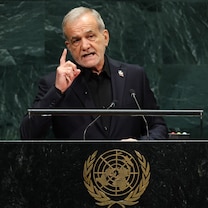
There is fragmentation, of course. We know that the president of the country, Pezeshkian, is pushing for a negotiation. He wants to provide some economic relief. And -- and so you have this happening at the same time.
So look, with the military in charge and at the same time the economy being weakened, I've argued that we should really pursue an economic blockade of the country, not just of the strait, but of all entry points -- air, ground and sea routes. We should sanction them.
And importantly, we should internationalize this conflict. This is having global impacts. So we should multilaterize (ph) -- multilateralize and get our Asian allies on board, our European allies, others around the world, and really put economic pressure on this country and slowly strangle it until they come back to the negotiation table in a serious way.
KARL: And how serious is the shortage of munitions that we're now hearing about? It seems like, you know, almost a desperate situation in terms of shortage, especially of anti-missile defense systems like the Patriot.
ESPER: It is a serious situation that goes back to the end of the Cold War and decisions we made between them and then with the onset of the Iraq and Afghanistan wars. And frankly, it accelerated during the Biden administration when we were expending munitions or giving munitions to Ukraine. And it's, of course, in the last six, seven months, it's really taken a toll that we've now find ourselves considerably low with regard to interceptors such as Patriot and THAAD, and to some ground attack weapons as well.
And look, when I look at the world, I'm most concerned about China and the messages it may be sending there and the deterrent effect of our munition stockpiles, and more importantly of our defense industrial base. So, it's something that we have to watch carefully out for.
I know as secretary of defense, I certainly did. I was always attuned in our operational plans to estimated casualties, estimated impacts on the readiness of the force, and of course, our munition stockpile.
So this is something that -- that is with us. It's not new. It's been reported multiple times. The secretary of defense spoke about it during one of his hearings in the past few months. And we have other reports coming out.
And in fact, there was this news story today or last night that deputy secretary of defense --
KARL: Feinberg.
ESPER: -- at the Pentagon, yeah, Feinberg, who's done a solid job on this front, has issued an order to the defense companies to report in the next three weeks about what they're going to do to accelerate weapons production. So the administration is trying hard in multiple ways.
But when you're talking about taking two years to build a Patriot missile, whatever we do now is not going to help in the short term, but nonetheless needs to be done for strategic reasons.
KARL: And finally, just a big picture question. We've heard the president repeatedly threaten to have big attacks on Iran and then back off claiming there was progress on negotiations. By my count, he's done this seven times.
What does that do to America's credibility around the world? How do our adversaries start to view those threats when they're threat, back off, threat, back off, and the cycle continues?
ESPER: Well, clearly the Iranians have figured this out. They are not reacting to these threats, and they are taking very strategic positions with regard to this. And so you saw them over the last week, put forward again this Omani plan that they're going to unveil at some point.
But these demands they've now raised last night show that they are emboldened, that they feel confident about their position in the world. And at the same time, they are flexing their muscles by using their proxies. So we know that the Houthis just this morning attacked a Saudi refinery on the Red Sea. Yesterday, Iran attacked a UAE ship.
But they've also, they being Tehran, have tried to expand this conflict. There was a long shot taken at an Egyptian port on the Mediterranean Sea to show the range of their weapons. And they've gone so far as to threaten U.S. ally, NATO ally, Bulgaria about supporting U.S. operations from there.
So they're expanding the conflict in many ways.
KARL: All right, Secretary Esper, thank you very much for joining us this morning.
Coming up, will the Iran War dragging on cost Republicans the midterms? Our Roundtable debates that when we come back.
(COMMERCIAL BREAK)
KARL: All right, we're back with the roundtable.
So, Governor Christie, how does Trump handle this latest with Iran? I mean, he told us just a few days ago, strait is about to be open. Everything is going to be fine. I mean, what does he do?
CHRIS CHRISTIE, ABC NEWS CONTRIBUTOR: Look, the real problem here is it was a -- it was an adventure without a plan. And now, you know, I've struck this week when the Iranians put out their list of demands to reopen the strait. Reparations.
KARL: Yes.
CHRISTIE: Et cetera. What struck me was that Donald Trump is about to become what he never, ever wanted to be. Jimmy Carter. He is being held hostage by Iran. They are holding the Strait of Hormuz hostage. As a result, they're holding the world economy hostage. And it's focused at Donald Trump. And I know from talking to him over the last 24 years, the one person he would never want to be is Jimmy Carter.
KARL: Jimmy Carter. I talked to him about Jimmy Carter, too. Yes.
CHRISTIE: Right. And so -- and here we are. And it was all voluntary.
KARL: So do you have a thought on this?
REP. JAKE AUCHINCLOSS (D-MA): I fought in one failed forever war. I don't want Americans to be fighting in another. We've already lost 18 American service members. And the only way that we get off course from a third quagmire in the Middle East of the 21st century is for Congress to take back the steering wheel from this impaired driver, and that means Americans need to elect Democrats in November and we can pass the war powers resolutions and force them and prevent him from deepening the imbroglio that has already caused higher prices and a weakened America.
KARL: I mean, he's trying to get out. It's like the Iranians are not cooperating. But let's switch to the domestic side of this, Scott. You heard the president just a short while ago there say that voters are angry at Republicans, not angry at me. They're angry at Republicans. Is he right on both?
SCOTT JENNINGS, CNN SENIOR POLITICAL COMMENTATOR: Well, I think he might have been talking about Republican voters. And I'll be honest, I've been all over the country this year, and they are a little upset with congressional leaders over the SAVE Act is one thing. And they see Trump fighting for that, and they see Congress with an inability to pass it.
Now, most congressmen, Republican congressmen, are for it. But obviously the Senate has been a little ungovernable on this issue and a few others. So he's not wrong that the Republican grassroots is quite upset. What he has to do is convince them that no matter who you're upset with, the alternative is worse. I mean, this has to be a contrast election. And Republican voters trust him to make that argument. He is the one that has to make it. You know, one of the technical tactical issues for the Republican Party is getting those voters who love Trump but may not love other politicians to turn out. And he's going to have to make the point that if you don't elect Republicans this fall, they're going to impeach me again and every other bad thing you don't want to have happen.
DONNA BRAZILE, ABC NEWS CONTRIBUTOR: No, they're going to hold him accountable. They're going to hold him accountable. They're going to hold the entire Republican controlled Congress accountable if Democrats prevail in November.
Look, Donald Trump should know one thing. The American people are very upset. They're angry at him. They're angry at his preoccupation with his ballroom, anger at his preoccupation with putting little gold things all over the White House and all over the city of Washington, D.C.. They're angry at him because he's not focused on the priorities of the American people, kitchen table issues.
They -- he should know they're very upset. They're very upset, not just with him, but they're also upset with the Republican controlled Congress.
KARL: So, Chris, he's also -- I mean, he is very focused, though, on some things. I mean, he's very focused on the ballroom and he is very focused on the Reflecting Pool.
And we saw him say that he wants Jeanine Pirro, somebody you know very well --
CHRIS CHRISTIE, (R) FORMER NEW JERSEY GOVERNOR & ABC NEWS CONTRIBUTOR: I do.
KARL: -- she dropped the case, said, look, there's no case of vandalism against this former Olympian. He just said this weekend that he wants her to reconsider that.
CHRISTIE: Well, let me separate what you just put there.
In terms of the ballroom and the Reflecting Pool, while it's entertaining for a lot of people, I disagree with Donna. I don't think that's what they're upset about. I think what they're upset about is that the president promised to lower prices, the president promised to focus on domestic things, and they haven't done it.
Now, on the Jeanine Pirro thing, this goes to the whole Department of Justice question. And Todd Blanche was confirmed.
KARL: Yep.
CHRISTIE: 50-49, and now he has got the job for the next two-and-a-half years to be the attorney general. He's got to decide --
KARL: Unless he's fired.
CHRISTIE: Well, I mean, yes, but, you know, I think he's got to decide what's he going to do now as the attorney general -- not the acting, but the attorney general.
KARL: Yep.
CHRISTIE: And this Jeanine Pirro thing is one of the early things that he's got to decide. She, as we talked about a week or so ago, she stepped up and did the right thing. She didn't have the evidence, and she walked away from the case.
Now, the question is, is her boss, either the president of the United States or the attorney general, going to put pressure on her to go back and redo it? Those are the things that the American people will be disquieted by when the justice system is not working in a way that is fair to people across the country, regardless of their political party or their opinion about the president.
KARL: Do you think Trump would fire her?
CHRISTIE: Well, I think he would be willing to fire anybody at this point. But I think this one's going to be a hard one for him, because whoever he puts there, when he's done that before, it hasn't worked out.
Remember the Comey indictment?
KARL: Yeah.
CHRISTIE: Remember the Letitia James indictment, when he put new people in those spots? Just to do that, it hasn't worked. So he'd be concerned about that, I think.
KARL: Donna?
BRAZILE: She has ice in her blood. I wouldn't cross if it was, you know, go ahead and walk across the street. She's tough. She's smart. And she knew exactly what she was doing.
She had no case against Mr. Hearn and those other individuals who went to the Reflecting Pool and saw that Donald Trump pool guy couldn't put down the paint. So he won't fire her.
KARL: All right. On that note, quick break. We'll be right back.
(COMMERCIAL BREAK)
KARL: All right, that's all for today. Thank you for sharing part of your Sunday with us. Check out "World News Tonight," and have a great day.
(COMMERCIAL BREAK)

Popular Reads

ABC News Live