South Carolina's next steps after senator's death
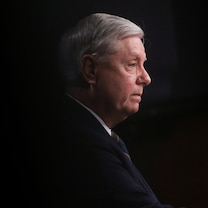
Sen. Lindsey Graham's death has sparked a political scramble in South Carolina
CHARLESTON, S.C. -- The death of Sen. Lindsey Graham, who was running for a fifth term when he passed away over the weekend, began a tumultuous new chapter in South Carolina politics during a year that has already been full of upheaval.
As the conservative state's senior senator and an influential ally of President Donald Trump, Graham was presumed to be on a glide path toward reelection.
Now, Gov. Henry McMaster must choose a temporary replacement who can serve until January while the state also prepares a special primary so voters can choose a new Republican nominee for the general election.
The rare open Senate seat has ignited a scramble among South Carolina's most ambitious conservatives, who have been eager to climb the political ladder.
Republicans just finished a sprawling and bruising contest to figure out their nominee for succeeding McMaster, who is wrapping up his second term. State Attorney General Alan Wilson won the nomination, overcoming a field that included Lt. Gov. Pamela Evette, Rep. Nancy Mace and Ralph Norman — all of whom are now eyeing Graham's seat.
According to South Carolina law, a one-week filing period for a special primary election begins on the second Tuesday after the candidate’s death, or July 21.
The special primary election would be held on the second Tuesday after that filing period closes, or Aug. 11. Any necessary runoff would follow two weeks after that, or Aug. 25.
From that point, the new nominee would have just over two months to campaign for the general election on Nov. 3.
All of this is problematic according to federal law, which requires military and overseas ballots to go out 45 days before any federal election. For the general election primary, that would have been June 27. Federal Election Commission officials didn’t immediately return a message seeking clarity about the process.
Graham died on Saturday night, and a preliminary medical examiner report said he suffered a tear in his aorta, known as an aortic dissection.
In the hours after Graham's death was announced, South Carolina’s Republican circles were already swirling with rumors about possible replacements. Given the proximity of November's election, it's likely that whomever McMaster appoints could be a top contender in the special primary, although it's possible that McMaster's choice will only serve as a temporary caretaker.
Evette, who has served nearly eight years alongside McMaster and received his endorsement in the governor's race, is one possibility. She lost the June 23 runoff to Wilson.
A person with knowledge of Evette's thinking but not authorized to discuss it publicly said that she was getting encouragement from across the state and feels she would have good chances in the special primary.
It's unlikely that any House member would be appointed to finish Graham's current term, since Republicans have such a slim majority in the chamber.
U.S. Rep. Joe Wilson, a rumored replacement, said he assured Trump on Sunday that “my goal is to remain in the House to keep his two-vote majority for the American people!!!”
However, that doesn't mean that House members won't run for the next full term. A person with knowledge of Mace's thinking but not authorized to speak about it publicly said she was considering the race. Mace is not running for reelection to the House.


But another Republican from the state, Rep. Russell Fry, could be a possibility. The two-term lawmaker represents the growing area around Myrtle Beach, and he's been a top Trump ally.
A spokesman for businessman Mark Lynch, whom Graham defeated in the primary, didn't return a message Sunday.
Treasury Secretary Scott Bessent, who lived in South Carolina prior to joining the Trump administration, has fielded calls about potentially replacing Graham but doesn’t have interest in the role and enjoys working for the president, according to a person who requested anonymity to describe private conversations.
No Democrat has won a Senate seat in South Carolina in decades, and Republicans in recent history typically take statewide seats by double digits. When he last ran in 2020, Graham defeated his Democratic opponent, Jaime Harrison, by a 10 percentage point margin.
So while history suggests that Graham was en route to a fifth term, Republicans are carefully surveying the landscape.
Charleston pediatrician Annie Andrews won the Democratic nomination last month and has raised more than $8 million in the race, and had just under $3 million cash on hand at the end of May, according to federal filings. Graham had taken in $6 million, with just over $4 million on hand.
In a statement Sunday, Andrews called on South Carolinians to join her “in setting partisanship aside and offering gratitude" to Graham for his service.
Noting that he and Graham “had our share of political disagreements,” Harrison wrote on social media that he “always appreciated that even in our fiercest political battles, we could still share a conversation, a laugh, and a mutual respect for South Carolina and the institutions we were both privileged to serve.”
Graham leaves a major void in the Senate, where seniority can determine influence. He served more than two decades in the chamber, positioning himself to lead committees and set the agenda.
Sen. Tim Scott, South Carolina's junior senator, has only been in office since 2012 — short by the state's standards. Fritz Hollings served for 38 years and Strom Thurmond was there for 47.
Scott, who co-chaired Graham's reelection effort, described his former colleague as “irreplaceable.”
“America lost a statesman, but I lost a friend,” he told ABC's “This Week."
___
Associated Press writer Fatima Hussein in Washington contributed to this report.
___
Kinnard can be reached at http://x.com/MegKinnardAP
Related Topics

Popular Reads

ABC News Live