Chickpeas have successfully grown and been harvested in simulated moon dirt, a new study says
Humans are now closer to being able to grow crops on the moon, researchers say.
Scientists are closer to being able to grow crops on the moon after successfully cultivating chickpeas in simulated lunar soil, according to a new study.
Researchers were able to accomplish the feat by treating the simulated regolith, as lunar soil is known, with both a symbiotic fungi and worm-produced compost, according to a paper published Thursday in Scientific Reports. The fungi and compost significantly improved the likelihood of reproduction of the chickpea plants, the study found.
Lunar soil on its own doesn't support healthy plant growth for a number of reasons, one of which is because it contains high concentrations of metals, including aluminum and zinc, Jess Atkin, a Ph.D. candidate at Texas A&M University's Department of Soil & Crop Sciences, told ABC News. The regolith also lacks the microbiome found in Earth soils, and its powder-like consistency doesn't allow water to easily filter through it, according to the paper.
"To have [arable] soil, you have to have two things: organic matter and microorganisms," Atkin said. "[A]nd the moon doesn't have either of those things."

But scientists took inspiration from Earth's plants, over 80% of which have symbiosis with the fungi known arbuscular mycorrhizae, which is "one of the oldest symbioses on Earth," Atkin said, adding that "it essentially is what enabled plants to be able to inhabit land and develop roots."
Chickpeas aren't the typical plants chosen for space crop production, but Atkin selected them because they are stress tolerant, high in protein, and because they send out signals to actively recruit the microorganisms that help them survive, she said.
"Generally, things like leafy greens, lettuce, tomatoes, things that are high in anthocyanins and can help protect from radiation are studied," Atkin said.
In the simulated lunar soil that featured higher concentrations of regolith, there was less reproduction and fewer less chickpea seeds, according to Atkin, who also said that the seeds were all about the same size, so it didn't alter their quality.

The seeds are currently being tested for their nutrition, protein and metal accumulation, according to the study.



In addition to the fungi, researchers chose vermicompost -- essentially, "worm poop" -- for the organic matter to add to the soil, Atkin said. They chose it because NASA employs a logistical reuse project that takes typically discarded items that can be fed to worms, such as coffee grounds, food scraps and even cotton T-shirts.
The byproduct the worms produce is a "really nutritious" fertilizer, Atkin said.
The simulated regolith, or simulant, is sourced from a lab in Florida, Atkin said. The simulants are meant to mimic the dirt at lunar landing sites, especially the site that will be used during the upcoming Artemis IV mission, currently scheduled for launch in 2028, in which NASA plans the first crewed lunar landing since Apollo 17 in December 1972.
"It is 99% compositionally accurate," Atkin said.
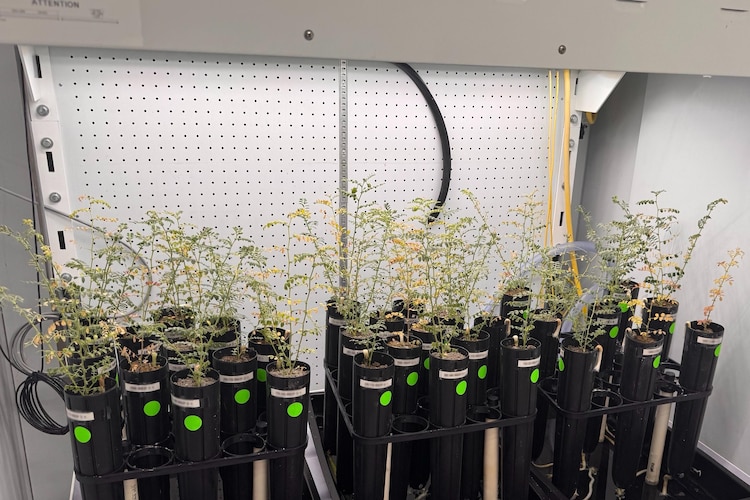
As a result of the study, scientists learned that plants can grow and the fungi can survive and colonize in 100% simulated moon dirt, Atkin said. An important next step is to determine how sustainable the simulant is.
"We're going to grow it out and see over how many generations how much structure can we create and how much can we make this like a living lunar soil," Atkin said.
The research paves the way for a future in which a diverse set of crops is able to be grown on the moon when humans are hypothetically living there, Atkin said.

Popular Reads

ABC News Live