Future Body Armor Has Lots of Flexibility
Feb. 5 -- In this week's Cybershake, we look at what scientists are cooking up to protect future combat soldiers. Plus, we note a new Web site that has some in a titter, but leaves Google searching for justice.
Better Body Armor
Body armor — more colloquially and incorrectly known as "bulletproof vests" — have helped saved countless lives of U.S. soldiers serving in dangerous places such as Iraq and Afghanistan. But they aren't without faults.
Although typically made of lightweight cloth such as Kevlar, body armor is still bulky and stiff. That can make it difficult to wear in hot climates such as Iraq. Moreover, the stiffness of the armor can't be applied everywhere on the soldier's body, otherwise they would be nearly as inflexible as a knight from King Arthur's time.
But researchers at the Massachusetts Institute of Technology and the U.S. Army have been working on all kinds of far-out future fighting gear — including a a uniform that with a flick of a switch can turn into light, flexible armor.
Mechanical engineer Gareth McKinley at MIT says it involves the use of an oily fluid full of very tiny iron particles. Using a magnet, the particles in that liquid can be forced to "line up," forming a stiff solid in a fraction of a second.
"When we apply a magnetic field, then the stiffness of that fabric changes by a factor of about 50," says McKinley. "It's very stiff. I mean, I have to push quite hard to be able to drive a probe through it."


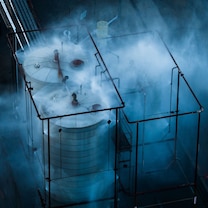
Turn off that magnetic force and it's back to liquid. "We can keep applying a magnetic field, turning off a magnetic field and the material will keep going backwards and forwards, from liquid-like to solid-like and back again," he says.
Used in future uniforms, the magnets would be replaced with electrical currents that soldiers could turn on and off. Or, eventually, the cloth may become smart enough to react on its own, changing from flexible to bullet-resistant as needed.
Researchers such as McKinley say the cloth is still five or 10 years away from actual field testing.

Popular Reads

ABC News Live