Coral reefs are under threat, but bleached corals aren’t a lost cause, study suggests
Bleached coral pieces were able to recover when in contact with healthy ones.
Coral reefs are more than just beautiful. They are among the planet's most diverse and critical ecosystems, home to thousands of fish and marine species. And while reefs cover only a tiny portion of the world's oceans, they provide a life-sustaining habitat for at least a quarter of the world's marine life, according to NOAA's National Ocean Service.
"Coral reefs really are the bedrock for why these ecosystems can be so productive and allow so many species in the ocean to thrive," explained Danny Collins, an Oceans PhD student at Stanford University.
Corals are actually animals, and they depend on algae inside their tissue for food. But they are also under threat due to climate change, warming oceans and human activity.
"When you think of beautiful corals and beautiful colors and think about Finding Nemo, those colors are actually not from the coral themselves. They're from colorful microscopic algae that are living in the coral's tissues, and these algae, through photosynthesis, provide a lot of the coral's food," said Collins.
When the ocean is too warm, the coral expels the algae from its tissues. This causes them to lose their color and turn white. It can also cause them to starve and die because the algae that provided nutrients are gone. When this happens on a wide scale, it's known as a global bleaching event. The last one spanned about two and a half years with an estimated 84% of the world’s coral reef area exposed to bleaching-level heat stress, according to NOAA.
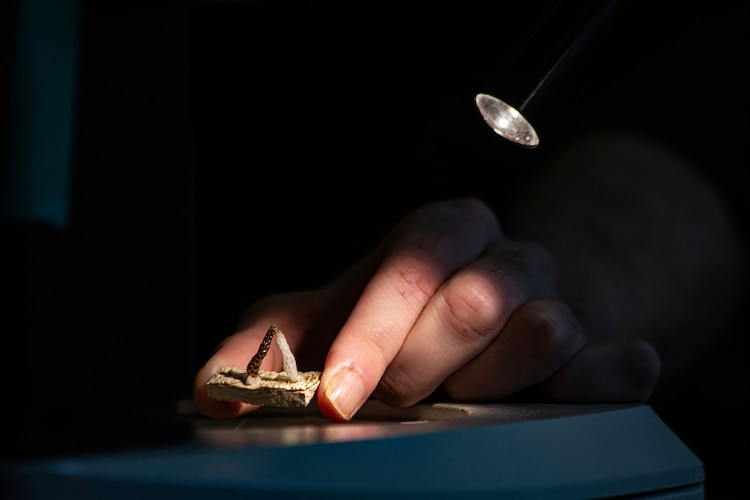
Even if the coral survives a bleaching event, it can take it months or years to recover. But Collins, along with Steve Palumbi, a professor in Marine Sciences at Stanford University, and a team of researchers at the university, may have discovered a way to turn the tide, bringing bleached corals on the verge of death back from the brink in what Stanford calls record time.
The findings from their lab study, published Wednesday in Science Advances, began with collaboration and a chance observation in 2025.
Collins, the study's lead author, was researching ways to protect corals from pathogenic bacteria found on plastic. When plastic comes in contact with corals, it can pass these pathogens to the animals, causing disease and death. Collins was curious whether the opposite was true.
"Could we flip this mechanism?" Collins wanted to know. "Could we use it to introduce these beneficial symbionts, these algae that the bleached corals are missing, as a way of recovering them?"
When he connected with Palumbi, the study's coauthor, he discovered they shared similar ideas about how to help corals recover. Collins said Palumbi told him that he had a "happenstance wacky observation" after a healthy coral accidentally came in contact with a bleached fragment.
"Based off of this plastic pathogen idea, with this kind of serendipitous observation, we then came together and thought, okay, there may be something here. And we first tested it with a really simple experiment of just putting a healthy coral in contact with a bleached coral. And we were then blown away to see the amazing results that they fully recovered in a short period of time," said Collins.



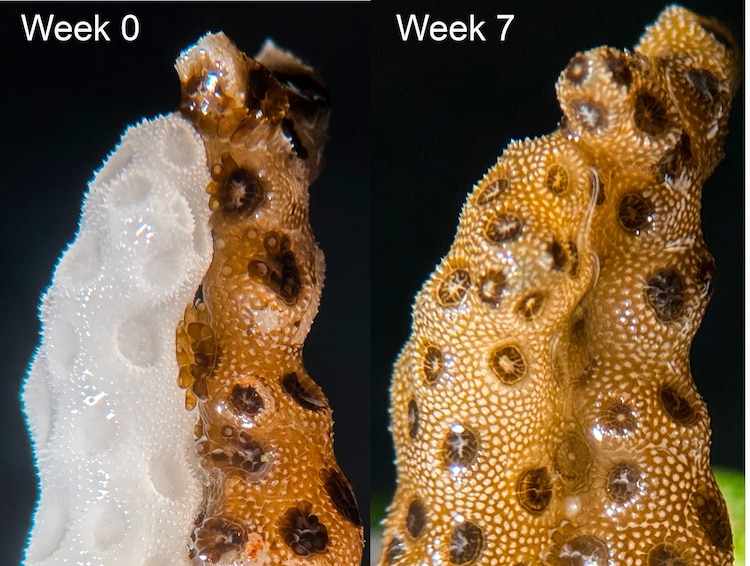
Using small fragments of a single coral species, Collins found that when bleached coral was in physical contact with a genetically identical healthy one, the injured animal recovered in just seven weeks.
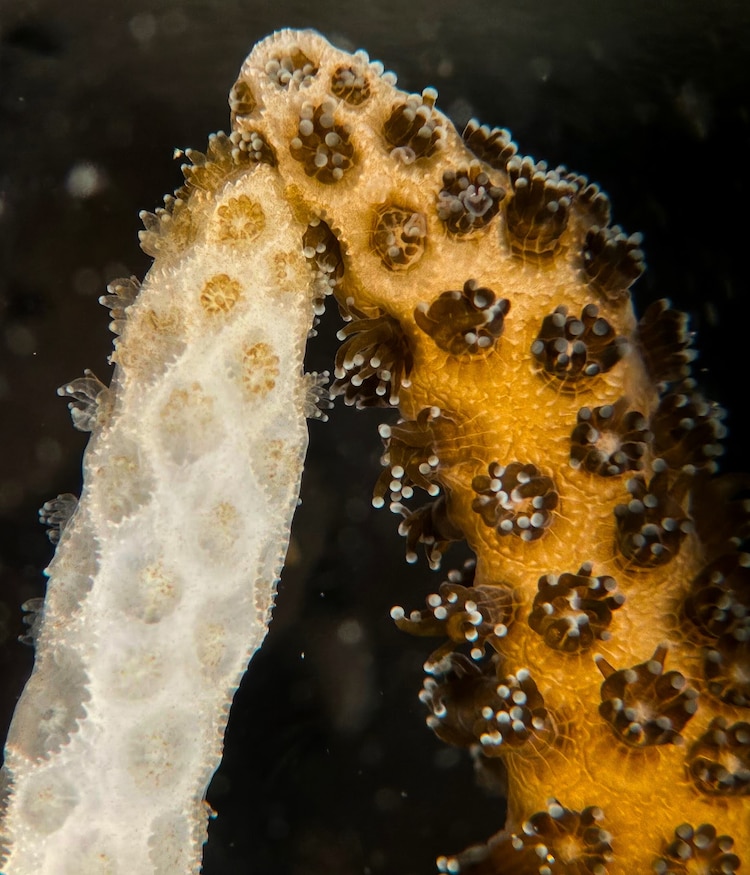
"We recognized that their tissues were fusing together, and they were creating a tissue bridge that acted as a nutrient highway, but then allowed for the healthy coral to send over these algal symbionts over to the bleached coral in a really short period of time, which was exciting," said Collins.
As a follow-up experiment, the team explored whether contact is actually necessary for recovery, so they set up pairs just a few millimeters apart. But in those cases, there was "basically no recovery."
When contact was maintained, the team found that the algae begin transferring between coral fragments in as little as 36 hours after making contact. Collins and his colleagues also tested different durations of contact between healthy and bleached corals. They found it took only a week for the unhealthy fragment to recover fully. Even with shorter periods, they found that the healthy coral could jump-start the bleached one's recovery.
"The limitation is that this requires contact, and it requires contact of corals of the same genetic clone. So, when we put them with different genetic backgrounds, and we put them in contact with each other, we actually didn't see recovery. We saw antagonistic interactions almost similar to an [rejected] organ transplant," explained Collins.
This limitation likely means that the technique won't be scalable in the wild, according to Collins. But their research findings could open the door to a new intervention to help corals recover from bleaching events.
"You can actually extract these symbionts, the algal symbionts, from healthy coral and have new interventions to introduce those to bleached corals. Then you could possibly explore rapid recovery without the need of contact or healthy corals at the reef, possibly at scale as well," said Collins.
Collins hopes that down the line, this technique could be one of many tools in a toolkit for helping bleached corals on a reef recover from an ocean heat wave or bleaching event. But he says prevention would be even better.
"The real solution will be trying to make sure that these corals then don't bleach," Collins said. "But this is just an additional method for making sure that they then can recover and stay healthy following these events."
Above all, Collins hopes people won't give up on bleached corals and will keep looking for ways to help them recover and thrive.
"Bleached corals aren't a lost cause, and they do have a remarkable potential and capacity to rapidly recover, which is what we're quite excited about," said Collins.
Related Topics

Popular Reads

ABC News Live