Eating fish from the Hudson River? Just don't get too hooked.
For the first time in 50 years, NY officials say some fish are safe to eat.
To many in the New York area, the idea of dining on fish from the Hudson River may sound like a recipe for disaster.
The Hudson has for years has been compared to an open-air sewer, is one of the largest Superfund sites in the country, and is contaminated not only by runoff and sewage from New York City but also over 1 million pounds of a forever chemical released for decades from two General Electric plants 200 miles upstream.
For decades, health officials have advised against eating fish caught from the banks of the Hudson, but that's beginning to change, thanks to years of cleanup efforts.
Earlier this year, New York State's Department of Health updated its guidance for the first time in 50 years, advising that everyone can eat some of the fish caught from the lower Hudson River. Sensitive populations, like women who may become pregnant and children under 15, can eat some fish as well, but fewer portions.
"We do recommend trimming and skinning your fish and cooking it so the fat drips off. That can actually get rid of about 50% of the [forever chemicals] in a fish meal," said Audrey Van Genechten, an outreach manager for the New York State Department of Health.
Certain fish -- like catfish and carp -- are still considered off limits from the Hudson due to excessive contamination, but other fish -- including prized sportfish like striped bass -- are considered safe to eat in moderation. Striped bass are migratory, however, and could potentially be exposed to contaminants elsewhere.
The primary pollutant that is a concern in catching and eating these fish is polychlorinated biphenyls (PCBs), once used as an insulator in electrical devices like transformers, which build up in the environment and is associated with certain types of cancer, thyroid disease and other health issues, according to the Environmental Protection Agency. New York state also warns about dioxin, cadmium and PFAS in some species.
"These are invisible chemicals, essentially. Once they're in the fish, they're there," Vangenechten said. "With really any of the chemicals that we're discussing in fish, it's not like a food poisoning issue where you're going to know that you ate bad fish right away. These are all chronic issues, so it's really they're building up in your body."
An entire family, including children and younger women, can eat one 8-ounce meal of striped bass every month, while adult men can have up to four servings a month, according to state health guidelines.
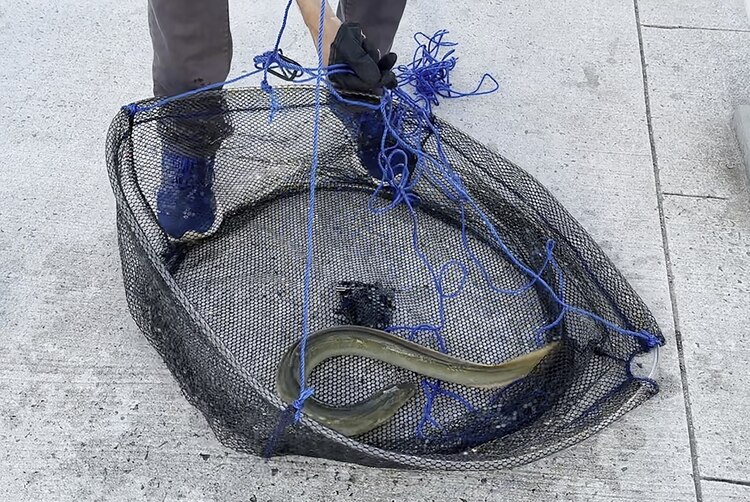
But years of contamination have had an impact on Manhattan's small fishing community.
Other than an exotic fish store in Chinatown that sells some tackle, Manhattan itself no longer has a dedicated bait and tackle shop, so dedicated anglers have to make a trip to the outer boroughs to get supplies.
"There's the fallacy of 'Oh my god, the water's dirty' and so on and so forth. And it's really not," said Mike Giordano, one of the owners of Bernie's Bait and Tackle in Brooklyn, referring to the Hudson. "The New York waters are actually the cleanest in my recollection. And again, I've been fishing in this bay for 40 years."


Seth Fera-Schanes -- a New York-based project manager runs fishing tours of Central Park and Hudson River -- uses social media and his tour groups to try to cultivate a community of anglers in the city. He argues that the Hudson is an ideal fishing location that allows anglers to enjoy the juxtaposition of nature against the bustling city background.

"I feel very comfortable fishing in the Hudson River. You get to experience -- if you look around us, right -- full city views, setting sun. It's worth coming out here for a few casts," Fera-Schanes told ABC News during one of his tours.
When Joey Vatthanavong isn't working his day job as a bellman in a Manhattan hotel, he says he loves trying out different fishing spots across the city, including the East and Hudson Rivers and Jamaica Bay.
Vatthanavong -- who runs a social media page about fishing in New York City -- says he has always eaten the fish he has caught for years from the waters around New York, but he is heartened by the improving water qualities.
New York City is still struggling to prevent pollution from storm runoff due to its combined sewer system, which diverts both runoff and sewage into local waterways during rainy weather.
According to Tracy Brown -- the president of conservation nonprofit Hudson Riverkeeper -- New York City's antiquated wastewater system pours about 21 billion gallons of untreated sewage into the waters of New York City each year.
"Treating your own sewage is kind of the threshold for civilization and civilized community," she told ABC News. "People don't know New York City is still not doing that."
The New York City Department of Environmental Protection said in a report from earlier this year that "the waters surrounding New York City are cleaner and healthier than they have been in more than a century" due to billions in investment in sewer systems and the city's wastewater treatment plants, resulting in a "return of a variety of plant and animal species to our waters."
But it acknowledged challenges remain due to the combined sewer system.
And while the efforts to clean up the forever chemicals that leaked into the Hudson are ongoing, progress has stalled, Brown said. Further upstream -- closer to the GE plants that released more than a million pounds of PCBs into the Hudson since 1947 -- health officials still advise not eating the fish caught from the contaminated waters.
"We are still struggling with unacceptably high PCB levels in the river and in our fish," Brown said.
"This many years out from a cleanup, we should have better news than the sensitive population can eat eight ounces of striped bass once a month."
Related Topics

Popular Reads

ABC News Live