A national lynching memorial recognizes the domestic terrorism that killed my great-great-grandfather
My family came to mourn his death and proclaim our history.

This story was written by Karin D. Berry, a general editor for The Undefeated. For a more immersive experience, head over to TheUndefeated.com. Opinions expressed in this article do not necessarily reflect the views of ABC News.
I mourn the man I never met.
Charles Brown, my maternal great-great-grandfather, who died 78 years before I was born, was taken from the cellar of his employer’s house and hanged by a white mob in southwestern Mississippi in September 1879.
What I imagine about his slaying is vivid, painful and sometimes difficult to talk about because I struggle not to cry. I think of his terror at being forced into the woods, knowing he was about to die. I am certain he felt betrayed and angry as he looked at his killers, whom he almost certainly knew or may have worked for as a carpenter.
I can’t forget the final words of the East Feliciana (Louisiana) Watchman article written about the lynching: “Brown … when called for Friday morning was found near Mount Pleasant, unable to respond -- his head in a halter -- his feet reaching vainly for terra firma — dead.”
For years, ugly newspaper reports and half-remembered family stories were the only evidence of my ancestor’s murder. That changed recently, when the nation’s first memorial to the more than 4,400 people who were lynched in the United States between 1877 and 1950 opened late last month in Montgomery, Alabama. For my family and thousands of others, the National Memorial for Peace and Justice is a chance at long last to see our loss publicly recognized, to tell the stories of the victims and prove that, despite everything, we have endured.
‘Outrage and Retribution’
I first learned about the lynching of Charles Brown in 1988. His grandson Theodore, my grandfather, told me about the killing when I asked him about our family’s history. He told me his grandfather, a carpenter, had built a house for a white man who then refused to pay him. Brown told his wife, “I’m going to get my money” and left home. His family never saw him alive again.
I spent decades struggling to confirm this story. So many seemingly simple facts weren’t known and may be unknowable: What really happened before the mob seized him? Where, exactly, did the lynching happen? Where was he buried? I switched to other questions about my family history and tried to solve them. Then I’d remember the story of Charles Brown’s lynching, and puzzle over it again.
My experience researching my family matches that of many African-Americans: equally fascinating and frustrating. I’ve traveled to five states and visited libraries, state archives, cemeteries and museums. I found freedmen who migrated to Ohio in 1843, a private in the U.S. Colored Troops during the Civil War and a great-great uncle who married an Irish immigrant around 1870. But most of what I need doesn’t exist. Descendants of enslaved Africans face the challenges of tracing a slave owner, slaves who are identified with only a first name and scarce records. Sometimes we are forced to ignore conventional genealogical research, work from family myths and stories, and rely on historical context.
When I first went down South on a research trip, the few facts my grandfather gave me had already fallen into place. An 1870 U.S. Census record in Louisiana showed that Charles Brown, a carpenter, lived in East Feliciana Parish, Louisiana, with his wife, Amanda, and four children. I found a parish death record from the U.S. Mortality Census dated June 1880. The column for the cause of death for Charles Brown, age 39, stated, “hung” in “Sept. 1879.” The 1880 U.S. Census said that his wife, my great-great grandmother Amanda, was a widow.
In 2006, I found what I believe is the first newspaper account of my great-great-grandfather’s lynching. Headlined “Outrage and Retribution,” it had been published in the Woodville Republican in Wilkinson County, Mississippi, the area where he was slain. The article stated that Brown had argued with Mary Phares, wife of the white homeowner, Wilbur Phares, and threatened her with a hatchet. Mary Phares ran screaming from the house, it said, as her husband and a black employee, Louis Swift, were returning from working in the fields. They took Brown under control for the sheriff. Neighbors heard about the confrontation, came to the house and took Brown away. He was found hanged the next morning.
It’s hard to know how much of this story to believe. There are reasons to doubt significant portions of it. But what is undoubtedly true is that Charles Brown’s murder matches the context of the times. The slaves of the Deep South had been freed only 14 years earlier, and the white backlash against Reconstruction and the empowerment of Southern blacks was in full force. Lynching, along with Jim Crow laws and racial segregation, were tools for maintaining control over all African-Americans, not simply devices for punishing individuals.
According to research by the Equal Justice Initiative, the organization behind the lynching memorial, Mississippi had the highest number of African-American lynching victims, followed by Georgia and Louisiana. Brown lived in Louisiana and his slaying occurred in Mississippi. And pieces of the story mirror common features of “terror lynchings”: a fear of interracial sex, especially between black men and white women, and allegations of violence. According to the Woodville Republican, Brown reportedly picked up a hatchet and was going to commit “a nameless outrage” (a euphemism for rape) on a white woman. Those whiffs of sex and violence are likely why the story of a carpenter’s killing in rural Mississippi was picked up by at least 10 newspapers from New Orleans to Bloomington, Illinois.
It’s still Mississippi
That terror of the Deep South has stayed with my family for generations. One of my trips, to the Mississippi Department of Archives and History in Jackson, alarmed two cousins from Ohio, who demanded that I call them as soon as I got to Mississippi and again as soon as I (safely) left.
Well … it was Mississippi, known for its white citizens’ murderous brutality toward black people. One doesn’t have to search hard for reasons to worry. In Woodville, the county seat, Clifton Earl Walker was attacked and killed by a white mob in 1964. The murder remains unsolved.
Mississippi got too close to my mother, Mattie Berry, when she and a cousin accompanied me on one of my trips. I wanted to find out whether Brown’s lynching resulted in a court case. I did not believe anyone had been arrested or charged in his death, but I had to rule it out. I found crumbling records of five or six criminal court cases dating to the 1800s at the courthouse in Woodville, but nothing about a prosecution for a lynching.
On the way back to Baton Rouge, Louisiana, our rental car got a flat tire. I pulled over and parked at the end of a driveway that led to a majestic old house. I could not get cellphone service to summon help, and as I walked up and down the quiet rural road hoping to get a signal, a white man walked out of the house, followed by three dogs. He offered to change the tire. We started chatting, and he told me that his family had lived in Wilkinson County for generations. They were descendants of Confederate officers and he had returned to Mississippi to retire in his family home. I asked him if he had heard of Mount Pleasant. “Why, yes,” he said, and pointed in the direction we had come from. I blurted, “That’s where my great-great-grandfather was lynched.” Looking stunned, he took a step back and said something about that being terrible.
When he finished installing the tire, my mother offered to pay him. He said no to the money and responded with a request: Pray for my wife, who has lung cancer. When I settled back into the car, my mother hissed from the back seat, “Why did you say that? You don’t know him. Something could happen. You don’t know.” I laughed it off -- someone who wishes you harm does not change your tire and ask for a prayer in return. But for mom, it still was Mississippi.
‘A rather good darky’
We don’t know much about Charles Brown’s daily life. Where was he born? Who were his parents? Did he have brothers and sisters? How did he learn his carpentry skills? My grandfather said his father told him that Brown was never a slave and that he was from Virginia. His slaying occurred at the height of the Exodusters movement in late 1879, when African-Americans fled the South to escape new Jim Crow segregation laws. As many as 40,000 people settled in Kansas, Oklahoma and Colorado -- 20,000 of them bought land in Kansas. Did he and Amanda long to leave the repression in Louisiana and Mississippi?
I found a complaint filed with the Freedmen’s Bureau in Baton Rouge by a Charles Brown who said that he wasn’t paid for whitewashing a fence in 1868. I don’t know if this was my great-great-grandfather. But if it was, it shows that, like many newly freed people, he was used to fighting to make a living.
However, he seemed to have been in demand for his skills as a carpenter, and he may have been viewed as good-natured. The East Feliciana Watchman reported that before Brown was killed he “heretofore had been regarded as a rather good darky.” Of course, that sentiment was no protection from a violent, undeserved death at the hands of some of the same people who found him such a valuable worker. His value stopped at the labor he provided to them.
Until now, the only versions of the circumstances of his hanging survived in newspaper accounts that spoke from his killers’ perspective. The East Feliciana Watchman reported: “The news spread, and by nightfall an incensed crowd of citizen neighbors neared the place and quietly took possession of Brown ...” The Memphis Daily Appeal declared, “A Black Rapist Lynched.” The Cincinnati Daily Star said, “Brown’s Body/Forms a Dangling Decoration/on a Mississippi Tree.” The headline in the East Feliciana Watchman called the hanging “Lynching of a Ravisher.” The Woodville Republican went further, saying, “Of his crime there is no doubt, of his fate, we have only to say, served him right. … We feel that in such cases there is but one course to be pursued, no matter whether the guilty wretch be black or white.”

Sunken graves
In March, I went back down South with my sister, Stephanie Berry, to trace Brown’s steps from his home in East Feliciana Parish, Louisiana, to the area where we believe he was hanged.
On this trip, the road into Mississippi seemed familiar. Woodville was very, very quiet. The town has only 986 residents. The county had 9,233 people in December 2017, 71 percent of them African-Americans. Many county residents are descended from slaves brought to cultivate cotton in the early 19th century and who later became sharecroppers. The longtime sheriff, Reginald “Pip” Jackson, is black.



Wilkinson County is well-known for its fine plantation mansions. The Woodville Civic Club has published several books about the plantations and Confederate history. The club has not published any books about slavery -- the word doesn’t even appear on its website -- but it does run the local African-American Museum, which features exhibits on famous people born in Wilkinson County, including composer and conductor William Grant Still (1895-1978) and civil rights activist Anne Moody (1940-2015).
Main Street in downtown Woodville becomes Route 24 east of town and runs past the Rosemont Plantation, which is the boyhood home of Jefferson Davis, the only president of the Confederate States of America. The civic club praises Davis on its website as someone “still recognized by almost all historians as one of the most remarkable and accomplished figures of 19th-century American life.”
We drove along Route 24 to search for whatever we could find of the Phares family. Newspaper articles about the lynching reported that Wilbur Phares lived in one of two neighborhoods: Whitestown, also called Whitesville (neither name appears on modern maps of the county), or Mount Pleasant. Wilbur was the nephew of David Lewis Phares, a prominent Mississippi physician who founded two schools in the county, both of which had closed by the end of the Civil War. Wilbur Phares grew up in his uncle’s home, probably beginning after his father died in 1845. Wilbur Phares’ home, the one my great-great-grandfather was building, was likely located somewhere between Woodville, the county seat, and Centreville, the county’s largest town. (I was able to find one Phares descendent, Stephanie Kirchner of Chicago, who is Wilbur Phares’ great-great-granddaughter. But her mother left Woodville for the North as a child, and Kirchner said she wasn’t aware of anyone in the family who knew the story of the lynching.)
As I drove, I kept thinking that somewhere along this 14-mile stretch, a mob hanged my great-great-grandfather. Exactly where, I would never know. I only have hints, including a newspaper article that said his body was found 3 miles from Phares’ house.
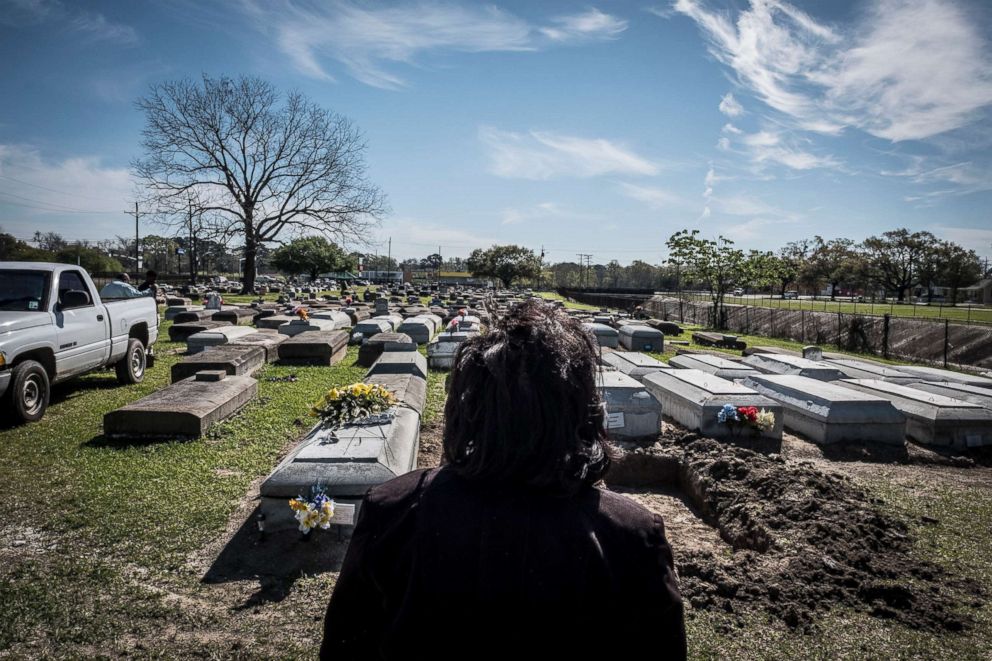
In my research, I’ve been able to find descendants of three of our great-great-grandparents’ eight children: my great-grandfather, Charles, his brother Thomas “Tom” Brown and their only sister, Estelle (Brown) Nickerson. The next day, Stephanie and I went looking for their graves. Charles is buried in Hope Cemetery, a small, gated graveyard located next to a strip mall in Baton Rouge. Many grave markers were faded or missing, as was the case with Charles’ grave. Several graves were sunken below ground, leaving only an outline in the grass.
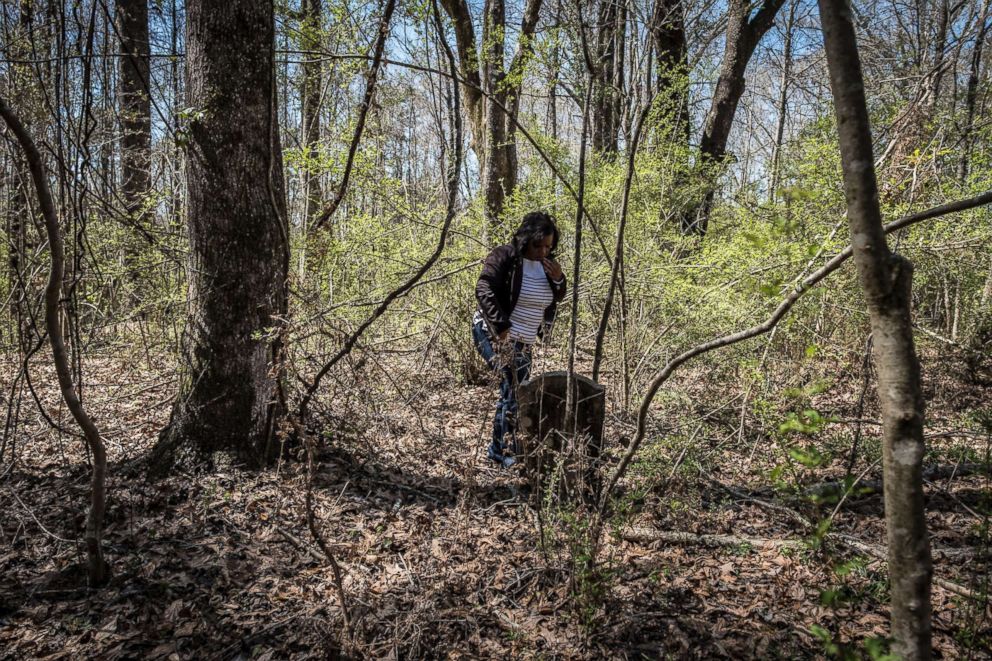
We headed to Norwood Cemetery in East Feliciana Parish, where Estelle Nickerson is buried. The cemetery was located in a large clearing in the woods. Similar to Hope Cemetery, many graves had no identification and others had simply sunk far underground, leaving only a casket-shaped outline. We did not find Estelle.
We checked Ebenezer Baptist Church Cemetery in the small town of Slaughter, where relatives said Tom Brown and his wife, Emma, were buried. Again, I stared at the outlines of collapsed graves, wondering if they held Tom or Emma Brown.
Our family story
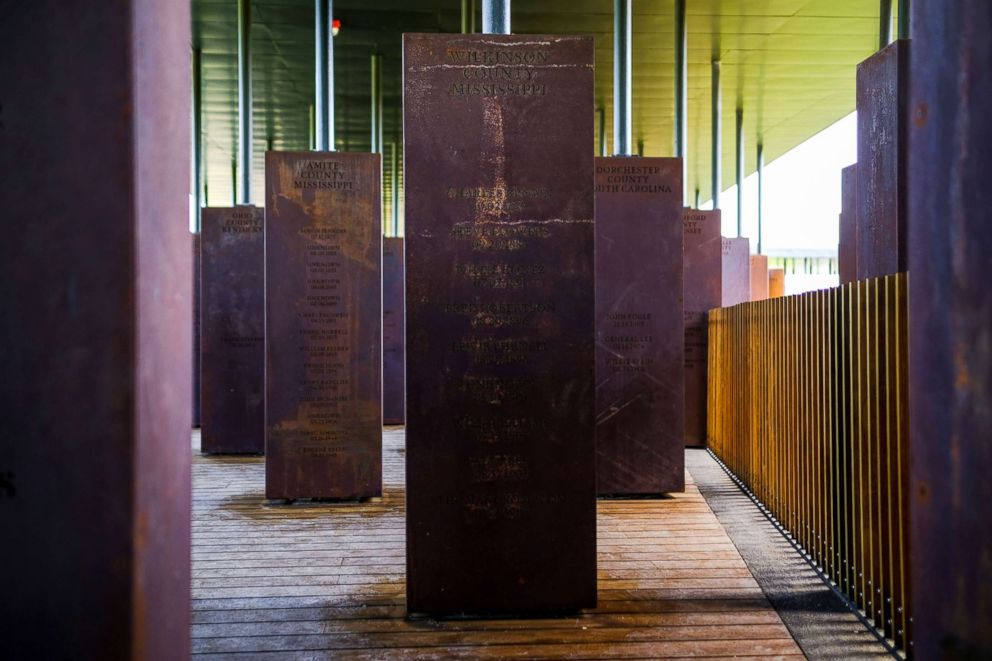
Like many of those 4,400 people whose names are etched -- or, sadly, only identified as “unknown” -- on the lynching memorial’s columns, no one knows Charles Brown’s burial place. No one knows where he was hanged. No one knows the names of his killers. The memorial is the only place where we can pay our respects to him.
My family has kept the memory of a father and husband alive for 139 years, beginning with his name. His son, my great-grandfather, was Charles Brown. In my grandparents’ generation, the oldest son, my great-uncle (we called him “Uncle Buddy”) was named Charles. My mother’s brother is named Charles Brown. My grandfather’s sister, Savannah Hudson, named one of her sons James Charles.
The lynching is etched in family memory, too, passed down by mothers, fathers and grandparents. But like a game of Telephone, the story has acquired layers over the years: One cousin says she was told Charles raped a white woman and was dragged behind a horse till he died. Another says she heard it was a setup by Mary Phares to get him killed. And one cousin declared that he was actually born in Brazil and never lived in Mississippi or Louisiana.
My mother’s two sisters don’t remember hearing about a lynching. Neither did her younger brother. Mom vaguely remembers talk about a hanging. However, my mother’s cousin, Thomas Hudson, said his mother told him about the lynching when he was 10 or 12. “We would sit on the porch,” he recalled. “We could get her to talk about other family members. … I remember he had worked all week and when it came time to get paid, he didn’t want to pay. They came to the house sometime during the night and lynched him.” His older sister Lois Sanders remembered her mother telling her, “‘My grandfather’s daddy was lynched, but I don’t remember no details.’ ”
I added my research to our family story, helping make the story of my great-great-grandfather more complete: He was a 39-year-old father and husband. He was determined, a hard worker who provided for his family. He would not let anyone cheat him out of payment for his work. He was brave -- he had to be to challenge Phares, a white man from a prominent family, for his rightful payment. If he was actually a free man from Virginia, as my grandfather said, then he was a survivor. Many free African-Americans starved to death when they could not find work after the Civil War.
His widow, Amanda, was only 28 when he died. She had to manage the family farm alone and raise eight children. When the U.S. Census taker came to the Brown home in June 1880, the summer after the lynching, he listed two of them as stepsons James, 15, and George, 13; and William, 10; Freeman, 8; Thomas, 6; Estelle, 5; Charles, 3; and Abram, 10 months. Abram would have been a newborn or Amanda may still have been pregnant when Charles was killed on Sept. 11, 1879.
A sacred space
My journey continued when I joined my mother, sister and cousins in Montgomery at the end of April to see Charles Brown’s name on the first national memorial dedicated to victims of lynchings. I was excited, but the sorrow I always feel about my great-great-grandfather remained.
Opening day was rainy, windy and cool, somber weather for a somber day. Signs at the entrance and posted throughout requested lowered voices and reminded all that it is “a sacred space for the dead.” I went by myself, and the few visitors in the early morning numbered in the dozens, with whites slightly outnumbering African-Americans. Most of the crowd was middle age to elderly.
The ground gradually declined until the columns were no longer at eye level but overhead. Lining the walls in the lower area were dozens of plaques that briefly described the circumstances of dozens of lynchings: A man was lynched because he failed to call a white man “mister”; a man was lynched because he owned a prosperous farm; a woman was lynched because she fussed at white children for throwing rocks at her.
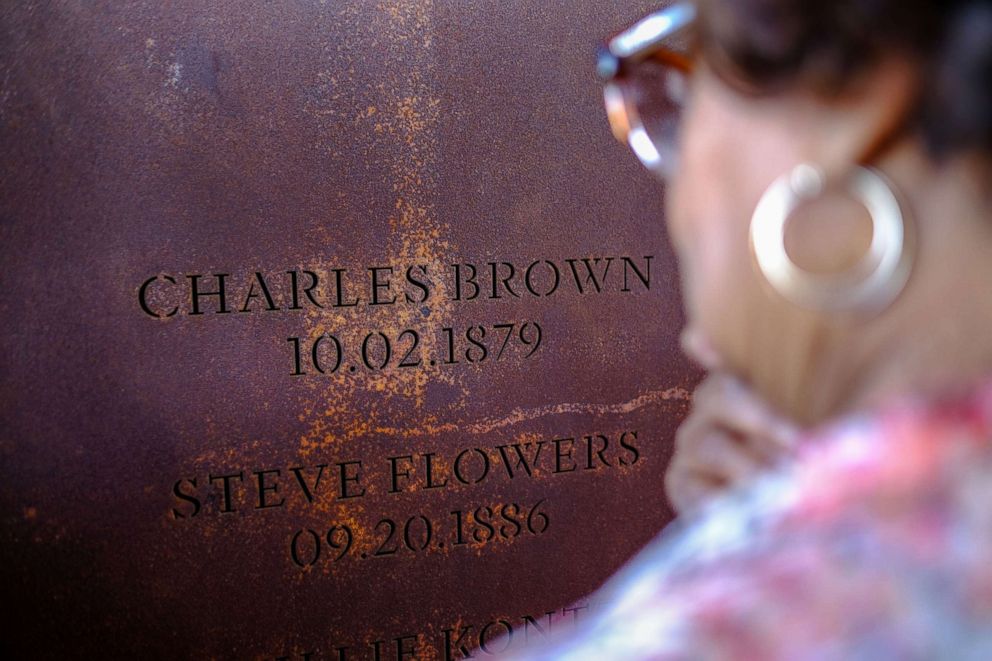
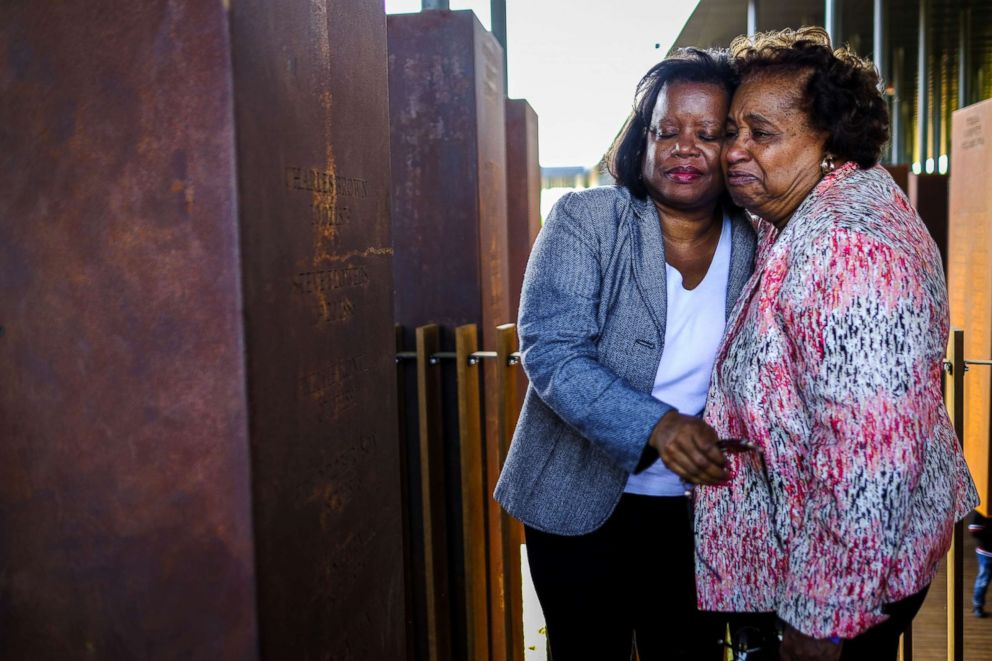
The rust-colored column with Charles Brown’s name is close to the entrance. Directly beneath the heading “WILKINSON COUNTY MISSISSIPPI,” my great-great-grandfather’s name is at the top of a list of nine victims. To finally view his name felt like a confirmation of his death, part of the process of researching his lynching for all these years.
But there was an error: The memorial lists the correct year for his death but has the wrong day and month.
EJI staff lawyer Jennifer Taylor responded to my letter about the mistake with an apology and said a corrected plate for the monument had been ordered.
“In many ways, the mainstream press's obscuration of lynching events when they occurred, and the challenges inherent to uncovering and verifying America's history of racial terror lynching today, are critical parts of the story the memorial seeks to tell,” Taylor wrote. “We know that amending and expanding the list of names, dates, and locations in response to incoming information will be a continuous and ongoing project. That is our hope and our duty.”
The next day, I returned with my mother and sister. I led them to the column that bore Charles Brown’s name. My sister and I watched as our mother strode to the column and smoothed her hand across her great-grandfather’s name. “Here it is,” I said.
My mother began to cry. “No, no,” she said. “It’s all good. It’s all good. … I made it. By the grace of God, I made it. He allowed me. Oh, my God.
“Bless you, Karin, you found it all,” she said, sobbing. “Oh. It was all true, wasn’t made up. … Can you believe it really happened?”
Twenty-one Brown descendants went to Alabama for the opening of the memorial. They came from Atlanta, St. Louis, Baton Rouge and a couple of cities in Texas. My first cousins, Gail Delaney and Felicia Powell, came with Felicia’s son, William, his wife, Dominique, and their 16-month-old daughter, Ari. Felicia said they stood in a circle around the column holding hands while William said a prayer. And they cried a little, she said.
“My granddaughter will be able to tell her granddaughter, and the memory will go on forever,” my cousin told me.
Mom’s first cousin Thomas Hudson visited the memorial with his wife, Julia, daughter Carol Hudson and grandson Julian Hudson-Love. They drove in from Fort Worth. “To me, it’s the equivalent of attending his funeral,” he said. “They don’t know where he’s buried, any of that … so you know your final resting place, my great-grandfather’s final resting place.”
Our visit to the memorial wasn’t the end of my journey or my great-great-grandfather’s story. I am still searching for the descendants of Charles and Amanda’s five other children. One of my cousins has proposed a family reunion.
But Charles Brown’s family was there: Mattie Berry, Stephanie Berry, Gail Delaney, Felicia Powell, William Powell, Dominique Powell, Ari Powell, Norma Reed, Mariea Dunn, Patricia Dunn, Jimmie Brown, Tommie L. Gauthia, John Henry Brown Jr., Thomas Hudson, Julia Hudson, Carol Hudson, Julian Hudson-Love, Tina George and Ina Hatch. They are witnesses to his legacy.
And I was there. I, too, am a witness.
For the hanged and beaten.
For the shot, drowned, and burned.
For the tortured, tormented, and terrorized.
For those abandoned by the rule of law.
We will remember.
With hope because hopelessness is the enemy of justice.
With courage because peace requires bravery.
With persistence because justice is a constant struggle.
With faith because we shall overcome.
– Inscription at The National Memorial for Peace and Justice in Montgomery, Alabama, 2018.

Popular Reads
ABC News Live