Trump poised to drop IRS suit, launch $1.7B 'weaponization' fund for allies: Sources
The fund would compensate allies who claim they were targeted under Biden.
President Donald Trump is expected to drop his $10 billion lawsuit against the Internal Revenue Service in exchange for the creation of a $1.7 billion fund to compensate allies who claim they were wrongfully targeted by the Biden administration, sources familiar with the matter told ABC News.
The commission overseeing the compensation fund would have the total authority to hand out approximately $1.7 billion in taxpayer funds to settle claims brought by anyone who alleges they were harmed by the Biden administration's "weaponization" of the legal system, including the nearly 1,600 individuals charged in connection with the Jan. 6 Capitol attack as well as potentially entities associated with President Trump himself.
While the settlement is expected to be agreed upon in the coming days, sources caution that the final terms will not be set until they are officially announced.
In addition to a public apology from the IRS, the compensation fund is believed to be the main condition for Trump to drop a series of legal actions he filed against the federal government, including the $10 billion lawsuit related to the 2019 leak of his tax returns as well as $230 million in legal claims related to the 2022 search of his Mar-a-Lago estate and the Russia collusion investigation he faced during his first term in office, sources familiar with the ongoing deliberations said.
The settlement terms are expected to prohibit Trump from directly receiving payments related to those three legal claims; however, entities associated with Trump are not explicitly barred from filing additional claims, sources said.
In response to a request for comment, a spokesperson for President Trump's legal team told ABC News, "The IRS wrongly allowed a rogue, politically-motivated employee to leak private and confidential information about President Trump, his family, and the Trump Organization to the New York Times, ProPublica and other left-wing news outlets, which was then illegally released to millions of people. President Trump continues to hold those who wrong America and Americans accountable."
A spokesperson for the Justice Department declined to comment when contacted by ABC News. Representatives for the IRS and the Treasury Department did not immediately respond to requests for comment.
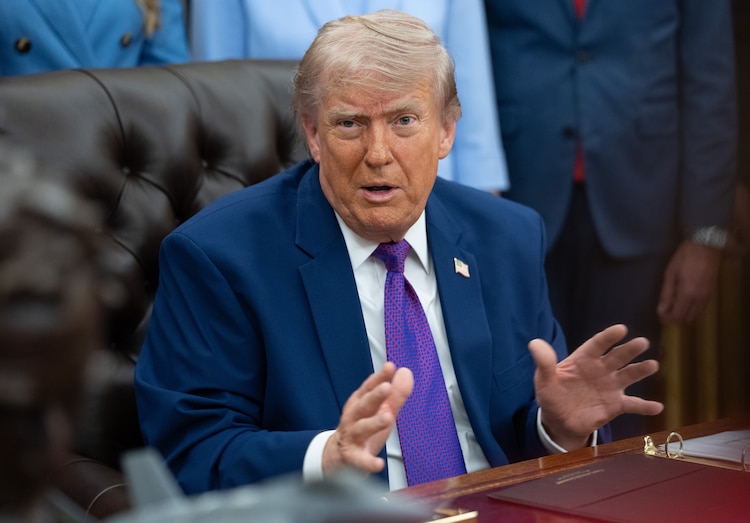
The proposed fund -- which could face significant legal hurdles -- would draw money from the Treasury Department's Judgment Fund, a permanent appropriation used by the federal government to pay court judgments and settlements, sources said.
The arrangement would be an unprecedented use of taxpayer dollars with little oversight. Under the terms of the potential settlement agreement, President Trump would have the authority to remove members of the commission running the fund without cause, and the commission would be under no obligation to disclose its procedures or decision-making process for awarding more than a billion dollars, the sources said.
The proposed creation of the compensation fund has led some administration officials to raise ethical concerns about the arrangement -- stemming not only from Trump suing his own government but also having control of an entity that can freely hand out $1.7 billion to his allies. When asked about his legal claims last year, Trump acknowledged the lawsuit "sort of looks bad," but claimed he would donate any money he receives from the claims to charity.
"It's interesting because I'm the one that makes a decision, right, and, you know, that decision would have to go across my desk," Trump said in the Oval Office in October. "It's awfully strange to make a decision where I'm paying myself."


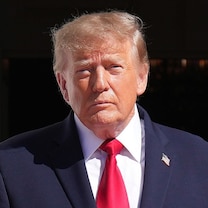
The settlement is also expected to stave off a concern raised by the judge overseeing his $10 billion lawsuit against the IRS, who has ordered Trump and the DOJ to justify by next week why the case should be able to proceed. In a ruling last month, U.S. District Judge Kathleen Williams questioned whether Trump and the defendants -- the Treasury Department and IRS -- are "sufficiently adverse" for the case to proceed.
"Moreover, although President Trump avers that he is bringing this lawsuit in his personal capacity, he is the sitting president and his named adversaries are entities whose decisions are subject to his direction. Indeed, President Trump's own remarks about this matter acknowledge the unique dynamic of this litigation," she wrote.
The New York Times first reported that DOJ officials were considering setting the IRS lawsuit ahead of next week's court deadline.
Since Trump's blanket pardons of defendants charged in connection with the Jan. 6 attack on the U.S. Capitol, hundreds have begun to seek payouts from the federal government. When asked about the possibility of creating a compensation fund for pardoned Jan. 6 defendants, Trump told Newsmax last year that "a lot of the people that are in government now talk about it" because they "really like that group of people."
"They were patriots as far as I was concerned," Trump said last year. "I talk about them a lot. They were treated very unfairly."
Earlier this year, a group of House Democrats introduced a bill to ban Jan. 6 defendants from receiving such compensation.
While the exact terms of the settlement are still being finalized, sources have described the proposed compensation fund as a hybrid between a victim compensation fund -- similar to the civil claims process that followed the 2010 Deepwater Horizon oil spill -- and a truth-and-reconciliation-style commission. Examples of truth and reconciliation commissions in other countries include governmental acknowledgment of wrongdoing related to apartheid in South Africa and Canada's Indian residential school system.
Over the last year, the Justice Department has utilized a so-called "Weaponization Working Group" to examine what it has described as abuses of power by the Biden administration, identifying cases of alleged anti-conservative and anti-Christian bias -- claims that are disputed by former officials.
Trump's proposed commission is expected to be composed of five members who would issue monetary awards based on a majority vote, and the process for awarding money and the identities of the recipient could be kept private, according to sources.
Any remaining funds would be turned back over to the government shortly before Trump leaves office, sources said.

Popular Reads
ABC News Live