World shares are mixed and oil prices surge after US strike on Iranian rocket launchers
Shares are mixed in Europe and Asia and U.S. futures have declined on expectations that the U.S. Federal Reserve may raise interest rates soon
BANGKOK -- Shares were mixed in Europe and Asia and U.S. futures declined Monday on expectations that the U.S. Federal Reserve may raise interest rates soon.
In early European trading, Germany's DAX lost 0.9% to 26,339.04, while the CAC 40 in Paris edged 0.1% lower, to 8,390.43. Markets in Britain were closed for a bank holiday.
The futures for the S&P 500 and the Dow Jones Industrial Average were 0.2% lower.
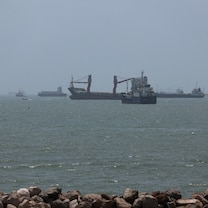
Oil prices surged more than 3% after U.S. forces struck Iranian rocket launchers on the Strait of Hormuz, marking their first military action in a month. The Trump administration just days earlier had shifted its focus to economic pressure, and a return to open conflict would be dangerous for the region.
Brent crude, the international standard, jumped 3.8% to $91.40 per barrel early Monday. U.S. benchmark crude oil was trading 3.8% higher at $86.58 per barrel.
“The Middle East had finally gone quiet enough for oil traders to start sanding some of the war premium out of crude. Then Sunday arrived, with a reminder that quiet in the Strait of Hormuz is not the same as peace,” Stephen Innes of SPI Asset Management said in a commentary.
Markets in Asia fell following a speech Friday by Fed Chairman Kevin Warsh that reinforced expectations the U.S. central bank will do what is needed, such as raising rates, to bring inflation down despite possible short-term pain for the economy.
In Tokyo, the Nikkei 225 lost 0.1% to 66,311.93, while the Kospi in South Korea reversed earlier losses, gaining 0.5% to 6,820.02.
Hong Kong's Hang Seng lost 0.1% to 25,566.99 and the Shanghai Composite index gained 0.9% to 3,986.30.
Shares in e-commerce and fast fashion giant Shein are due to begin trading in Hong Kong on Tuesday in the city's biggest initial public offering this year, part of a trend toward big Chinese-founded companies raising funds in Chinese markets.
An official survey released Monday showed Chinese factory activity remained in contraction for a second straight month in August, though there were slight improvements in some areas such as new export orders and production.


Elsewhere in the region, Australia's S&P/ASX 200 lost 0.2% to 9,076.00.
Taiwan's Taiex fell 0.4% and the Sensex in India slipped 0.4%.
On Friday, the S&P 500 fell 0.2% and the Dow industrials dipped by less than 0.1%. The Nasdaq composite fell 0.5%.
In what is seen as a big move for the bond market, the yield on the two-year Treasury, which closely tracks expectations about Fed moves, jumped to 4.35% from 4.22% just before Warsh's speech at an annual economic symposium held in Jackson Hole, Wyoming.
Worries had grown that his tough talk about getting inflation down to the Fed’s 2% target may be just that. The Fed could hike short-term interest rates to get price increases under control, but it could also be reluctant to do so because that would slow the economy and hurt prices for investments.
U.S. President Donald Trump, who appointed Warsh, has emphasized he wants lower interest rates.
Warsh was adamant again on Friday that he wants to give financial markets fewer clues about what the Fed plans to do with rates for its two jobs of keeping inflation low and the job market strong. But he also said “short-term interest rates are the predominant tool” for the Fed to do its job.
In other dealings early Monday, the U.S. dollar fell to 159.75 Japanese yen from 160.10 yen. It has rebounded after falling for a spell following a rare coordinated intervention by the U.S. Treasury and Japanese regulators in late July.
The euro rose to $1.1601 from $1.1580.

Popular Reads

ABC News Live