From the sea and the air: How a US naval blockade works
A naval blockade can be carried out by surface ships at sea and planes by air.
The U.S. military began a blockade of Iranian ports on Monday as reopening the Strait of Hormuz remains a sticking point in talks between the U.S. and Iran over negotiations to end the war.
Late Tuesday night, the head of U.S. Central Command Adm. Brad Cooper said the naval blockade had been "fully implemented" and that "U.S. forces have completely halted economic trade going into and out of Iran by sea."
More than 10,000 U.S. sailors, Marines, and airmen, along with over a dozen warships and dozens of aircraft, are executing the blockade against vessels entering or leaving Iranian ports and coastal areas, according to CENTCOM.

A naval blockade can be carried out by surface ships at sea and planes by air.
Effectively carrying out a blockade also means having accurate intelligence about what port a ship may have left from or is going to which is important given that the U.S. Navy's blockade only applies to vessels leaving or headed to Iranian ports.
Here's a look at how a naval blockade works.
Blockade from the sea
Of the 16 U.S. Navy ships now in the Middle East, 11 are destroyers capable of intercepting vessels at sea.

A key part of enforcing a blockade is also having good situational awareness, experts. That could mean using drones to monitor a ship's movements, using intelligence to know a ship's origin or destination, using reconnaissance aircraft like the E-2 Hawkeye or helicopters that are launched from an aircraft carrier.
That means that all of the Navy ships currently in the Middle East can play a role in enforcing a blockade.
Each destroyer is equipped with two SH-60 Sea Hawk helicopters that can fly out to ships that might be potentially approaching the blockade line and can provide visual identification of the approaching ship.
The destroyers are also equipped with sophisticated Aegis radar systems capable of tracking ships at long distances.
Warning message US is sending
If a ship is encountered at sea, the destroyer's crew will issue a warning by radio to the approaching ship that follows a carefully worded script.

In this case, the message is: "The U.S. has announced a formal blockade of Iranian ports and coastal areas. This is a legal action ... If you do not comply with this blockade, we will use force. The whole of the United State Navy is ready to force compliance. Out."
The blockade could be enforced by sending a team of service members to board any approaching vessels. The boarding party could be composed of sailors, Marines, or special operations personnel depending on the situation.
Boarding operations
Boarding operations are tightly choreographed. Marines, or other troops, typically approach a vessel either by fast-rope from helicopters onto the deck or by climbing from small boats, aiming to overwhelm a crew before it can react.

Teams are trained to quickly secure key parts of the ship which can include the bridge, engine room and communications spaces, while separating and controlling the crew. The goal is speed and dominance, but also restraint, especially when dealing with civilian mariners who may be caught in the middle of a military operation.
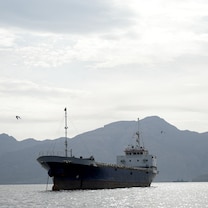
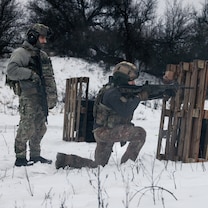
"If you're looking for illegal shipments of arms or oil or anything else, you got to go on board. And that's why we have boarding parties," Retired Adm. and Dean of the Center for Maritime Strategy James Foggo said. "If it's an oiler, you're looking at the records. I mean, oil is oil. It's hard to tell when you look at black oil what well it came from. But you look at the records, and you try to find an indication in the records where they all came from."

The 31st Marine Expeditionary Unit (MEU) is aboard three amphibious ships, but they could also be deployed to destroyers if needed.
These Marines are trained in what is known as VBSS (Visit, Board, Search, and Seizure) which can be carried out by approaching a ship on a rigid hull boat or a helicopter. VBSS are legal boardings of armed service members who can board a ship to undertake an inspection for smuggling or other unlawful activity.
"If you find something that's nefarious, if you find something that's criminal, if you find something that's wrong, then, you know, you can impound the vessel and compel the vessel to go to a friendly port," Foggo said.
At times, VBSS inspections can be carried out by specially trained teams drawn from a ship's crew or by highly trained SEAL teams, depending on the risks involved.
Blockade from the air
The P-8 Poseidon, a long-range maritime patrol and reconnaissance aircraft, alongside SH-60 helicopters, unmanned aircraft and virtually any U.S. aircraft in the region, can work to create an operating picture of the waters below.
Former CENTCOM commander John "Fozzie" Miller said these pictures are critical in maintaining a blockade, as radar has limits from the water. Airplanes and helicopters can provide a more comprehensive view, Miller said, especially across the sprawling coast of Iran.

"The larger area that you have an accurate picture of, the more capable you are of ensuring that your blockade, or any activity you're doing is effective," Miller said. "Our Navy spends considerable time every single minute of every single day, understanding the sea space around them as far out as we possibly can."
Once a ship is flagged, the Navy can hail that vessel to determine its origin. If service members do board, Miller said it's a lot like getting pulled over by police.
Trained military personnel ask questions about the ship's manifest, records or origin, to see if it matches with the Navy's reconnaissance.
"These are airplanes that will go fly for a very long period of time. There aren't going to be a lot of surprises," Miller said. "It'd be very difficult for a ship to sneak through the blockade, and for us to find ourselves in a position where we suddenly had to, you know, sort of run one down because it snuck through the area."
Related Topics

Popular Reads

ABC News Live